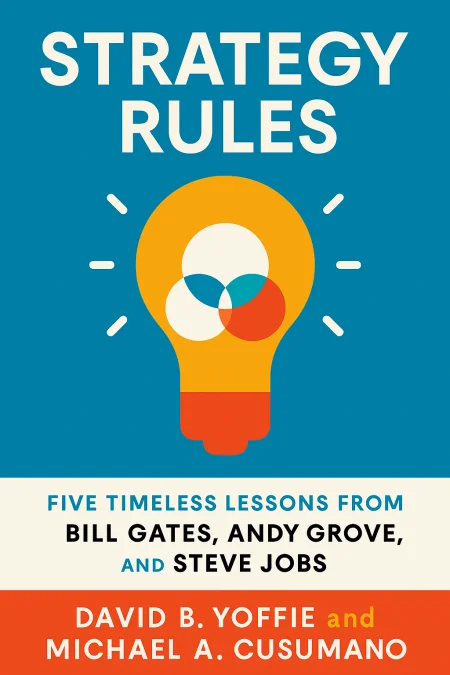
Strategy Rules
Five Timeless Lessons From Bill Gates, Andy Grove and Steve Jobs
byDavid B. Yoffie, Michael A. Cusumano
Book Edition Details
Summary
In the whirlwind world of tech titans, Strategy Rules offers an insider's playbook on how three visionaries—Bill Gates, Steve Jobs, and Andy Grove—shaped our digital landscape. This riveting guide draws back the curtain on the strategic mindsets that catapulted Microsoft, Apple, and Intel to unprecedented heights, exploring the shared philosophies and distinct approaches that set these industry giants apart from the rest. Through the eyes of Harvard and MIT scholars David B. Yoffie and Michael A. Cusumano, who have devoted decades to studying these luminaries, readers are invited to grasp the essence of groundbreaking leadership and innovation. This book distills five strategic commandments that every entrepreneur and executive should heed to foster enduring success. An essential read for those aspiring to carve their own path in the competitive arena of business and technology.
Introduction
What separates truly exceptional strategists from the rest? This exploration examines the decision-making patterns and organizational approaches that enabled three technology titans to achieve unprecedented dominance in their respective industries. Rather than focusing on their well-documented personalities or biographical details, this analysis dissects the systematic principles underlying their strategic thinking and execution methods. The investigation reveals a coherent framework of five interconnected rules that governed their approach to anticipating market shifts, managing risk, building industry platforms, wielding competitive leverage, and shaping organizational capabilities. These principles challenge conventional wisdom about leadership and strategy, demonstrating how visionary thinking must be coupled with disciplined execution to create lasting competitive advantage. Through careful examination of their most critical decisions, both successful and failed, we can understand how these leaders navigated uncertainty, adapted to technological disruption, and built companies that continued to generate exceptional returns long after their departure. Their methods offer a blueprint for strategic thinking that transcends the technology sector, providing insights into how any leader can develop the analytical frameworks and organizational systems necessary to compete effectively in rapidly changing markets.
The Strategic Framework: Forward Vision and Platform Thinking
The foundation of exceptional strategy lies in the ability to project future market conditions while reasoning backward to determine present actions. This approach inverts traditional planning methods that extrapolate from current circumstances. Instead of relying on historical patterns, master strategists develop hypotheses about where industries are heading and then identify the capabilities, partnerships, and positions required to capitalize on those shifts. This forward-looking perspective enables leaders to anticipate customer needs before they become apparent, recognize emerging competitive threats, and position their organizations ahead of major market transitions. The strategic framework also emphasizes platform thinking over product development. Rather than optimizing individual offerings, successful leaders focus on creating foundational technologies and business models that enable entire ecosystems of complementary innovation. This requires understanding network effects, where value increases exponentially as more participants join the platform. Platform strategies demand different trade-offs than product strategies, often requiring leaders to sacrifice short-term profits to build market position and ecosystem partnerships. A critical component involves identifying strategic inflection points where fundamental industry dynamics shift. These moments create both extraordinary opportunities and existential threats, requiring leaders to commit resources before outcomes become certain. The ability to recognize these transition periods and respond decisively separates exceptional strategists from those who merely react to change after competitors have already established new market positions. The framework demands continuous updating as new information emerges and competitive dynamics evolve. Strategic vision must remain flexible enough to incorporate unexpected developments while maintaining sufficient coherence to guide organizational decision-making and resource allocation across extended time horizons.
Execution Excellence: Bold Moves and Tactical Mastery
Strategic execution requires the courage to make transformative bets without risking organizational survival. This balance between boldness and prudence involves several key principles: timing major investments to coincide with market readiness, diversifying risks across multiple initiatives, and maintaining financial reserves that enable sustained competition during market transitions. Successful leaders understand that incremental approaches rarely generate sufficient competitive advantage in rapidly evolving industries, yet reckless gambling can destroy decades of accumulated strategic position. The willingness to cannibalize existing revenue streams proves essential for maintaining market leadership. Organizations often resist internal disruption because it threatens established profit centers and organizational structures. However, waiting for external forces to drive change typically results in competitors capturing new market opportunities while incumbent leaders struggle to adapt legacy systems and business models. Strategic leaders actively accelerate the obsolescence of their own products when superior alternatives become technically feasible. Tactical execution involves mastering both leverage-based and power-based competitive approaches. Leverage tactics use speed, positioning, and market dynamics to overcome better-resourced competitors, while power tactics employ scale, resources, and market position to overwhelm opposition. The most effective leaders maintain capabilities in both areas, selecting approaches based on specific competitive situations rather than defaulting to single methods. When strategic bets fail to produce expected results, exceptional leaders demonstrate intellectual honesty by admitting mistakes and cutting losses quickly. This requires distinguishing between temporary execution problems that merit additional investment and fundamental strategic errors that demand different approaches. The ability to learn from failure and redirect resources toward more promising opportunities prevents organizations from becoming trapped in declining market positions.
Organizational Leadership: Personal Anchors and Knowledge Power
Exceptional leaders shape their organizations around distinctive personal strengths rather than attempting to become well-rounded general managers. These personal anchors provide focus and direction while establishing organizational competencies that persist beyond individual tenures. One leader might anchor an organization around deep technical expertise, another around operational discipline, and another around design excellence. The key lies in recognizing personal strengths, building organizational systems that leverage those capabilities, and recruiting complementary talent to address areas of lesser expertise. This approach requires extraordinary attention to selective details while maintaining broad strategic perspective. Rather than attempting to control every aspect of organizational performance, effective leaders identify the leverage points where their personal involvement creates maximum impact. This might involve direct engagement with product development, strategic marketing decisions, or operational processes, depending on individual strengths and organizational needs. The most successful leaders actively seek out expertise throughout their organizations, regardless of hierarchical position or formal authority. They create systems that surface critical information and innovative ideas from any level, recognizing that knowledge power often resides with individual contributors rather than senior managers. This requires flattening organizational barriers that prevent information flow and creating incentives for employees to share insights that might challenge conventional thinking. Building organizational capability around personal anchors creates both competitive advantage and potential vulnerability. While these distinctive competencies can generate sustained superior performance, they also risk creating organizational dependencies that limit adaptability when market conditions change or leadership transitions occur. The most effective leaders work to institutionalize their key insights and methods while developing succession plans that maintain organizational capabilities.
Lessons and Limitations: Succession Challenges and Future Applications
The strategic principles that enable exceptional performance also create potential organizational constraints. Personal anchors that provide focus and direction can become rigid limitations when market conditions shift beyond their original scope. Technology-focused organizations might struggle to adapt when business model innovation becomes more important than technical advancement. Design-centric companies might face difficulties when cost competition intensifies or when platform dynamics begin to outweigh product differentiation. Succession planning reveals the fundamental challenge of transferring strategic leadership capabilities. Complementary executives who excel at operational execution or functional expertise often lack the strategic vision and integrative capabilities required for overall organizational leadership. The skills that make someone an effective complement to a visionary leader differ fundamentally from those required to replace that leader. This creates succession gaps that can undermine organizational performance for extended periods following leadership transitions. The principles maintain relevance across different industries and competitive contexts, though their application must adapt to specific market dynamics. Platform strategies prove most powerful in industries with strong network effects, while product-focused approaches might succeed better in markets where customer preferences change rapidly or where technical performance provides decisive advantage. The key lies in understanding which principles apply most directly to particular competitive situations. Future applications of these strategic principles must account for accelerating technological change and increasingly global competitive dynamics. Leaders operating in digital-first industries face compressed time horizons for strategic planning and execution, while those in traditional sectors must navigate the integration of digital capabilities with established business models. The fundamental logic of forward-thinking strategy and systematic execution remains constant, but the specific methods for implementing these approaches continue to evolve with changing competitive landscapes.
Summary
The systematic analysis of strategic excellence reveals that exceptional performance results from coherent frameworks rather than intuitive genius or favorable circumstances. The five principles demonstrate how visionary thinking must be coupled with disciplined execution, bold risk-taking must be balanced with organizational survival, platform strategies must be weighed against product excellence, tactical flexibility must be combined with strategic consistency, and personal leadership must be institutionalized through organizational capability building. These insights provide a practical blueprint for developing strategic thinking capabilities and building organizations capable of sustained competitive advantage in uncertain environments. The framework proves particularly valuable for leaders facing technological disruption, rapid market evolution, or the challenge of scaling organizations while maintaining strategic coherence and execution excellence.
Related Books
Download PDF & EPUB
To save this Black List summary for later, download the free PDF and EPUB. You can print it out, or read offline at your convenience.
By David B. Yoffie
