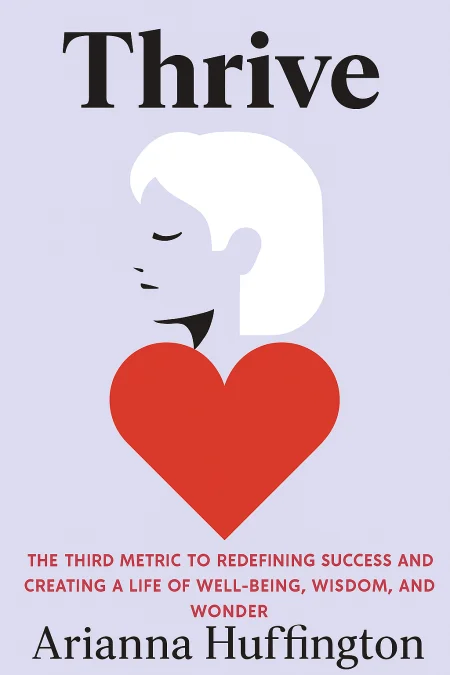
Thrive
The Third Metric to Redefining Success and Creating a Life of Well-Being, Wisdom and Wonder
Book Edition Details
Summary
Arianna Huffington's "Thrive" turns the conventional idea of success on its head, challenging us to redefine triumph beyond wealth and authority. After a life-altering collapse from sheer exhaustion, Huffington, a media titan and cultural icon, questioned the true essence of achievement. Are fame and fortune the ultimate goals, or are they mere mirages in a desert of burnout and stress? This compelling narrative invites you to discover the third metric of success—nurturing well-being, intuition, wonder, and compassion. Drawing from her own life and groundbreaking research, Huffington crafts a manifesto for a balanced life where joy and fulfillment reign. Prepare for a paradigm shift that dares you to thrive in ways society has long overlooked.
Introduction
Picture this: a successful media executive lies unconscious on her office floor, blood pooling around her head after collapsing from sheer exhaustion. Despite achieving everything our society defines as success, she finds herself broken and empty. This moment of crisis becomes a profound awakening—not just for her, but for millions who have built their lives on a foundation that's slowly crumbling beneath them. We live in a world that equates success with the relentless pursuit of money and power, where sleep deprivation is worn as a badge of honor and burnout is the price we pay for achievement. Yet beneath the surface of our hyperconnected, always-on culture, something is deeply wrong. Women are paying an even higher price, with stress-related illnesses skyrocketing and talented professionals abandoning their careers not for family reasons alone, but because the cost to their wellbeing has become unbearable. The truth is, our current definition of success is like a two-legged stool—money and power can support us for a while, but eventually, we topple over. What we desperately need is a third pillar, a new metric that includes wellbeing, wisdom, wonder, and giving. This isn't just about achieving work-life balance; it's about fundamentally redefining what it means to live a truly successful life. When we learn to thrive rather than merely survive, we discover that peak performance and deep fulfillment aren't opposing forces—they're natural partners in creating a life worth living.
The Wake-Up Call: From Burnout to Well-Being
The morning I collapsed in my office wasn't just a medical emergency—it was the universe delivering a message I could no longer ignore. After building a media empire, gracing magazine covers, and being named one of the world's most influential people, I found myself lying on the floor in a pool of blood, having hit the corner of my desk on my way down. The doctors found nothing wrong beyond exhaustion, but those hours in waiting rooms gave me time to ask the most important question of my life: was this what success looked like? I had been working eighteen-hour days, seven days a week, living on four hours of sleep and wearing my exhaustion like armor. The metrics that society celebrates—the long hours, the constant connectivity, the ability to function on minimal rest—had become my prison. I was succeeding by every traditional measure while failing at the art of living. The wake-up call forced me to confront a troubling truth: I wasn't alone in this struggle. The science reveals a sobering reality about our burnout epidemic. Women in high-stress jobs have a nearly 40 percent increased risk of heart disease and a 60 percent greater risk of diabetes. Sleep deprivation, which has become normalized in our work culture, affects everything from our decision-making abilities to our capacity for empathy. We've created workplaces that reward the very behaviors that undermine our humanity, mistaking motion for progress and busyness for productivity. Yet within this crisis lies an extraordinary opportunity. Companies that prioritize employee wellbeing don't just create healthier workforces—they create more innovative, resilient, and ultimately successful organizations. The research is overwhelming: meditation reduces healthcare costs, adequate sleep boosts creativity, and mindfulness practices enhance leadership abilities. The choice isn't between high performance and wellbeing—it's between short-term productivity and sustainable excellence. When we finally understand that taking care of ourselves isn't selfish but strategic, we open the door to a completely different way of living and working.
Finding Wisdom in Our Always-Connected World
The paradox of our digital age is that we have access to infinite information yet seem to have lost our connection to wisdom. I learned this lesson when my daughter was battling addiction, and I watched her transform not through more data or advice, but through finding her inner strength and learning to be vulnerable without shame. Wisdom isn't about accumulating knowledge—it's about accessing the quiet voice within that knows the difference between what serves us and what simply distracts us. We live in a world of continuous partial attention, where our devices ping and buzz with such frequency that we've lost the ability to hear our own intuition. Neuroscience shows us that our brains are being rewired by technology in ways that diminish our capacity for deep thinking, genuine connection, and the kind of reflection that leads to wise decisions. We're drowning in data while starving for insight, mistaking the urgent for the important, and sacrificing our capacity for wonder at the altar of constant connectivity. But wisdom has always been available to us, requiring only that we create space for silence and stillness in our lives. The ancient Greeks understood that philosophy wasn't an academic exercise but a daily practice in the art of living. Marcus Aurelius, leading an empire while maintaining his inner equilibrium, showed us that true strength comes not from controlling external circumstances but from cultivating an unshakeable inner foundation. The path back to wisdom isn't complicated, though it requires courage in our hyperconnected world. It means setting boundaries with technology, creating rituals of silence, and learning to trust the intelligence that emerges when we stop feeding our minds constant stimulation. When we make space for contemplation, meditation, or simply quiet reflection, we discover that wisdom isn't something we need to acquire—it's something we need to uncover. The insights we seek aren't in the next notification or breaking news alert; they're in the stillness between thoughts, waiting patiently for us to remember how to listen.
Wonder and Giving: The Path to Fulfillment
Standing in the rain in Munich after launching HuffPost Germany, I found myself surrounded by magic while others complained about the weather. We were all experiencing the same meteorological event, yet I was seeing shimmering beauty where others saw inconvenience. This moment crystallized a truth I'd been learning throughout my journey: wonder isn't just about what we encounter in the world—it's about the state of consciousness we bring to our encounters. Wonder is our birthright, as natural to us as breathing, yet we systematically educate it out of ourselves and our children. We rush through art museums taking photographs instead of truly seeing, we multitask our way through conversations instead of being present, and we fill every moment with stimulation instead of allowing space for awe. The digital world, for all its marvels, often reduces our capacity for genuine amazement by giving us increasingly sophisticated simulations of connection while disconnecting us from direct experience. Yet wonder returns the moment we slow down enough to notice. It's there in a child's face, in the way light falls across a room, in the simple miracle of breath entering and leaving our bodies. Museums, nature, art, and even everyday moments become gateways to transcendence when we approach them with openness rather than agenda. The secret isn't in seeking more spectacular experiences but in bringing fuller presence to the experiences we already have. The ultimate expression of wonder is giving—extending our sense of caring beyond the boundaries of our immediate concerns. When we recognize our fundamental interconnectedness, service becomes not a burden but a joy, not a sacrifice but an expansion. The science confirms what wisdom traditions have always taught: giving literally rewires our brains for happiness, reduces stress, and creates meaning in ways that accumulating possessions never can. Whether we're volunteering at a local charity, using our professional skills to help others, or simply bringing more kindness to our daily interactions, every act of generosity weaves us more deeply into the fabric of community and connection that makes life worth living.
Summary
The collapse that began this journey wasn't ultimately about exhaustion—it was about awakening to a deeper question of how to live. Through exploring the landscape of wellbeing, wisdom, wonder, and giving, we discover that success isn't about adding more achievements to our résumé but about subtracting everything that separates us from our most authentic and generous selves. The research is clear and the evidence overwhelming: the practices that make us more human—sleep, mindfulness, gratitude, service—also make us more effective, creative, and resilient. The companies that prioritize employee wellbeing outperform those that don't. The individuals who cultivate inner resources alongside outer achievements find both greater satisfaction and sustainable success. We don't have to choose between thriving and achieving; we can discover that they're actually the same destination reached by different paths. The invitation before us is both simple and revolutionary: to step off the hamster wheel of endless striving and step into a life of conscious contribution. This means sleeping enough to think clearly, creating space for reflection, approaching each day with curiosity and gratitude, and finding ways to serve something larger than our immediate desires. When we redefine success to include our inner landscape alongside our external accomplishments, we don't just improve our own lives—we become part of the solution our world desperately needs.
Related Books
Download PDF & EPUB
To save this Black List summary for later, download the free PDF and EPUB. You can print it out, or read offline at your convenience.
By Arianna Huffington
