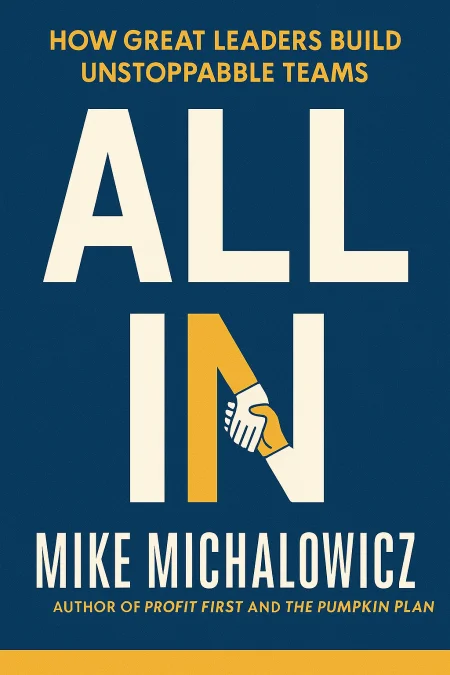
All In
How Great Leaders Build Unstoppable Teams
Book Edition Details
Summary
In a business world fraught with challenges, from remote work to generational gaps, leaders are in a constant quest for the secret to team success. Enter Mike Michalowicz, the bestselling author who has cracked the code with "All In." Forget the superficial perks and gimmicks; this book digs deeper, offering a transformative approach to building teams that thrive. Michalowicz shares his blueprint for assembling a workforce that doesn't just perform but excels—one that thinks like owners and stays invested in the company's future. Discover how to identify untapped potential, turn underperformers into assets, and align individual strengths with company goals. In a landscape where employee engagement often feels elusive, "All In" unveils a revolutionary path to fostering a workplace where everyone—from leader to team member—wins. If you're ready to cultivate a community where passion meets purpose, this is your essential guide.
Introduction
Every leader dreams of having a team that truly cares about the company's success as much as they do. Yet most find themselves frustrated with employees who seem disengaged, do the bare minimum, or worse, actively undermine the organization. The gap between what leaders want and what they experience often feels insurmountable. What if the solution isn't about finding better employees, but about becoming a better leader? What if creating an unstoppable team starts with understanding that your employees will care about the business to the level you care about them? This fundamental shift in perspective transforms everything about how we approach leadership, hiring, and team building. The most successful organizations aren't built on complex systems or revolutionary strategies, but on leaders who recognize that everyone has potential and create the conditions for that potential to flourish. When you go all in for your team, they go all in for you.
The FASO Formula for Team Success
Great leadership isn't about charisma or grand gestures, it's about creating the right conditions for people to thrive. The FASO formula represents four essential elements that transform ordinary employees into extraordinary performers: Fit, Ability, Safety, and Ownership. This isn't just theory, it's a practical framework that multiplies individual potential into collective success. Consider the story of Alexander Vasiliev, a security guard who drew eyes on a million-dollar painting during his first day at work, compared to the guards at the Baltimore Museum of Art who were invited to curate their own exhibition. The difference wasn't in their character or capabilities, but in the leadership they experienced. The Baltimore guards were given psychological ownership over their work, felt safe to express themselves, and found their abilities aligned with meaningful opportunities. One guard, Ben Bjork, had fantasized about sitting in an art chair made of pencils but never acted on it because he respected the art. When given the chance to curate, he chose that very piece, writing about the irony of a chair that would break if you sat on it, like a prank on tired guards. This transformation happened because the museum's leadership recognized that the guards spent more time with the art than anyone else. They possessed intimate knowledge and genuine care that, when properly channeled, became extraordinary dedication. The guards didn't just protect art anymore, they became advocates for it, educators about it, and innovators around it. The FASO formula works by ensuring each person is in the right role for their talents, has the abilities needed to excel, feels physically and psychologically safe to contribute, and experiences genuine ownership over their work. Start by assessing your current team through this lens. Where do you see misalignments? Which elements are strongest in your organization, and which need attention? The magic happens when all four elements work together, creating conditions where people naturally want to give their best.
Finding and Developing Employee Potential
The traditional approach to hiring focuses on finding people who already have everything you need, but this mindset severely limits your talent pool and misses the most important factor: potential. Everyone is an A-player when placed in the right environment with the right support. The key is learning to recognize and develop the potential that exists in every person. Kip Tindell of The Container Store discovered something remarkable about employee productivity. His research showed that one A-level employee could accomplish as much work as three B-level employees, and one B-level employee could do the work of three C-level employees. But here's the crucial insight: A-players aren't born, they're developed. Kip's team consisted of aspiring actors, hospitality professionals, and retirees who were empowered to use their natural talents in service of the company's mission. The actors could practice their craft by playing kind characters with customers. The hospitality professionals managed new challenges that stretched their abilities. The retirees found social connection and purpose. This approach required paying employees 1.5 times the industry average, but the economics worked beautifully. While competitors needed three people at twenty dollars per hour to accomplish what one Container Store employee did at thirty-five dollars per hour, Kip's payroll costs were actually lower while delivering superior results. His employees weren't just filling positions, they were expressing their authentic selves in ways that served the business. To implement this approach, start looking for curiosity, desire, and thirst in candidates rather than just experience. Host workshops or hands-on experiences that reveal genuine interest in the work. Home Depot does this brilliantly with their DIY workshops, observing participants to identify those who naturally help others, ask thoughtful questions, and demonstrate real enthusiasm for the craft. Create opportunities to see people's potential in action rather than relying solely on interviews and resumes. Remember that potential reveals itself in stages: first curiosity, then desire, then thirst. Look for people who can't stop themselves from learning and improving in your field. These are the individuals who will become your elite performers when given the right conditions to grow.
Creating Psychological Safety and Ownership
When people feel safe to be themselves and have genuine ownership over their work, they transform from employees into partners in success. This isn't about stock options or profit sharing, though those can help. It's about creating psychological conditions where people feel invested in outcomes because they have control, intimate knowledge, and emotional investment in their work. The story of Shyla Cottonware at King's Texas Smokehouse illustrates this perfectly. When Steven King bought two struggling meat market stores, he was bombarded with questions about every tiny detail. Instead of trying to control everything, he gave Shyla ownership of the soda fountain area. She reorganized the space, streamlined inventory, and improved customer flow. Her success led to managing front-of-house operations and eventually handling ordering for the entire store. When supply chain issues threatened the business, Shyla used her own resources to locate needed items because she felt genuine ownership over the success. The transformation was so complete that Shyla didn't think of the store as hers because that would be stealing, but as her home. When the phone rings on her days off and they need her help, she doesn't find it frustrating. She loves that she's important to the company and that they trust her judgment even when she's not there. This is what psychological ownership looks like in practice. You can foster this same sense of ownership by giving people control over specific areas, sharing intimate knowledge about how their work impacts the business, and ensuring they invest time and effort into making their domain successful. Start small with one person and one area. Give them complete authority to organize and improve their space, teach them the business principles behind their decisions, and celebrate their innovations publicly. Physical symbols matter too. Simply adding names to tools, equipment, or workspace creates immediate psychological attachment. When people see their name on something, they naturally care for it better and take pride in its condition and performance.
Building Community and Retaining Talent
The strongest teams aren't built on shared values imposed from above, but on genuine community that emerges when people feel they truly belong. This distinction matters enormously because culture can feel restrictive and artificial, while community feels organic and inclusive. When you focus on building community first, authentic culture emerges naturally from the collective identity of the group. The security guards at the Baltimore Museum of Art exemplify this principle. They weren't given a list of values to memorize. Instead, they were invited to contribute their perspectives, share their expertise, and shape the institution's approach to art appreciation. Guard Michael Jones designed a special case for a bronze door knocker that visitors kept touching, positioning it for optimal camera surveillance while creating what he called a "reverent presentation." He referred to the sculpture as "she" and declared, "Finally, she's safe." This wasn't job compliance, it was personal investment born from genuine community membership. Community thrives when people feel seen, connected, supported, and proud. Rhodes Perry, who experienced workplace isolation while transitioning gender identity in government, emphasizes that belonging requires authentic relationships where people can share as much as they want about themselves and trust it will be received with care. Without this foundation, people exist in protective mode rather than contributory mode. Build community by creating opportunities for people to know each other as whole human beings, not just work functions. Implement weekly one-on-ones that start with personal check-ins. Design retreats that prioritize relationship building alongside business planning. Share stories that reveal the dimensionality of each team member's experience and perspective. Most importantly, demonstrate through your own vulnerability that authenticity is welcomed and valued. When community exists, people naturally support each other's dreams, cover for each other's challenges, and celebrate each other's victories. They don't leave for small improvements in compensation or convenience because they're not just employed, they're home.
Summary
The path to building unstoppable teams isn't found in complex systems or revolutionary techniques, but in a fundamental truth: your team will care about the business to the level you care about them. This means seeing every person as having tremendous potential and creating conditions where that potential can flourish. The FASO formula provides a practical framework, but the real transformation happens when you shift from trying to get the most out of people to giving the most to people. As one leader discovered, "When you teach somebody how to own their life, they own all the results in their position." Start today by having one meaningful conversation with one team member about their dreams, challenges, and aspirations. Listen not to respond, but to understand and support. This single action, repeated consistently, will begin the transformation from ordinary employment to extraordinary partnership.
Related Books
Download PDF & EPUB
To save this Black List summary for later, download the free PDF and EPUB. You can print it out, or read offline at your convenience.
By Mike Michalowicz
