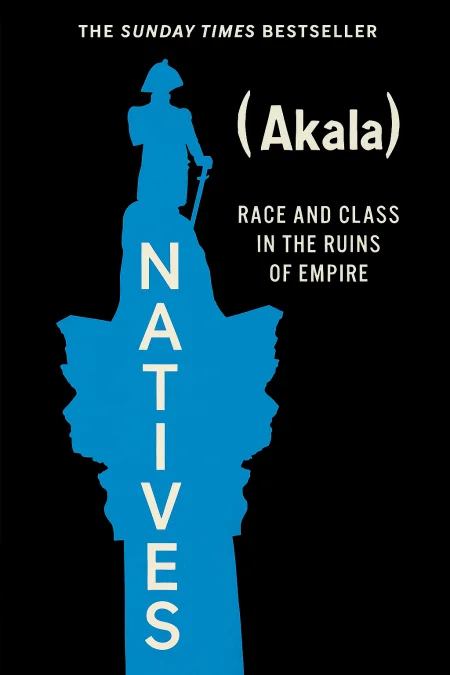
Natives
Race and Class in the Ruins of Empire
byAkala
Book Edition Details
Summary
The streets of London in the 1980s and '90s were a classroom for young Akala, where lessons came wrapped in harsh realities of race and class. In "Natives," Akala fuses personal narrative with a blistering critique of British society, daring readers to confront the deep-seated inequities etched into the country's fabric. As he recounts formative encounters—from the stark moment he first realized his mother's whiteness to the insidious racism within the educational system—Akala unravels the threads of history that bind modern Britain to its imperial past. This is more than memoir; it is a rallying cry against denial, a bold exploration of identity that challenges readers to rethink what they know about race and class. With unflinching honesty and a voice both raw and eloquent, Akala provides a lens through which to see the enduring impact of Britain's racialized empire.
Introduction
Picture a young boy in 1980s London, watching his hero Linford Christie drape himself in the Union Jack after winning Olympic gold, only to see the next day's newspapers obsess not over his athletic triumph but over crude sexual stereotypes. This moment captures the profound contradictions at the heart of modern Britain—a nation that celebrates black excellence while simultaneously questioning black humanity, that prides itself on tolerance while maintaining systems of exclusion rooted in centuries of imperial dominance. This exploration reveals how Britain's colonial past continues to shape present-day realities in ways most citizens barely recognize. From the classroom dynamics that funnel bright children into "special needs" programs based on skin color, to the economic structures that ensure wealth flows upward while blame flows down, we see how empire's logic persists in new forms. The story traces how ideas of racial hierarchy, forged in slave plantations and colonial outposts, became embedded in British institutions and consciousness, creating a caste system that operates through seemingly neutral mechanisms of education, policing, and social mobility. Anyone seeking to understand why Britain remains so stratified despite decades of equality legislation will find essential insights here. This is particularly vital for those who wonder why multicultural London can feel simultaneously like humanity's future and a reminder of its most troubling past, where success stories coexist with systematic disadvantage in ways that seem to defy simple explanations.
Colonial Foundations: Slavery, Empire and the Construction of Racial Hierarchy (1600s-1800s)
The foundations of modern British racial thinking were laid not in abstract philosophy but in the concrete realities of plantation economics and imperial expansion. During the seventeenth and eighteenth centuries, Britain transformed from a relatively minor European power into the world's dominant slave trader, shipping over three million Africans across the Atlantic while developing sophisticated ideologies to justify this human trafficking as civilizing mission. The invention of "whiteness" as a political category emerged from these colonial laboratories. In early Virginia, European and African laborers often worked side by side in similar conditions of bondage. But after Bacon's Rebellion in 1676, when enslaved Africans and European indentured servants united against colonial authorities, the ruling class began offering privileges based on skin color. Europeans gained rights to bear arms and hold certain positions, while Africans were increasingly relegated to permanent bondage. This wasn't natural evolution but deliberate social engineering designed to prevent future alliances between the oppressed. British intellectuals provided the theoretical framework for these practices. Figures like Edward Long argued that Africans were not fully human, while Enlightenment philosophers including Hume and Kant developed hierarchical theories of race that placed Europeans at civilization's apex. These weren't fringe ideas but mainstream academic positions that influenced law, policy, and popular culture across the empire. The profits from this system didn't remain in distant colonies but flowed directly into British development. Slave-produced sugar, tobacco, and cotton financed everything from country estates to the early industrial revolution. Insurance companies like Lloyd's of London insured enslaved people as property, while banks provided credit secured by human collateral. The wealth accumulated through these means created the capital base that would fund Britain's global dominance for centuries to come.
Imperial Narratives and Educational Control: Managing Contradictions at Home (1800s-1960s)
As Britain's empire reached its zenith in the nineteenth century, the challenge became managing the contradictions between liberal rhetoric at home and authoritarian rule abroad. The solution was a sophisticated propaganda system that reframed imperial domination as humanitarian intervention, presenting the British Empire as history's greatest force for civilization and progress. Educational curricula played a central role in this mythmaking. British children learned about heroic explorers bringing light to dark continents, benevolent administrators building railways and schools, and grateful natives embracing superior British values. The violence, exploitation, and resistance that defined actual colonial relationships disappeared from official narratives, replaced by sanitized tales of mutual benefit and peaceful progress. The abolition of slavery became a particularly powerful myth in this imperial storytelling. William Wilberforce emerged as the sole hero of emancipation, while the Haitian Revolution—the only successful slave rebellion in history—vanished from British memory. This selective amnesia served multiple purposes: it positioned Britain as humanity's moral leader while erasing evidence of successful resistance by colonized peoples. The fact that Britain spent the 1790s trying to crush Haitian independence and reinstall slavery throughout the French Caribbean was conveniently forgotten. These narratives weren't merely historical curiosities but active forces shaping contemporary politics. When British forces encountered resistance in India, Africa, or Ireland, it was framed as ungrateful savages rejecting civilization rather than peoples defending their freedom. The mythology of benevolent empire provided moral justification for whatever violence was necessary to maintain control, from the crushing of the Indian Rebellion of 1857 to the concentration camps of the Boer War.
Post-War Reckonings: Immigration, Resistance and Institutional Persistence (1948-2000s)
The arrival of the Empire Windrush in 1948 marked a crucial turning point in British racial dynamics. Caribbean workers, recruited to fill labor shortages in the post-war economy, discovered that their British passports meant little when confronted with widespread discrimination in housing, employment, and daily life. The "mother country" they had been taught to revere proved far less welcoming than colonial propaganda had promised. This period witnessed the emergence of distinctly British forms of racial resistance. The 1958 Notting Hill riots, sparked by white attacks on Caribbean residents, marked an early assertion of black British identity. By the 1970s and 1980s, a generation of British-born black youth was refusing to accept second-class citizenship, creating new forms of cultural and political expression that challenged both white supremacy and their parents' more accommodating approaches. The state's response revealed the persistence of colonial attitudes within British institutions. The 1981 Brixton uprising, triggered by aggressive stop-and-search operations, was met not with reflection on police practices but with calls for tougher law enforcement. The New Cross Fire of the same year, which killed thirteen young black Londoners in what many believed was a racist arson attack, received minimal official attention—a stark contrast to how similar tragedies affecting white communities would have been handled. Educational battles became particularly significant during this era. The massive overrepresentation of Caribbean children in schools for the "educationally subnormal" led to community organizing and the establishment of supplementary schools. Parents recognized that the British education system was not designed to nurture black excellence but to channel their children into subordinate roles. Their response—creating alternative educational spaces with limited resources—demonstrated both the failures of official multiculturalism and the determination of communities to secure their children's futures despite institutional hostility.
Contemporary Struggles: From Multiculturalism to Structural Change (1990s-Present)
The final decades of the twentieth century and opening years of the twenty-first have seen both significant progress and persistent challenges in British race relations. The Stephen Lawrence inquiry forced official acknowledgment of institutional racism within the Metropolitan Police, while the growth of a visible black middle class suggested that barriers to advancement were finally cracking. Yet these gains coexist with troubling continuities. Stop-and-search practices continue to disproportionately target young black men, while educational achievement gaps persist despite decades of equality initiatives. The 2011 riots, sparked by the police killing of Mark Duggan, revealed that many of the grievances that fueled earlier uprisings remained unresolved. The state's response—emphasizing punishment over addressing underlying causes—echoed patterns established in previous decades. The Grenfell Tower fire of 2017 crystallized many of these ongoing inequalities. The predominantly working-class, ethnically diverse residents of the tower had repeatedly warned about fire safety, only to be ignored by authorities. When disaster struck, the state's inadequate response contrasted sharply with the community solidarity that emerged in the tragedy's aftermath. The fact that most survivors remained unhoused months later, despite millions in donations and substantial council reserves, suggested that certain lives remained more valuable than others. Contemporary debates about multiculturalism and integration often miss these deeper structural issues. While celebrating diversity in cuisine and culture, British society struggles to address the material inequalities that empire's legacy has embedded in its institutions. The result is a form of multicultural nationalism that embraces difference at the surface level while maintaining hierarchies that ensure certain groups remain subordinate. Understanding this dynamic requires grappling honestly with how imperial history continues to shape present realities, rather than treating racism as merely individual prejudice that education and good intentions can overcome.
Summary
The thread connecting Britain's imperial past to its multicultural present runs through the persistent logic of racial hierarchy that emerged from plantation slavery and colonial domination. What began as crude justifications for human trafficking evolved into sophisticated systems of classification and control that survived empire's formal end. The same intellectual frameworks that once justified ruling over distant colonies now operate through seemingly neutral mechanisms of education, policing, and economic policy to maintain familiar patterns of inclusion and exclusion. This history reveals that racism was never simply about individual prejudice but about power—who gets to define normality, who deserves protection, whose voices matter in public discourse. The mythology of British benevolence, from Wilberforce's supposed single-handed abolition of slavery to the empire's alleged civilizing mission, serves to obscure these power relations while making resistance appear ungrateful or irrational. Understanding these dynamics is essential for anyone seeking to build a more equitable society. The path forward requires honest reckoning with this history rather than comfortable myths about progress and tolerance. This means examining how imperial wealth continues to shape contemporary inequality, how colonial attitudes persist in modern institutions, and how the beneficiaries of these systems might genuinely share power rather than simply managing diversity. Only by understanding how we arrived at the present moment can we hope to create futures that fulfill democracy's promise rather than merely its rhetoric.
Related Books
Download PDF & EPUB
To save this Black List summary for later, download the free PDF and EPUB. You can print it out, or read offline at your convenience.
By Akala
