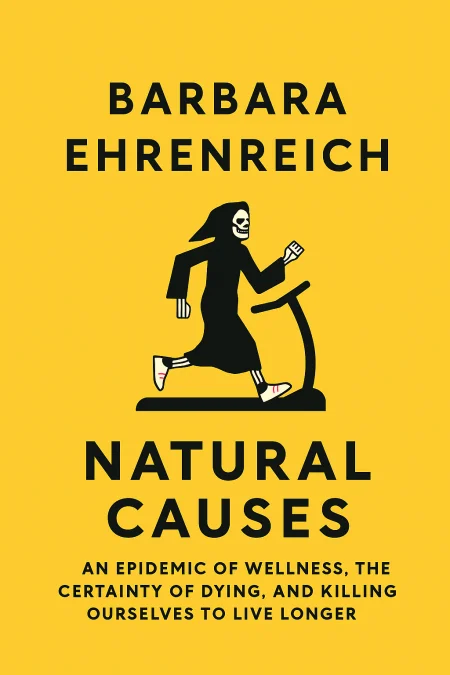
Natural Causes
An Epidemic of Wellness, the Certainty of Dying, and Killing Ourselves to Live Longer
Book Edition Details
Summary
In a world where the quest for longevity often eclipses the art of living itself, Barbara Ehrenreich's "Natural Causes" dismantles the comforting myths of modern health culture. With piercing insight, Ehrenreich challenges our obsession with control—over our bodies, our minds, and even our mortality. This provocative exploration delves into the unsettling autonomy of our cellular universe, where the very mechanisms meant to sustain us can betray us in the most unexpected ways. She questions the blind faith we place in wellness trends and medical procedures, exposing them as mere illusions of control. With a blend of science, philosophy, and wit, Ehrenreich invites us to reevaluate our relationship with life’s inevitable decline, urging us to embrace the chaos and find joy in the imperfection of being. Unflinchingly bold, "Natural Causes" is a call to live more authentically and fearlessly, untethered from the shackles of false promises.
Introduction
Modern culture promotes an illusion of unprecedented human agency over biological destiny. From fitness regimens to preventive medicine, from mindfulness practices to wellness protocols, we operate under the assumption that conscious effort can reliably control bodily outcomes. This perspective fundamentally misunderstands the nature of biological systems and the autonomous behavior of cellular life. Rather than harmonious machines responding predictably to conscious intervention, human bodies function as complex confederations of semi-independent entities, each capable of decision-making that may conflict with the organism's apparent interests. The evidence reveals that immune cells can abet cancer growth, that inflammation drives aging, and that cellular "treason" represents not malfunction but normal biological behavior. This analysis challenges the dominant paradigm by examining scientific evidence for cellular autonomy, questioning the philosophical foundations of mind-body dualism, and revealing how the concept of the unified "self" obscures our understanding of biological reality. Through systematic examination of medical rituals, fitness culture, and emerging research on cellular decision-making, a different picture emerges—one where agency exists throughout the natural world, not as the exclusive domain of human consciousness but as a fundamental property of matter itself.
The Illusion of Control: Medical Rituals and Wellness Culture
Medical screening culture represents a elaborate system of ritual behaviors disguised as scientific practice. Annual physicals, mammograms, and colonoscopies continue despite mounting evidence of their limited effectiveness, revealing their true function as ceremonies of control rather than health interventions. These procedures serve to reinforce the illusion that death and disease can be forestalled through vigilant monitoring and early detection. The statistical evidence undermines this narrative: mammographic screening shows no significant reduction in breast cancer mortality, while PSA testing fails to decrease prostate cancer deaths. False positives generate cascades of unnecessary interventions, often causing more harm than the conditions they purport to detect. The persistence of these practices despite contrary evidence illuminates their ritualistic nature. Like religious ceremonies, medical screenings provide psychological comfort through the performance of prescribed actions, regardless of their practical efficacy. The transformation of healthy individuals into "patients" through screening creates a population perpetually anxious about their biological status, dependent on medical authority for reassurance about their bodily integrity. Wellness culture extends this dynamic beyond clinical settings into daily life. The quantified self movement, corporate wellness programs, and fitness tracking technologies promise unprecedented control over biological processes through constant monitoring and adjustment. Yet this surveillance generates its own pathologies, creating obsessive relationships with data that bear little connection to actual health outcomes. The fundamental error underlying both medical screening and wellness culture lies in their assumption that conscious human agency can reliably direct biological processes. This perspective treats the body as a passive machine responding predictably to inputs, ignoring mounting evidence for cellular autonomy and the inherent unpredictability of living systems.
Cellular Rebellion: When the Body Betrays Itself
The immune system's relationship with cancer reveals the limitations of viewing the body as a unified, harmonious system working toward collective survival. Macrophages, traditionally understood as the body's defenders against foreign invaders, actively assist in tumor growth and metastasis. These immune cells provide growth factors to cancer cells, help construct blood vessels to nourish tumors, and escort cancer cells into the bloodstream to establish metastases throughout the body. This collaboration between immune cells and cancer represents not a malfunction but normal cellular behavior that contradicts the organism's survival interests. Scientific visualization techniques now reveal the intimate cooperation between macrophages and tumor cells. In real-time microscopy, macrophages can be observed partnering with individual cancer cells to breach blood vessel walls, enabling metastatic spread. The relationship involves complex chemical communication, creating positive feedback loops that amplify both cellular types' destructive activities. This cellular "treason" extends beyond cancer to autoimmune diseases, where immune cells attack healthy tissues, and to the inflammatory processes driving aging itself. Inflammaging, the chronic activation of immune cells in aging tissues, demonstrates how the body's protective mechanisms become agents of destruction over time. Macrophages accumulate in aging organs, consuming healthy cells and tissues in processes that manifest as arthritis, atherosclerosis, and neurodegeneration. Rather than simple wear and tear, aging involves active assault by the body's own cellular components. These phenomena reveal that cellular behavior cannot be understood through the lens of organismal function. Individual cells pursue their own agendas, which may conflict with the survival of the larger biological system. The implications challenge fundamental assumptions about biological harmony and the possibility of conscious control over bodily processes.
The Self as Obstacle: From Soul to Scientific Materialism
The concept of the unified self, far from being a natural or inevitable aspect of human experience, represents a historical invention that emerged alongside market economies and Protestant introspection. Prior to the Renaissance, individuals understood themselves primarily through social roles and divine relationships rather than as autonomous agents possessing interior psychological landscapes. The development of self-consciousness created new forms of anxiety and depression, as individuals became trapped in recursive loops of self-examination and self-judgment. Modern scientific materialism eliminates divine agency from the natural world while preserving human consciousness as the sole remaining source of purposeful action. This creates an untenable philosophical position: humans experience themselves as conscious agents in a universe otherwise devoid of agency or intention. The resulting worldview generates both narcissistic inflation of human importance and existential terror at the prospect of individual extinction in a meaningless cosmos. The self proves to be a poor vehicle for confronting mortality. Efforts to maintain, improve, and extend the self through health interventions become compulsive precisely because they attempt the impossible: permanent control over inherently uncontrollable biological processes. The harder individuals work to preserve their bodily integrity through diet, exercise, and medical monitoring, the more acutely they experience their fundamental powerlessness over cellular behavior and biological destiny. Contemporary neuroscience research using psychedelic compounds demonstrates that suppression of self-awareness correlates with decreased death anxiety and increased sense of connection to the broader universe. When the brain's "default mode network" responsible for self-referential thinking goes offline, individuals report mystical experiences of unity that eliminate fear of personal extinction. These findings suggest that the self, rather than being humanity's crowning achievement, may represent an obstacle to peaceful acceptance of biological reality.
Embracing Agency: Death and the Living Universe
The scientific evidence points toward a radical reconceptualization of agency in the natural world. Rather than existing solely in human consciousness, purposeful action appears throughout biological systems, from cellular decision-making to viral "choices" about reproductive strategies. Even subatomic particles exhibit behaviors that physicists describe as involving "free will" and "decisions." This suggests that our animistic ancestors may have been closer to truth than modern scientific materialism in recognizing the natural world as inherently alive and self-directed. Quantum mechanics reveals that apparent emptiness seethes with spontaneous particle creation and annihilation. The vacuum itself generates matter through quantum fluctuations, suggesting that agency and spontaneous action represent fundamental properties of reality rather than rare emergent phenomena limited to biological systems. From this perspective, human consciousness represents not an island of purpose in a dead universe but one manifestation of agency that extends throughout the natural world. Accepting biological autonomy at the cellular level eliminates the burden of imagining that conscious effort can control bodily processes. This recognition shifts the relationship with aging and death from futile struggle toward peaceful acceptance of natural processes. Rather than viewing cellular "rebellion" as pathology to be prevented, it becomes possible to understand these behaviors as expressions of the same vital forces that sustain life itself. Death, in this framework, represents not extinction into nothingness but reintegration into the broader patterns of agency and spontaneous action that characterize the living universe. Individual consciousness emerges from and returns to the creative processes that generate stars, planets, and life itself. This perspective transforms mortality from ultimate defeat into participation in cosmic creativity.
Summary
The evidence reveals that human bodies operate not as controllable machines but as complex societies of semi-autonomous cellular entities pursuing their own agendas, often in conflict with organismal survival. This biological reality undermines the modern assumption that conscious effort can reliably direct health outcomes, exposing medical screening and wellness culture as elaborate rituals of control rather than effective interventions. The concept of the unified self, rather than representing humanity's greatest achievement, creates psychological obstacles to accepting biological reality and mortality. Recognition that agency extends throughout the natural world, from cellular decision-making to quantum fluctuations, dissolves the existential terror generated by scientific materialism's vision of consciousness as isolated in a dead universe. This shift in perspective transforms death from ultimate defeat into reintegration with the creative forces that sustain cosmic evolution, enabling peaceful acceptance of biological processes beyond human control.
Related Books
Download PDF & EPUB
To save this Black List summary for later, download the free PDF and EPUB. You can print it out, or read offline at your convenience.
By Barbara Ehrenreich
