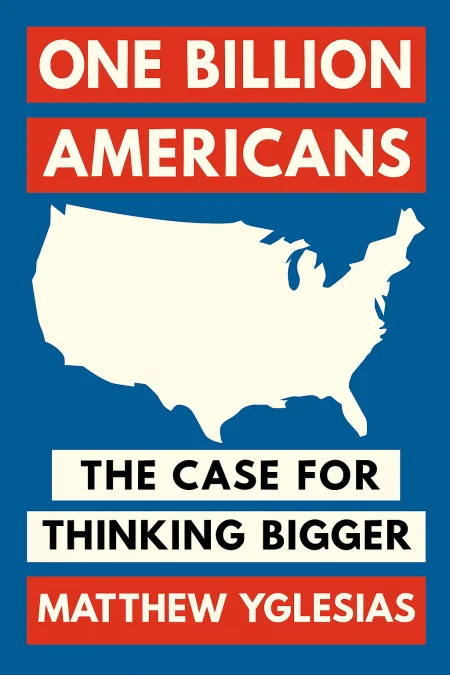
One Billion Americans
The Case for Thinking Bigger
Book Edition Details
Summary
Ever wonder what it would take for America to reclaim its status as a global powerhouse? Matthew Yglesias delivers a startling prescription in "One Billion Americans," urging the nation to drastically expand its population to eclipse the competition. This thought-provoking manifesto challenges conventional wisdom, arguing that a surge in population is the key to economic vitality. Yglesias paints a vivid picture of an America bustling with innovation, opportunity, and sustainable growth. From enhancing public infrastructure to embracing immigration, he outlines a blueprint for a vibrant future. With a narrative as bold as its premise, this book dares readers to envision an ambitious America that isn't just surviving but thriving on the world stage.
Introduction
Picture this: a young nation in 1783, barely recovered from revolution, with George Washington welcoming Irish immigrants not out of charity, but out of strategic necessity. "America is open to receive not only the opulent & respectable Stranger, but the oppressed & persecuted of all Nations & Religions," he declared, understanding something profound about national power that we seem to have forgotten today. This book challenges one of the most fundamental assumptions of contemporary American politics: that our country is somehow "full" and that growth inevitably leads to decline in living standards. Through a compelling blend of economic analysis, demographic data, and policy prescriptions, it reveals how America's greatest historical advantage—its ability to attract and integrate people from around the world—has become perhaps our most underutilized strategic asset. The central thesis is as audacious as it is logical: to maintain American global leadership in the face of rising powers like China and India, we need to think bigger. Much bigger. The path forward isn't about building walls or managing decline, but about embracing the growth mindset that made America great in the first place. This book is essential reading for anyone concerned about America's future role in the world, the challenges of an aging population, or the untapped potential of immigration reform. It offers a roadmap for those ready to think beyond the cramped politics of scarcity toward a vision of American abundance.
The Making of American Power: Population and National Strength (1776-1945)
From the earliest days of the republic, American leaders understood a fundamental truth about power that seems almost radical today: a nation's strength flows not from the scarcity of its people, but from their abundance. When the Continental Congress surveyed the challenges facing the new United States, they saw vast territories, untapped resources, and dangerous neighbors. Their solution wasn't to restrict growth, but to actively encourage it. The early republic's approach to population growth was remarkably deliberate. The Homestead Acts, canal projects, and railroad subsidies weren't just infrastructure investments—they were conscious efforts to fill a continent with productive, prosperous Americans. Immigration wasn't seen as a burden to be managed, but as a strategic advantage to be maximized. German farmers, Irish laborers, and Scandinavian settlers didn't threaten American identity; they strengthened American capacity. This philosophy paid extraordinary dividends when it mattered most. By 1938, the United States possessed a gross domestic product larger than Germany, Japan, and Italy combined. This wasn't an accident of geography or resources—it was the deliberate result of generations of growth-oriented policies. When World War II erupted, America could serve as the "arsenal of democracy" precisely because it had built the demographic and economic foundation to support such a role. The contrast with authoritarian competitors was stark and decisive. Germany, for all its military prowess and technological innovation, remained constrained by its population of 80 million. The Soviet Union had numbers but lacked productivity. America uniquely combined demographic weight with economic dynamism, a combination that proved unstoppable. The lesson was clear: in the modern world, national power requires both scale and prosperity, and the countries that understood this truth would shape the century to come.
Demographic Decline and Rising Rivals: The China Challenge (1990s-2020)
The end of the Cold War should have inaugurated an era of confident American expansion, but instead it marked the beginning of a dangerous complacency about the fundamentals of national power. While America celebrated its victory over Soviet communism, a quiet revolution was reshaping the global balance. China, with its population of 1.3 billion, began the long march from poverty to prosperity that would ultimately challenge every assumption about American primacy. The mathematics of this challenge are stark and unforgiving. For China to match American living standards would be ideal but unnecessary for global dominance. If Chinese citizens achieve even one-third the per capita wealth of Americans—roughly the level of Portugal or Greece—China's economy would dwarf America's. This isn't a distant theoretical concern; it's happening in real time as Chinese growth continues to outpace American expansion year after year. Meanwhile, America has drifted into demographic decline without seeming to notice the implications. Birth rates have fallen to historic lows, not because Americans don't want children, but because the economics of child-rearing have become increasingly prohibitive. Immigration, the traditional source of American demographic vitality, has become politically toxic rather than strategically valuable. The result is a nation aging faster than its competitors and growing slower than necessary to maintain global leadership. The cruel irony is that this demographic retreat comes precisely when America's advantages remain overwhelming. The country offers superior economic opportunities, political freedoms, and social mobility compared to most of the world. Millions of talented, ambitious people would gladly move to America if given the opportunity. Instead of leveraging this incredible strategic asset, American policy makers have treated population growth as a problem to be managed rather than a source of strength to be maximized. The window for reversing this trend remains open, but it will not remain so indefinitely.
The Path Forward: Immigration, Families, and Urban Renewal (2020-2050)
The solution to America's demographic challenge isn't mysterious—it's already working in countries around the world that have chosen growth over stagnation. The path forward requires simultaneous action on three fronts: welcoming more immigrants, supporting more families, and revitalizing the cities and regions that have been left behind by economic change. Immigration reform should start with the recognition that America's ability to attract global talent represents an incredible competitive advantage. While other countries struggle with brain drain, America suffers from the opposite problem: too many qualified people want to come here. The answer isn't to build higher walls, but to build better bridges. Strategic immigration policies could simultaneously address rural depopulation, urban housing shortages, and the fiscal challenges of an aging society. Supporting American families requires acknowledging that the traditional model of child-rearing—where parents shoulder most costs privately—no longer works in a modern economy. Countries like France and Germany have shown that comprehensive family support policies, from child allowances to universal childcare, don't just improve children's lives; they enable parents to have the number of children they actually want. The result is stronger families, healthier communities, and more sustainable demographics. Perhaps most importantly, America must rediscover the art of building. The country has vast territories of underused land, declining cities with excellent infrastructure, and regulatory barriers that prevent people from living where economic opportunities exist. Removing these barriers wouldn't just accommodate more people; it would unleash tremendous economic dynamism. Cities like Detroit, Cleveland, and Buffalo could become magnets for growth rather than symbols of decline. The vision that emerges isn't one of crowded tenements or environmental degradation, but of a more prosperous, dynamic, and confident America. A country of one billion Americans would be denser than today but less crowded than most of Europe. It would be more diverse but also more unified around shared prosperity. Most importantly, it would be strong enough to maintain global leadership while generous enough to remain true to American values.
Summary
The central thread running through American history has been the tension between the politics of scarcity and the reality of abundance. From the founding era through World War II, American leaders consistently chose abundance, welcoming new people and building the infrastructure to support them. This growth-oriented mindset created the demographic and economic foundation for global leadership. Today, that foundation is eroding not because America lacks resources or opportunities, but because it has lost faith in its own capacity for beneficial growth. The rise of China and India represents both a challenge and an opportunity for American renewal. These countries' success demonstrates that rapid economic development remains possible in the modern world, but their vast populations mean that even modest per capita gains translate into enormous shifts in global power. America cannot win this competition by keeping competitors poor or by accepting its own decline as inevitable. The only sustainable path forward requires embracing the growth mindset that built American power in the first place. Three practical steps could begin this renewal immediately. First, reform immigration policy to treat newcomers as strategic assets rather than burdens to be managed. Second, implement family-friendly policies that enable Americans to have the children they say they want. Third, remove regulatory barriers that prevent people from living and building where economic opportunities exist. These aren't radical departures from American tradition; they're returns to the fundamental principles that made America great. The question isn't whether America can support one billion people, but whether Americans have the vision and confidence to secure their country's future through growth rather than retreat.
Related Books
Download PDF & EPUB
To save this Black List summary for later, download the free PDF and EPUB. You can print it out, or read offline at your convenience.
By Matthew Yglesias
