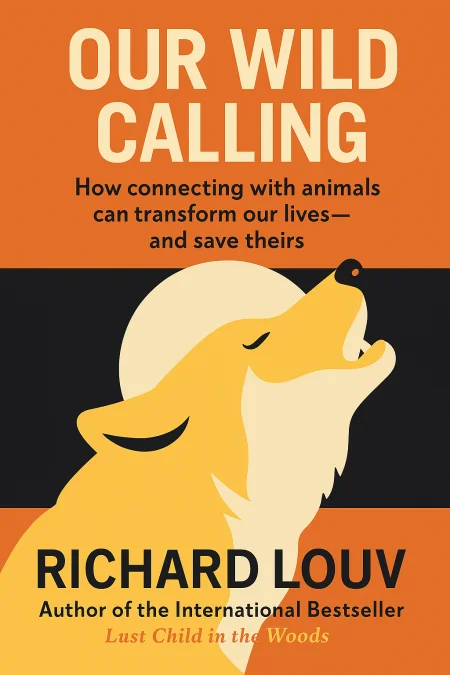
Our Wild Calling
How Connecting with Animals Can Transform Our Lives—and Save Theirs
Book Edition Details
Summary
Amidst the hum of technology and the solitude it often brings, "Our Wild Calling" by Richard Louv emerges as a beacon of reconnection. What if the answers to our modern loneliness lie not in screens, but in the primal, unspoken bonds we share with the animal kingdom? Louv, renowned for igniting a global movement with "Last Child in the Woods," now turns his gaze to the profound relationships between humans and animals. Through captivating interviews with a diverse array of voices—from indigenous healers to urban wildlife experts—he unveils a tapestry of stories that challenge us to see our world anew. As cities blur the line between wild and domestic, this book invites us to foster a shared habitat built on empathy and love, paving the way for a future where every creature, great and small, is cherished.
Introduction
In our screen-dominated world, something remarkable is happening beneath the surface of our daily lives. While children struggle to identify common birds and adults find themselves mysteriously drawn to viral animal videos, scientists are uncovering profound truths about our deep-seated need for connection with other species. This isn't mere sentimentality—it's biology. When we interact with animals, our brains release the same bonding hormones triggered by human love and friendship. Our nervous systems calm, our empathy expands, and something ancient within us awakens. From therapy dogs that can detect seizures before they occur to urban coyotes teaching us new models of coexistence, the animal kingdom continues offering lessons we desperately need. As climate change reshapes our planet and cities expand into wild spaces, understanding these connections has become more than fascinating—it's essential. We're discovering that the health of human communities and the wellbeing of other species are not separate concerns but interconnected aspects of the same vital relationship. The science reveals that learning to communicate across species boundaries, recognizing animal intelligence, and creating spaces where humans and wildlife can thrive together may hold keys to healing both our psychological isolation and our fractured relationship with the living world.
The Language of Interspecies Communication
Imagine a vast communication network that makes our internet seem primitive—a planetary conversation involving billions of participants exchanging vital information every moment. This network has operated for millions of years, connecting everything from the smallest insects to the largest whales through channels we're only beginning to understand. Trees warn their neighbors of insect attacks through chemical signals, elephants coordinate across miles using subsonic rumbles, and dolphins appear to have signature whistles that function like personal names. Recent scientific breakthroughs reveal just how sophisticated these communication systems truly are. Prairie dogs possess one of the most complex animal languages ever decoded, with specific "words" for different predators that can even describe their size and color. Some dolphins demonstrate grammatical structures in their vocalizations, while certain bird species modify their songs in real-time to cut through urban noise pollution. Even more remarkably, researchers have documented instances of interspecies cooperation where different animals develop shared communication protocols, like ravens guiding wolves to prey in exchange for sharing the meal. The barrier between human and animal communication proves far more permeable than previously imagined. Scientists are developing technologies that could enable real-time translation between species, while rediscovering ancient human abilities to read natural signs. Farmers are learning to interpret bird alarm calls to protect crops from pests, and urban planners use animal communication patterns to design wildlife-friendly cities. This emerging field suggests that our ancestors' ability to "speak" with nature—once essential for survival—can be enhanced by modern science. What makes this research particularly compelling is its practical impact on human development. Children who learn to recognize and respond to animal communication develop stronger empathy skills and enhanced emotional intelligence. Adults who tune into the natural communication networks around them report reduced anxiety and increased feelings of connection to the living world. As we face environmental challenges requiring cooperation across all forms of life, understanding and participating in these ancient communication systems may prove crucial for creating a more harmonious relationship with our planet.
Animal Intelligence and Cross-Species Bonds
For centuries, humans have dramatically underestimated the cognitive abilities of other species, but revolutionary discoveries are shattering these assumptions. Crows can solve multi-step puzzles and plan for future events, elephants demonstrate self-awareness and mourn their dead, while octopuses show problem-solving skills that suggest a form of consciousness entirely alien to our own experience. These findings reveal that intelligence takes many forms, each perfectly adapted to different ecological niches and survival challenges. What's particularly fascinating is how different species have evolved specialized cognitive abilities that often surpass human capabilities in specific domains. Dogs can detect diseases through scent with accuracy that exceeds medical equipment, bees perform complex mathematical calculations to optimize foraging routes, and some birds demonstrate memory feats that would challenge the most skilled human performers. This diversity of intelligence suggests that consciousness itself may be far more widespread and varied than we ever imagined. The emotional connections that form between humans and animals operate through what researchers call genuine interspecies empathy. When we interact with animals, we're not simply projecting human emotions onto them—we're tapping into shared evolutionary heritage and similar neurological structures. Horses can read human facial expressions with remarkable accuracy, distinguishing between genuine and forced emotions. Dogs have evolved the unique ability among non-primates to follow human pointing gestures and maintain eye contact in ways that mirror human social bonding patterns. These connections produce measurable benefits for both species involved. Humans who maintain strong bonds with animals exhibit greater resilience to stress, enhanced capacity for empathy with other humans, and improved mental health outcomes. The animals often display behavioral changes suggesting they derive emotional benefits from these relationships as well. Studies show that therapy animals working with humans demonstrate signs of job satisfaction and emotional fulfillment, challenging the notion that such bonds are purely one-sided human constructions. This reciprocal relationship suggests that the capacity for cross-species friendship may be an evolved trait that benefits entire ecosystems.
Urban Wildlife and Coexistence Strategies
Cities worldwide are experiencing an unprecedented phenomenon as wild animals establish permanent residence in urban environments, creating a new category of creatures scientists call "urban adapters." Coyotes navigate subway systems with the skill of seasoned commuters, bears have learned to operate door handles and raid refrigerators, while mountain lions prowl through suburban neighborhoods under cover of darkness. Rather than viewing this as an invasion, researchers recognize it as an evolutionary response to habitat loss and climate change that offers unique opportunities for developing new models of interspecies coexistence. These urban-dwelling animals are adapting to city life with remarkable speed and creativity. Raccoons have developed sophisticated problem-solving skills to access human food sources, while urban birds are evolving shorter songs to cut through traffic noise. Some species are even becoming more intelligent in response to urban challenges, with city-dwelling animals showing enhanced cognitive abilities compared to their rural counterparts. These rapid adaptations demonstrate that cities, despite their apparent hostility to wildlife, can become thriving ecosystems when properly designed and managed. The challenges of coexistence are complex and sometimes dangerous, requiring innovative solutions that go beyond traditional wildlife management approaches. When large predators appear in residential areas, the encounters can be fatal for both humans and animals. Simply relocating problem animals often fails because they either return to their original territory or become problems elsewhere. Instead, successful coexistence strategies focus on changing human behavior and designing urban spaces that accommodate multiple species' needs. Cities that embrace this approach are discovering unexpected benefits from their wild neighbors. Urban wildlife provides natural pest control, pollination services, and seed dispersal that maintain healthy ecosystems within city limits. The presence of diverse animal life also enhances human wellbeing, providing opportunities for wonder and connection that improve mental health and community cohesion. Wildlife corridors, green roofs, and native plant gardens create habitat while reducing human-wildlife conflicts. Education programs that teach residents how to respond appropriately to animal encounters prove more effective than removal strategies, fostering communities where humans and wildlife can thrive as neighbors rather than adversaries.
Conservation Through Connection and Understanding
Traditional conservation approaches that separate humans from nature are giving way to revolutionary models that recognize our fundamental interconnectedness with other species. The most successful conservation efforts now focus on building emotional connections between people and wildlife rather than simply establishing protected areas or implementing regulations. When individuals develop personal relationships with animals—whether through wildlife watching, citizen science projects, or even brief urban encounters—they become passionate advocates for environmental protection with a power that abstract arguments about ecosystem services cannot match. This shift toward relationship-based conservation reflects a deeper understanding of human psychology and motivation. Children who participate in programs connecting them with local wildlife grow up to be adults who vote for environmental protection and make lifestyle choices supporting biodiversity. The emotional investment proves more influential than scientific data or economic arguments in driving long-term behavioral change. Indigenous cultures have long understood this principle, recognizing that human and environmental health are inseparable aspects of community wellbeing. The principle of reciprocity lies at the heart of this new conservation paradigm. Rather than viewing environmental protection as a sacrifice humans make for nature, successful programs demonstrate how protecting wildlife directly benefits human communities. Wetlands that provide habitat for birds also prevent flooding and purify drinking water. Forests that shelter endangered species also sequester carbon and provide recreational opportunities that boost local economies. Urban green spaces supporting wildlife simultaneously reduce air pollution and create venues for community gathering and mental health restoration. Perhaps most importantly, this approach recognizes that humans are not separate from nature but integral parts of it. Our wellbeing depends entirely on the health of the broader community of life, and our actions inevitably affect other species whether we acknowledge it or not. By fostering connections with animals and understanding our role in the web of life, we can move beyond the destructive patterns driving the current extinction crisis toward sustainable relationships with our fellow creatures. The future of conservation may depend not on keeping humans and wildlife apart, but on learning how to live together as members of Earth's extended family, each species contributing unique gifts to the whole.
Summary
At its core, this exploration reveals that our connections with other animals are not luxuries or sentimental indulgences, but fundamental requirements for human psychological, physical, and spiritual wellbeing that have been shaped by millions of years of coevolution. The emerging science demonstrates that when we learn to communicate across species boundaries, recognize the intelligence and emotional lives of other creatures, and create spaces where humans and wildlife can thrive together, we address both the mental health crisis facing humanity and the environmental crisis threatening our planet. As we face unprecedented challenges from climate change and urbanization, the path forward lies not in further separation from the natural world, but in rediscovering and nurturing our ancient bonds with other species through innovative approaches that benefit entire ecosystems. The research suggests that successful conservation, urban planning, and even human development depend on understanding that our wellbeing is inseparable from the health of the broader community of life. How might we redesign our communities, educational systems, and daily practices to honor these connections and create a civilization that recognizes the intelligence and intrinsic value of all life forms? What would it mean for future generations to grow up in a world where encounters with wildlife are not rare exceptions but regular sources of wonder, learning, and mutual enrichment? For readers seeking to understand their place in the broader web of life and explore practical ways to foster meaningful relationships with the more-than-human world, this field offers both profound hope and a roadmap for creating more compassionate and sustainable ways of living on Earth.
Related Books
Download PDF & EPUB
To save this Black List summary for later, download the free PDF and EPUB. You can print it out, or read offline at your convenience.
By Richard Louv
