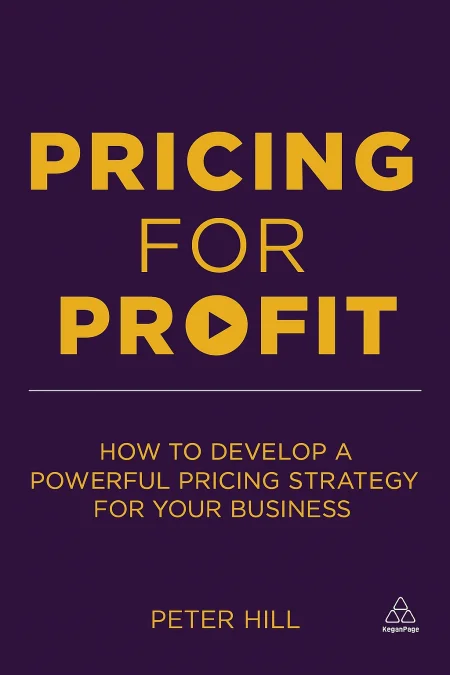
Pricing For Profit
How to Develop a Powerful Pricing Strategy for Your Business
Book Edition Details
Summary
In the high-stakes arena of business, the right pricing strategy can be your secret weapon. "Pricing for Profit" is not just a guide—it's a revelation, drawing on real-world triumphs and pitfalls to reshape how you think about profit. This book breaks the mold, challenging the knee-jerk impulse to slash prices or outbid competitors. Instead, it lays out a strategic blueprint to fortify your pricing tactics, transforming them into a powerhouse of sustainable growth. For entrepreneurs and leaders ready to rethink their approach, the question isn't whether you can afford to change—it's whether you can afford not to. Dive into these pages and discover the true art of pricing mastery.
Introduction
In the fast-paced world of business, countless entrepreneurs and executives find themselves trapped in a relentless cycle of competing on price, watching their profit margins shrink while desperately seeking ways to grow their bottom line. They invest heavily in marketing campaigns to attract new customers, implement cost-cutting measures that often compromise quality, and work tirelessly to increase sales volumes, yet their financial results remain disappointingly stagnant. What if the solution to doubling your profits was simpler than you ever imagined? What if it didn't require massive investments in new technology, aggressive expansion plans, or dramatic operational overhauls? The truth is, the most powerful lever for profit growth has been sitting right under your nose all along, waiting to be pulled with confidence and strategic precision. This journey will challenge everything you think you know about pricing, reveal the hidden psychology behind customer buying decisions, and equip you with practical tools to transform your financial results immediately.
Understanding the Profit Equation and Value Scales
Profit improvement isn't the mysterious art that many business owners believe it to be. At its core, every business has exactly five ways to grow: increase the number of customers, increase transaction frequency, increase average transaction value, increase prices, and increase efficiency. Yet when most executives examine these options mathematically, they discover a shocking truth about which lever delivers the greatest impact. Consider the story of a million-pound business selling outdoor equipment. When the owner analyzed his customer base of 840 active clients, each making six purchases annually at an average value of £198, he faced a revelation that would transform his entire approach to growth. While increasing customer acquisition from 10% to 12% would boost profits by 11%, and improving customer retention from 95% to 96.5% would increase profits by 9%, a mere 2% price increase delivered a staggering 40% profit improvement. This wasn't theoretical mathematics, it was the cold, hard reality of business dynamics. The owner initially resisted implementing the price increase, fearing customer backlash and competitive disadvantage. However, when presented with these calculations alongside careful customer research and competitor analysis, he realized his fears were largely unfounded. Most customers perceived tremendous value in his expertise, product quality, and service reliability. The price increase was implemented with clear communication about enhanced value propositions, and remarkably, customer complaints were minimal while profits soared. The key lies in understanding the Value Scales concept, where every purchase decision balances perceived value against price. Your role is to load maximum value onto the customer's side of these scales while confidently stating your price. This means articulating your unique benefits, demonstrating superior quality, highlighting convenience factors, and showcasing the total cost of ownership advantage your solution provides. Start by listing every feature and benefit you currently offer but may not be actively communicating to customers. Many businesses provide exceptional value through warranties, expert advice, convenient locations, or superior service, yet fail to emphasize these differentiators during sales conversations. The goal is ensuring customers understand the complete value equation before making their buying decision. Remember that customers don't automatically know why your offering is worth the price you're asking. Your job is to make the value so clear and compelling that your price becomes secondary to the benefits they'll receive.
Stop Discounting: Control Your Pricing Power
Discounting has become the default response to competitive pressure, yet it represents one of the most destructive practices in modern business. Every discount dollar flows directly from your bottom line, creating a downward spiral that's difficult to escape. The mathematics are unforgiving: if you operate on a 30% margin and offer a 10% discount, you must increase sales volume by 50% just to maintain the same profit level. The story of Special Events Limited illustrates this point powerfully. This £25 million company was struggling with profitability despite healthy sales volumes. When external analysis revealed they were giving away an average 21% discount across all products, the leadership team was stunned to discover their second-largest business expense was completely uncontrolled. Their discount bill exceeded £6.5 million annually, dwarfing their payroll costs and representing money simply given away at the point of sale. The transformation began with implementing strict discount authorization levels and training programs that helped salespeople understand the financial impact of their pricing decisions. Instead of automatically offering 20% off when challenged on price, sales staff learned to present the discount as 16.83% with detailed calculations, making the offer appear more considered and final. They introduced cash-back policies for prompt payment rather than upfront discounts, changing both customer and salesperson psychology around the transaction. Within months, the company reduced their average discount rate from 21% to 19.95%, generating an additional £332,500 in profit. This represented a 44% increase in bottom-line results from what appeared to be a modest adjustment in discounting practices. To regain control over your pricing power, establish clear authorization levels for discounts, implement systems that track every price reduction by salesperson and customer, and train your team to exhaust value-added options before resorting to price cuts. Create discount guidelines that specify when and why price reductions are acceptable, and make it difficult for frontline staff to give money away without proper justification. Most importantly, help your team understand that their primary job is creating customer satisfaction through superior value delivery, not through financial concessions that ultimately undermine the business's sustainability and growth prospects.
Present Your Prices for Maximum Impact
The way you present your prices can dramatically influence customer acceptance and willingness to pay. Price presentation isn't about deception; it's about communicating value and certainty in ways that build customer confidence in their purchasing decision. Every element, from the specific numbers you use to the words that accompany them, shapes customer perception and behavior. The solar panel installation case study demonstrates this principle beautifully. When homeowners received quotes from five different companies for identical work, their selection criteria revealed fascinating insights about price psychology. One contractor quoted "£5k all in" while another specified "The all-inclusive, fixed price will be £4,173.68 + VAT so exactly £5,008.42." Despite the second quote being slightly higher, it generated significantly more customer confidence and acceptance. The precise calculation suggested careful analysis rather than rough estimation. Customers interpreted the detailed breakdown as evidence of thorough planning and fair pricing, while round numbers appeared arbitrary or inflated. The specific figures implied that every component had been properly considered, including a reasonable profit margin, rather than a price pulled from thin air or padded for negotiation. The transformation occurred when this contractor began applying the same precision to discount offers. Instead of saying "I can give you 20% off," he would calculate exactly 16.27% after apparent consideration, explaining it as a special rate based on the specific project requirements and prompt payment terms. This approach eliminated further negotiation attempts because customers believed they were receiving a carefully calculated, final offer. Present your prices using specific, non-round numbers that suggest careful calculation. Replace vague terms like "about £5,000" with precise figures that demonstrate thoroughness. When offering discounts, use calculated percentages rather than round numbers, and always tie the discount to specific conditions or customer actions. Develop professional price presentations that emphasize certainty and remove uncertainty from customer minds. Use words like "investment" instead of "cost" and "professional fee" instead of "price" when appropriate. Create urgency through time-limited offers and emphasize the fixed nature of your pricing to prevent ongoing negotiations. Your goal is building customer confidence that your price represents fair value for superior results, presented by professionals who have done their homework and stand behind their numbers with complete certainty.
Build Your Pricing Strategy Action Plan
Creating sustainable profit growth through better pricing requires systematic implementation rather than ad-hoc price changes. Your pricing strategy must be comprehensive, involving the right people, clear processes, and ongoing measurement to ensure long-term success. This isn't about implementing a single price increase; it's about building organizational capability that consistently optimizes profitability. The key to successful implementation lies in assembling a cross-functional pricing team that includes representatives from sales, finance, and operations. This team needs someone who understands customer relationships and competitive dynamics, someone who can calculate financial impacts accurately, and someone who comprehends operational constraints and capabilities. The most successful pricing transformations involve regular meetings where this team analyzes performance data, reviews competitive intelligence, and develops specific improvement initiatives. Start by conducting a comprehensive audit of your current pricing practices. Identify your most profitable products and customers, analyze discount patterns across different salespeople and market segments, and calculate the true cost of serving different customer types. Many businesses discover they're actually losing money on their smallest customers once all serving costs are considered, while their most profitable customers could potentially bear higher prices without switching suppliers. Implement authorization levels that require management approval for significant discounts, establish monthly reporting on pricing performance, and create incentive systems that reward salespeople for maintaining margins rather than just generating volume. Train your entire customer-facing team to articulate value propositions confidently and handle price objections professionally. Most importantly, commit to regular pricing reviews rather than treating price setting as an annual event. Market conditions change continuously, your value proposition evolves, and competitive landscapes shift throughout the year. Successful pricing strategies require ongoing attention and adjustment to maintain optimal profit margins. Begin immediately with a modest across-the-board price increase to test market sensitivity, then build systematic processes for continuous pricing optimization that will drive sustainable profit growth for years to come.
Summary
The path to doubling your bottom line lies not in revolutionary business model changes or massive operational overhauls, but in the disciplined application of strategic pricing principles that most businesses completely overlook. As demonstrated throughout countless real-world examples, small improvements in pricing deliver exponentially greater profit impacts than equivalent efforts applied to customer acquisition, cost reduction, or operational efficiency. The fundamental truth remains unchanged: "This stuff works, you just need to do it!" Your pricing power represents the fastest, most direct route to financial transformation, requiring only the courage to recognize your true value and the discipline to communicate it confidently to your market. Stop competing on price, start commanding premium margins, and begin implementing systematic pricing improvements today that will compound into substantial profit growth tomorrow.
Related Books
Download PDF & EPUB
To save this Black List summary for later, download the free PDF and EPUB. You can print it out, or read offline at your convenience.
By Peter Hill
