
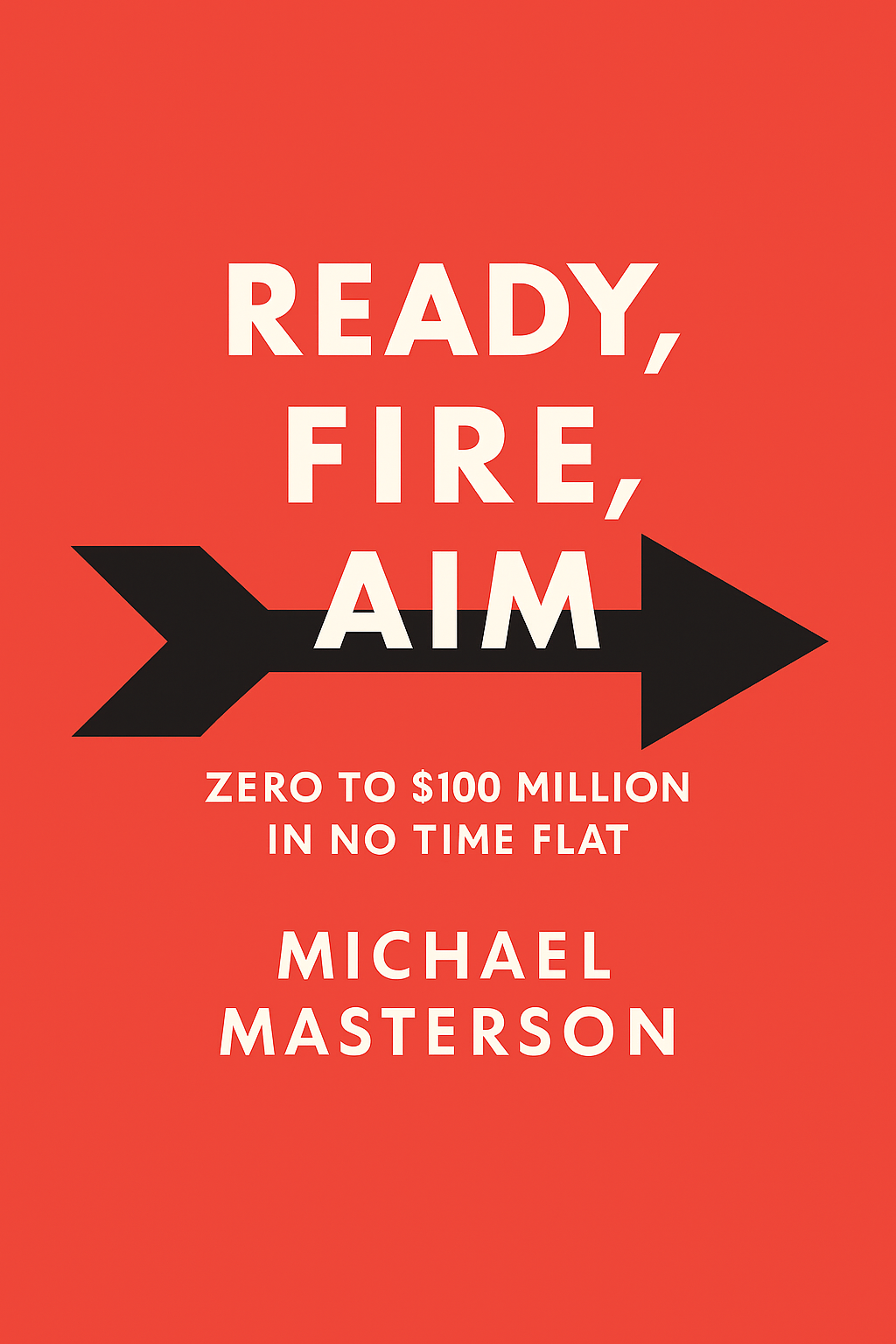
Ready, Fire, Aim
Zero to $100 Million in No Time Flat
Book Edition Details
Summary
Business dreams take flight with "Ready, Fire, Aim," a treasure trove of entrepreneurial wisdom penned by a self-made multimillionaire. This book offers a dynamic playbook for navigating the exhilarating phases of business growth. Michael Masterson, seasoned entrepreneur and bestselling author, distills decades of experience into actionable strategies designed to catapult small ventures into success stories. As you progress through its pages, you'll uncover the critical skills necessary to thrive in a competitive landscape, learn how to replicate triumphs across various enterprises, and unlock paths to financial independence. Whether launching your first endeavor or scaling an established one, this guide is your trusted companion in the relentless pursuit of business excellence.
Introduction
Picture yourself standing at the starting line of the most important race of your life. The traditional wisdom tells you to study every possible route, analyze every potential obstacle, and create the perfect strategy before taking your first step. But what if this approach is exactly what's keeping you from winning? In the fast-paced world of business building, the entrepreneurs who achieve extraordinary success aren't necessarily the ones with the most detailed plans—they're the ones who move quickly, learn constantly, and adapt fearlessly. While others spend months perfecting their strategies, true business builders understand a counterintuitive truth: sometimes the fastest path to success requires you to start before you feel completely ready. The marketplace rewards action over analysis, speed over certainty, and the courage to begin with incomplete information while learning and adjusting along the way.
Stage One: Master Selling to Build Your Foundation
The bedrock of every successful business empire rests on one fundamental skill that separates thriving companies from struggling startups: the ability to sell effectively. This isn't about high-pressure tactics or manipulation, but about genuinely connecting your solution with people who desperately need what you offer. At its essence, selling is the art of creating value exchanges that transform lives while building sustainable businesses. Consider the remarkable story of Jim Koch, who would later build The Boston Beer Company into a household name. When Koch called his uncle to share his excitement about his first batch of Samuel Adams beer aging in tanks, he expected congratulations. Instead, his uncle asked what he'd accomplished that day. Koch proudly explained he'd been shopping for a computer system to track sales and payables. His uncle's response was both brutal and brilliant: "Sales? Do you have any? I've seen more businesses go broke from lack of sales than lack of computers. Work on first things first." That conversation changed everything for Koch and illustrates a principle that transforms struggling entrepreneurs into successful business builders. Instead of continuing his search for the perfect computer system, Koch grabbed six bottles of his beer, walked into a nearby bar, and focused entirely on making his first sale. The terror of that moment transformed into pure ecstasy when the bar manager not only bought the beer but immediately ordered 25 cases. Koch discovered what every successful entrepreneur learns: selling is the direct interface between your product and your customers, the crucial feedback loop that drives everything forward. To master this foundation stage, you must commit 80 percent of your time, energy, and resources to selling activities. Everything else can wait. Find your ideal customers, understand exactly what they want, and deliver it at a price they're willing to pay. Test different approaches relentlessly, measure your results obsessively, and refine your process based on real market feedback rather than theoretical assumptions. Remember that your first million comes not from having the perfect product, but from developing an unstoppable selling system that consistently converts prospects into delighted customers.
Stage Two: Innovate at Speed for Explosive Growth
Once you've proven your ability to sell consistently and reached that crucial million-dollar milestone, everything changes. The strategy that built your foundation won't take you to the next level. You're entering a new phase where innovation becomes your competitive superpower, but not the kind of innovation most people imagine. This stage demands that you transform from a single-product company into a product-generating machine that creates and launches new offerings at unprecedented speed. The businesses that explode from one million to ten million dollars share a common trait: they become masters of what experts call "one step removed" innovation. They don't try to reinvent entire industries or create revolutionary breakthroughs. Instead, they take what's already working in the marketplace and make it slightly better, faster, or more convenient for their customers. Think of this as adding that final drop of water that causes an entire glass to overflow—small changes that create massive results. A newsletter publishing company perfectly demonstrates this principle in action. Starting with revenues around eight million dollars, they made a bold decision to enter the consumer investment newsletter market. Their strategy was elegantly simple: find what's working and create something similar but superior. They developed a digest of successful investment newsletters, offering readers the best ideas from multiple sources at half the price of individual subscriptions. Within one year, this single product grew from zero to 30,000 subscribers, generating over a million dollars in additional revenue and proving their innovation methodology. The breakthrough came when they realized this success wasn't about the specific product—it was about understanding their optimal innovation process. They had discovered how to identify market opportunities, develop products quickly, and launch them before competitors could respond. They then applied this same methodology to create dozens of additional products, each building on proven market demand while adding their unique value proposition. To implement this strategy effectively, you must embrace speed over perfection and testing over planning. Create systems that allow you to develop and launch new products in months rather than years. Focus your best creative talent on front-end products that attract new customers, while building systematic processes for profitable back-end offerings that serve your existing base. Most importantly, launch products at 80 percent completion rather than waiting for 100 percent perfection, then improve them based on real customer feedback and market response.
Stage Three: Build Systems That Scale Without You
As your business rockets past ten million dollars, you'll encounter a challenge that catches most entrepreneurs completely off guard. The very success you've worked so hard to achieve begins creating operational chaos that threatens to destroy everything you've built. Orders pile up, customers complain, employees scramble, and you find yourself working harder than ever while feeling less in control. This is where Stage Three mastery becomes essential: transforming from someone who does everything personally to someone who ensures everything gets done properly through others. The transition requires a fundamental shift in how you view your role and your company's structure. You must evolve from being the chief problem-solver to becoming the chief system-builder. Every critical process, from customer acquisition to product development to quality control, must be documented, systematized, and delegated to capable team members who can execute your vision without constant supervision. Consider the transformation experienced by a consulting business founder whose company had grown to nearly fifty million dollars through his personal relationships and hands-on involvement in every major decision. As revenues climbed, he realized that his direct involvement was actually becoming the biggest bottleneck in his own business. Clients were waiting weeks for decisions that only he could make, new opportunities were being missed, and his team was becoming frustrated by their inability to move forward without his constant approval. The breakthrough came when he implemented what he called "systematic delegation." Instead of trying to maintain control over every decision, he created clear frameworks and criteria that allowed his team members to make most decisions independently. He developed detailed processes for client onboarding, project management, and quality assurance that could be executed consistently regardless of who was handling the work. He established regular reporting systems that kept him informed without requiring his involvement in daily operations. The results were transformational and initially surprising. Not only did the business continue growing without his constant involvement, but client satisfaction actually improved because decisions were made faster and more consistently. The founder discovered he could focus his energy on strategic planning and business development while his team handled day-to-day operations with confidence and competence. To build these systems effectively, start by identifying the critical processes that drive your business success, document each step in detail, create comprehensive training materials, and establish clear metrics for measuring performance. Most importantly, resist the temptation to jump back in when problems arise, instead using challenges as opportunities to strengthen your systems and develop your team's capabilities.
Stage Four: Transform Into a Strategic Wealth Builder
The final stage of entrepreneurial evolution presents you with the ultimate challenge and opportunity: transitioning from business operator to wealth creator and strategic investor. At this level, your company has become a valuable asset in its own right, and your role fundamentally shifts from managing day-to-day operations to making strategic decisions about the business's future direction and long-term value creation. This transformation requires you to view your business through the lens of an outside investor rather than an involved operator. What is the company worth today? What factors could dramatically increase or decrease that value? How can you structure the business to maximize long-term wealth creation for all stakeholders while reducing your personal involvement in daily operations? These questions demand a completely different kind of thinking than the operational challenges you've mastered in previous stages. The story of two entrepreneurs who built their business to 135 million dollars illustrates this transition perfectly. When one partner wanted to retire after a heart attack, they faced a critical choice: sell the business and take the cash, or find a way to maintain ownership while reducing their day-to-day involvement. They chose a third option that transformed their understanding of wealth building and business structure. They broke their single large company into five separate profit centers, each run by capable managers they promoted from within their existing team. Instead of micromanaging these new entities, they established a governance structure where they met with each manager once monthly, providing strategic guidance and facilitating knowledge sharing across the different divisions. This structure allowed best practices and innovations to flow between units while giving each division the autonomy to innovate and grow according to market opportunities. The results exceeded their most optimistic expectations. Revenue growth actually accelerated, profitability improved across all divisions, and the overall business became more valuable than it had ever been as a single entity. Most importantly, they discovered they could create more value by stepping back strategically than they ever could by staying involved in daily operations. Their role evolved to focus on what only they could provide: vision, strategic direction, and the wisdom that comes from years of building successful businesses. To master Stage Four, you must develop comfort with ambiguity and deep trust in others' capabilities. Focus your energy on strategic decisions that only you can make: major acquisitions, key partnerships, long-term vision setting, and wealth optimization strategies. Create governance structures that protect the business's interests while empowering your team to execute brilliantly. Remember that your greatest contribution at this stage isn't your daily involvement, but your ability to see opportunities and threats that others might miss, and to make the bold decisions that position your business for continued growth and lasting prosperity.
Summary
The journey from startup to hundred-million-dollar enterprise isn't just about financial achievement—it's about personal transformation and the creation of lasting value for everyone your business touches. As one successful entrepreneur observed, "If you can teach yourself to welcome change, you can lead your business through each of the four stages of business growth." This insight captures the essence of entrepreneurial success: the willingness to evolve continuously, embrace new challenges, and develop new capabilities as your business demands them. The path forward requires courage over comfort, action over analysis, and the understanding that each stage builds upon the previous one while demanding entirely new skills and perspectives. Your next step is clear and immediate: identify which stage your business currently occupies, commit to mastering the specific skills that stage demands, and begin implementing those changes today. Whether you're perfecting your selling approach, building innovation systems, creating scalable operations, or transitioning to strategic wealth building, the time for action is now—start imperfectly, start immediately, but start with the confidence that each step forward teaches you something valuable about the next one.
Related Books
Download PDF & EPUB
To save this Black List summary for later, download the free PDF and EPUB. You can print it out, or read offline at your convenience.
By Michael Masterson
