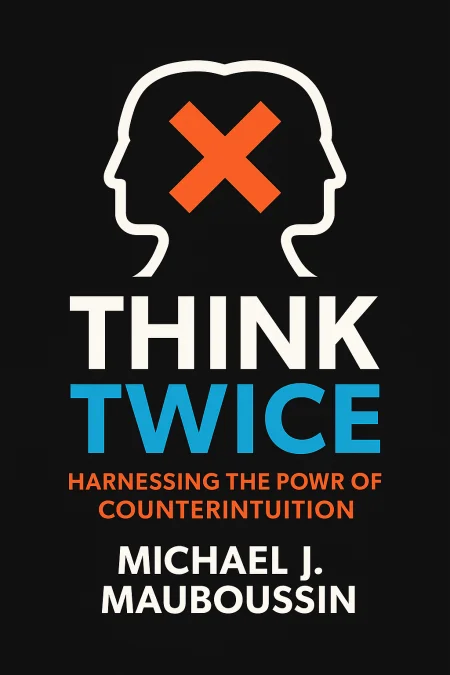
Think Twice
Harnessing the Power of Counterintuition
Book Edition Details
Summary
In the realm where critical decisions shape destinies, even the most astute leaders stumble, not from lack of intent but from unseen mental pitfalls. "Think Twice" by Michael Mauboussin unveils the cognitive traps that sabotage sound judgment, guiding you to sidestep these silent saboteurs. Through captivating anecdotes spanning various industries, Mauboussin elucidates how our brains misinterpret cause and effect, misjudge patterns, and overly rely on so-called experts. Yet, these errors are not inevitable. By challenging ingrained thinking and embracing counterintuitive strategies, this book equips you to refine your decision-making prowess. Master the wisdom of thinking twice, and transform your choices from precarious to precise, safeguarding both your leadership and your legacy.
Introduction
Human decision-making operates on predictable patterns, yet these patterns often lead us astray in complex modern environments. The fundamental premise examined here challenges a core assumption about intelligence: that smart people naturally make better decisions. Evidence consistently demonstrates that highly intelligent individuals frequently make spectacular errors, not despite their intelligence, but because of how their mental processes interact with contemporary challenges. The exploration centers on a critical distinction between two types of thinking systems. The first operates automatically and effortlessly, drawing on intuitive responses that served our ancestors well in simpler environments. The second requires deliberate effort and systematic analysis, often producing conclusions that feel counterintuitive but prove more accurate. Most decision-makers rely heavily on the first system, even in situations where the second would serve them better. This investigation employs a multidisciplinary approach, drawing insights from psychology, behavioral economics, neuroscience, and complex systems theory. Rather than offering simple prescriptions, it reveals the underlying mechanisms that drive poor decisions across diverse fields—from corporate boardrooms to medical offices, from investment strategies to personal choices. The analysis proceeds through systematic examination of common decision-making errors, their psychological origins, and practical methods for recognition and mitigation.
The Cognitive Traps: Why Smart People Make Predictable Mistakes
Intelligence quotient tests measure certain cognitive abilities effectively, but they fail to assess the mental flexibility and calibration skills essential for quality decision-making. The disconnect between measured intelligence and decision quality stems from fundamental design features of human cognition. Our minds evolved to handle immediate, concrete problems in small social groups, not the abstract, probabilistic challenges of modern life. The inside view versus outside view represents a crucial cognitive divide. Most people naturally focus on the specific details of their current situation—the inside view—while neglecting the broader statistical patterns revealed by similar situations—the outside view. This tendency explains why acquisition-minded executives remain optimistic despite overwhelming evidence that most mergers destroy shareholder value, or why patients choose treatments based on compelling anecdotes rather than clinical evidence. Three psychological illusions compound this problem. The illusion of superiority leads people to believe they perform better than average across various domains, a statistical impossibility for entire populations. The illusion of optimism creates expectations of disproportionately positive future outcomes. The illusion of control generates confidence in managing chance events, as demonstrated by lottery players who believe their number selection strategies matter. These cognitive biases interact with systematic planning failures. Research consistently shows that people underestimate both the time and resources required for projects, even when they possess relevant experience. The planning fallacy occurs because individuals focus on their specific situation rather than consulting base rates from similar projects. Interestingly, people predict others' project timelines more accurately than their own, suggesting the solution lies in shifting perspective rather than gathering more information.
Beyond Intuition: When Experts, Crowds, and Models Outperform
Traditional reliance on human expertise faces increasing challenges from algorithmic approaches and collective intelligence. The expert squeeze phenomenon reveals that in many domains, mathematical models and diverse crowds consistently outperform individual experts, even those with impressive credentials and extensive experience. This shift reflects not a failure of human intelligence, but a mismatch between the types of problems experts evolved to solve and the analytical challenges of modern decision-making. Different problem types require different solution approaches. Rule-based problems with limited outcomes often yield to algorithmic solutions once experts identify the underlying patterns. Wine quality prediction exemplifies this transition—mathematical models based on weather data consistently outperform expert tasters for young wines. Probabilistic problems with wide outcome ranges benefit from crowd wisdom when diversity, aggregation, and incentives align properly. The wisdom of crowds operates through a fundamental mathematical principle: collective error equals average individual error minus prediction diversity. This relationship explains why diverse groups often outperform even their most capable members. The diversity prediction theorem demonstrates that reducing collective error requires either improving individual accuracy or increasing prediction diversity. Both components contribute equally to group performance. However, crowd wisdom fails when diversity breaks down. Social influence, information cascades, and coordination create conditions where collective intelligence collapses into collective folly. Financial bubbles, fashion trends, and political movements illustrate how positive feedback loops can override individual judgment. Recognition of these breakdown conditions becomes essential for knowing when to trust collective intelligence and when to seek alternative approaches.
Context and Complexity: How Situations and Systems Shape Outcomes
Environmental factors exert profound influence on decision-making, often operating below conscious awareness. Contextual priming demonstrates how seemingly irrelevant stimuli shape choices—background music influences wine purchases, ambient scents affect cleanliness behavior, and visual elements bias product preferences. These effects occur automatically, making them particularly difficult to detect and counter. Default options wield enormous power over decision outcomes. Organ donation rates vary dramatically between countries with opt-in versus opt-out systems, despite similar underlying attitudes toward donation. Choice architecture—how options are presented and structured—can nudge people toward particular decisions without restricting their freedom to choose otherwise. This phenomenon reveals the myth of context-independent choice. Situational power extends beyond simple priming effects to fundamental attribution errors. People consistently underestimate situational influences while overattributing behavior to individual character traits. Classic experiments in social psychology demonstrate how ordinary individuals can be induced to engage in extraordinary behaviors—both positive and negative—through situational manipulation. Understanding these dynamics proves crucial for evaluating both one's own decisions and the actions of others. The confirmation bias and selective exposure compound situational influences by filtering information to match existing beliefs. Brain imaging studies reveal that partisans literally see different realities when processing identical information. These perceptual differences occur not through conscious reasoning but through automatic emotional and attentional processes. Recognizing the power of the situation requires active effort to counteract natural tendencies toward selective perception and attribution.
From Skill to Luck: Managing Uncertainty and Reversion to Mean
Distinguishing skill from luck presents one of the most challenging aspects of decision evaluation. Most outcomes result from some combination of these factors, yet human psychology systematically misattributes results. Success gets credited to skill while failure gets blamed on bad luck, creating systematic biases in learning and adjustment. Reversion to the mean represents a statistical phenomenon where extreme outcomes tend to be followed by more average results. This pattern occurs naturally in any system where outcomes depend partly on chance, regardless of underlying skill levels. Understanding mean reversion proves essential for evaluating performance in business, sports, education, and other domains where luck plays a role. The halo effect demonstrates how outcome-based thinking distorts perception of underlying factors. When companies perform well, observers attribute success to leadership, strategy, and culture. When the same companies later perform poorly, these identical factors get blamed for the decline. Media coverage particularly suffers from this bias, creating misleading narratives about success and failure that ignore random variation. Three types of reversion-related mistakes plague decision-makers. First, people believe they are special and exempt from mean reversion patterns observed in others. Second, they misinterpret statistical regression as evidence of declining standards rather than natural variation around stable means. Third, they provide feedback based on outcomes rather than focusing on the controllable aspects of performance processes.
Summary
The central insight emerging from this analysis reveals that optimal decision-making often requires approaches that feel unnatural and counterintuitive to the human mind. Our cognitive equipment, admirably suited for ancestral environments, systematically misleads us in contemporary contexts characterized by complexity, uncertainty, and delayed feedback. Recognition of these limitations, combined with systematic application of corrective techniques, offers substantial opportunities for improvement across personal and professional domains. This work serves readers seeking to understand not just what decisions to make, but how the decision-making process itself can be enhanced through awareness of its inherent biases and systematic application of evidence-based alternatives.
Related Books
Download PDF & EPUB
To save this Black List summary for later, download the free PDF and EPUB. You can print it out, or read offline at your convenience.
By Michael J. Mauboussin
