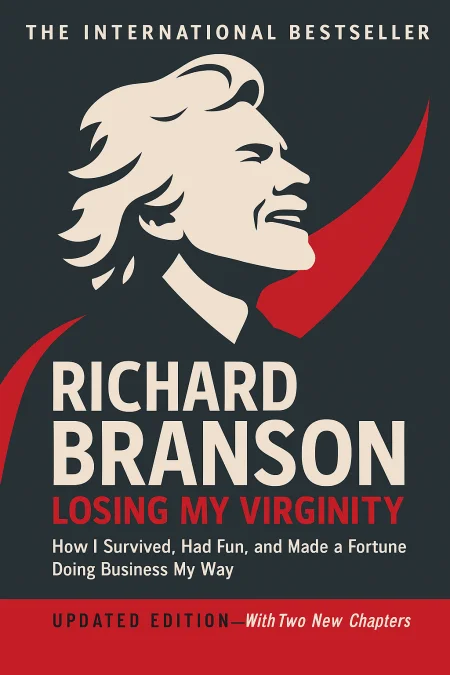
Losing My Virginity
How I Survived, Had Fun, and Made a Fortune Doing Business My Way
Book Edition Details
Summary
Richard Branson's "Losing My Virginity" unfolds like an electrifying tale of audacious innovation and fearless adventure, charting the meteoric rise of a rebel entrepreneur who defied the odds and redefined business success. In just a quarter of a century, Branson orchestrated a hundred ventures across industries, from airlines and music to soft drinks and beyond, each venture a testament to his uncanny ability to spot opportunities amidst chaos and complacency. With a life as colorful as his enterprises, Branson's narrative interweaves high-octane escapades—crash-landing hot-air balloons, battling corporate giants like British Airways, and orchestrating daring rescues—with the strategic brilliance of a self-made titan who values fun and freedom as much as fortune. This is more than an autobiography; it's a riveting manifesto for those who dare to dream big and live even bigger.
Introduction
In the early hours of January 7, 1997, Richard Branson found himself writing what could have been his final letter to his children, preparing for what many considered a foolhardy attempt to circumnavigate the globe in a hot-air balloon. This moment of vulnerability reveals the essence of a man who has spent his life pushing boundaries and embracing the impossible. From a dyslexic teenager who struggled in school to the founder of one of the world's most recognizable brands, Branson's journey embodies the spirit of entrepreneurial adventure that defined the late 20th century. Branson emerged during an era of unprecedented change, when traditional business models were being shattered and young entrepreneurs could build empires from their bedrooms. His story unfolds against the backdrop of Britain's transformation from a post-war society into a modern, dynamic economy where youth culture and business innovation collided to create entirely new industries. Through his experiences, readers discover not merely the mechanics of building a business empire, but the fundamental principles of leadership that prioritize people over profit, adventure over security, and purpose over convention. His narrative offers insights into the art of calculated risk-taking, the power of brand building through authentic values, and the importance of maintaining humanity in the face of massive success.
From Student Revolutionary to Virgin Records Pioneer
Richard Branson's entrepreneurial journey began not in a boardroom, but in the basement of his friend's parents' house in 1967, where two seventeen-year-old schoolboys decided to launch a magazine that would give voice to their generation. Student magazine emerged during the height of 1960s counterculture, when young people were challenging authority and demanding change. Branson, despite struggling with dyslexia and feeling like an outsider in the traditional academic environment of Stowe School, possessed an innate understanding that his generation needed a platform to express their views on everything from the Vietnam War to social justice. The magazine's creation revealed Branson's early mastery of what would become his signature approach to business: identifying unmet needs and filling them with passion and creativity rather than vast capital. Operating from cramped quarters with a team of volunteers, Branson learned to charm advertisers over the phone, secure interviews with major figures like Mick Jagger and John Lennon, and create a publication that felt authentic to its readers. His natural ability to connect with people, combined with an almost reckless optimism, allowed Student to punch far above its weight, attracting contributors and attention that established publications envied. When postal strikes threatened to destroy their mail-order record business in 1971, Branson made a pivotal decision that would define his career: rather than retreat, he opened Virgin's first record shop on Oxford Street. This moment marked the transformation from idealistic publisher to serious entrepreneur. The shop embodied everything Branson believed business should be – welcoming, innovative, and focused on customer experience rather than mere transactions. Customers could lounge on cushions, listen to music for hours, and feel part of a community rather than just consumers in a sterile retail environment. The evolution from Student magazine to Virgin Records demonstrated Branson's ability to recognize when one chapter must end for another to begin. Though Student never achieved financial success, it provided invaluable lessons in brand building, customer connection, and the power of authentic communication. These principles would prove essential as Virgin expanded from a single record shop into a music empire that would eventually challenge the industry's biggest players.
Taking Flight: Virgin Atlantic and Industry Disruption
The 1980s found Branson at a crossroads where his business success enabled him to pursue increasingly ambitious challenges that seemed to have little connection to selling records. His decision to enter the airline industry appeared to many as the folly of a wealthy entrepreneur seeking new thrills. However, the creation of Virgin Atlantic revealed a deeper strategic understanding of how extraordinary vision could build brand value and capture public imagination in ways that traditional business expansion never could. The launch of Virgin Atlantic in 1984 represented everything Branson stood for: challenging established monopolies, putting customer experience first, and refusing to accept that business had to be boring. While British Airways offered functional but uninspiring service, Virgin Atlantic introduced innovations that seem obvious in retrospect but were revolutionary at the time – better food, more entertainment, and flight attendants who actually seemed to enjoy their jobs. Branson understood that people didn't just want to get from point A to point B; they wanted to feel valued and entertained during the journey. The early years of Virgin Atlantic were marked by financial struggles that nearly bankrupted the entire Virgin Group, compounded by British Airways' systematic campaign to destroy the upstart competitor. What became known as the "dirty tricks" affair revealed the lengths to which established players would go to maintain their market dominance. Rather than retreat in the face of this corporate warfare, Branson chose to fight back through the courts and the media, ultimately winning a landmark libel case that vindicated his belief that business should be conducted with integrity. The airline's survival and eventual success proved that even in capital-intensive industries, a small company with big ideas could compete against giants. Branson's willingness to risk everything for his principles, whether fighting British Airways' predatory tactics or maintaining Virgin's commitment to superior customer service, demonstrated that David could indeed defeat Goliath when armed with courage, creativity, and genuine care for customers. This victory established Virgin Atlantic as more than just an airline; it became a symbol of entrepreneurial determination and fair competition.
Building a Global Brand Through Bold Risk-Taking
The transformation of Virgin from a British music company into a global brand required Branson to master the art of calculated risk-taking on an unprecedented scale. His approach to international expansion demonstrated his understanding that global brands must adapt to local markets while maintaining their core identity. Rather than imposing a rigid corporate structure, Branson empowered local entrepreneurs to build Virgin businesses that reflected his values while serving their specific markets, creating a network of companies that felt authentically Virgin while remaining responsive to local customer needs. Branson's willingness to enter seemingly unrelated industries defied conventional business wisdom, which typically advocates focusing on core competencies. Instead, he identified common threads that connected Virgin's various ventures: a commitment to customer service, a willingness to challenge established players, and an emphasis on making business fun for both employees and customers. Whether launching Virgin Cola against Coca-Cola or entering financial services with Virgin Money, Branson consistently targeted industries where customers felt underserved by complacent incumbents. The key to Virgin's successful diversification lay in Branson's partnership strategy and organizational structure. Rather than building a traditional conglomerate, he created a network of semi-autonomous companies, each with its own management team and equity structure. This approach allowed Virgin to enter new markets quickly while maintaining the entrepreneurial spirit that had driven its initial success. Partners brought industry expertise and capital, while Virgin contributed its brand recognition and customer-focused philosophy. Throughout this period of rapid expansion, Branson maintained his hands-on management style and his commitment to treating employees as partners rather than subordinates. His practice of involving staff in decision-making, sharing profits through equity participation, and creating work environments that prioritized fun alongside productivity became central to the Virgin brand identity. This approach proved that successful companies could maintain their entrepreneurial culture even as they grew into major corporations, provided their leaders remained committed to the values that originally defined them.
Environmental Champion and Social Entrepreneur
As Virgin matured into a global brand, Branson began to grapple with the environmental and social implications of his business empire. The turning point came when Al Gore visited his London home to deliver a personal presentation on climate change. This encounter transformed Branson from a successful businessman into what he calls a "social entrepreneur," someone who uses business methods to address global challenges. His environmental awakening led to his pledge to invest billions in developing clean fuels and fighting climate change, demonstrating how successful entrepreneurs could use their resources and platforms to address humanity's greatest challenges. The establishment of Virgin Unite marked Branson's formal entry into philanthropy and social entrepreneurship. Unlike traditional charity work, Virgin Unite focuses on using business principles to create sustainable solutions to global problems. Projects have included fighting HIV/AIDS in Africa, supporting education initiatives, and developing innovative healthcare delivery systems. Branson's approach to social problems mirrors his business philosophy: identify unmet needs, find innovative solutions, and create systems that can scale and sustain themselves. Perhaps most ambitiously, Branson helped establish The Elders, a group of respected global leaders including Nelson Mandela and Archbishop Desmond Tutu, who work to resolve conflicts and address humanitarian crises. This initiative reflects Branson's belief that business leaders have a responsibility to use their resources and influence to tackle the world's most pressing challenges. It also demonstrates how his networking skills and talent for bringing people together, originally developed in the music industry, could be applied to global diplomacy and social change. The integration of social responsibility into Virgin's business model, from environmental initiatives to employee welfare programs, illustrated Branson's belief that successful companies must contribute positively to society. His advocacy for entrepreneurship as a force for social good, combined with his willingness to use Virgin's platform to address political and social issues, established him as a business leader who understood that corporate success and social responsibility were not competing objectives but complementary aspects of sustainable enterprise.
Summary
Richard Branson's extraordinary journey from dyslexic schoolboy to global business icon demonstrates that the most powerful entrepreneurial weapon is not capital or connections, but the courage to challenge conventional wisdom while maintaining unwavering focus on customer satisfaction and employee fulfillment. His story reveals that sustainable business success comes not from pursuing profit above all else, but from building organizations that create value for all stakeholders while remaining true to their founding principles. For aspiring entrepreneurs, Branson's career offers two essential lessons: first, that the greatest opportunities often exist in industries where customers are underserved by complacent incumbents, and second, that maintaining company culture and values becomes more critical, not less, as organizations grow and face increasing complexity. His legacy suggests that the most successful business leaders of the future will be those who can combine entrepreneurial innovation with social responsibility, creating enterprises that generate both financial returns and positive impact on the world.
Related Books
Download PDF & EPUB
To save this Black List summary for later, download the free PDF and EPUB. You can print it out, or read offline at your convenience.
By Richard Branson
