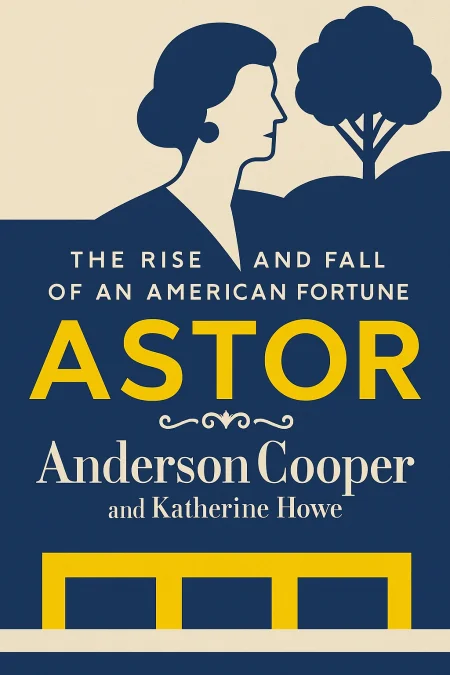
Astor
The Rise and Fall of an American Fortune
byAnderson Cooper, Katherine Howe
Book Edition Details
Summary
In the glittering corridors of America's past, one family name echoes with tales of ambition and opulence: the Astors. Anderson Cooper and Katherine Howe invite readers into an enthralling tapestry of American legacy, where fortunes were built on the fur trade and solidified in Manhattan's bedrock. This isn't just a story of wealth—it's a saga of reinvention, as the Astors weathered societal tides, from their zenith in Gilded Age splendor to the shadows cast by scandal. With vivid portraits and historical insight, "Astor" unveils the triumphs and tragedies that shaped not just a dynasty, but the very fabric of a nation. Here lies a narrative as grand as the American dream itself, infused with the resilience and allure of its time.
Introduction
In the predawn darkness of April 15, 1912, as the RMS Titanic disappeared beneath the icy Atlantic waters, the death of John Jacob Astor IV marked more than a maritime tragedy—it symbolized the twilight of America's first great dynasty. The richest man aboard that doomed vessel represented the culmination of over a century of wealth accumulation that had fundamentally shaped American capitalism and society. The Astor story reveals how great American fortunes are truly built and why they inevitably crumble. From the blood-soaked fur trade that generated initial wealth to the glittering ballrooms where social hierarchies were enforced, from the tenement slums that produced rental income to the philanthropic foundations that marked the dynasty's final act, this family's trajectory illuminates the hidden mechanics of power in American society. Their rise demonstrates the ruthless efficiency required to build vast wealth, while their fall exposes the social forces that ultimately challenge even the most entrenched privilege. This chronicle speaks to anyone seeking to understand how extreme wealth shapes generations, how democratic societies grapple with inherited aristocracy, and why the concentration of vast resources in few hands creates tensions that reverberate across centuries. The Astor legacy offers profound insights into the cyclical nature of American capitalism and the eternal struggle between private accumulation and public responsibility.
Empire Foundations: From Fur Trade to Manhattan Monopoly (1784-1848)
When Johann Jakob Astor arrived at New York Harbor in 1784, he carried little beyond musical instruments and immigrant determination. Yet within decades, this German butcher's son had transformed into John Jacob Astor, America's richest man, through a combination of visionary thinking and ruthless execution that would define American capitalism for generations. Astor's genius lay in recognizing that the North American wilderness represented an untapped reservoir of wealth waiting to be systematically extracted. His American Fur Company became a machine of exploitation, using alcohol and debt to manipulate Indigenous peoples while building a trading network that stretched from the Great Lakes to the Pacific Coast. The company's agents spread rumors, undercut government trading posts, and employed what contemporaries called their most effective weapon—whiskey sold at astronomical prices to create dependency and ensure loyalty. The foundation of Astor's empire rested on understanding leverage and control. He advanced goods to trappers on credit, creating cycles of debt that bound them to his enterprise while minimizing his own risk. When they returned with furs, they often owed more than their catch was worth, feeding a perpetual system that concentrated wealth upward while dispersing risk downward. This model would become the template for American industrial capitalism. Astor's masterstroke was his prescient pivot from fur to Manhattan real estate. As New York expanded northward, he systematically acquired land that seemed worthless, then waited for urban development to generate astronomical returns. His rental empire, built on long-term leases that reverted improved properties back to Astor ownership, created a perpetual wealth-generating machine. By his death in 1848, he controlled vast swaths of Manhattan and left an estate worth roughly one-fifteenth of all personal wealth in America, establishing the foundation upon which his descendants would build their social empire.
Gilded Age Supremacy: Social Power and Cultural Dominance (1849-1912)
The transformation of Astor wealth from mere money into social power reached its zenith under Caroline Schermerhorn Astor, who became known simply as "the Mrs. Astor." Her Fifth Avenue mansion served as the epicenter of American society, where she wielded unprecedented influence over who belonged to the nation's emerging aristocracy and who remained forever excluded from its inner circles. Caroline's revolutionary innovation was creating artificial scarcity around social acceptance. Her famous "Four Hundred" represented not just the capacity of her ballroom, but the principle that true society must be exclusive to maintain its value. Working alongside social arbiter Ward McAllister, she established the "three-generation rule"—new money had to age for three generations before achieving full social acceptance. This system allowed established families to maintain their position while selectively admitting worthy newcomers, creating a self-perpetuating elite that controlled not just wealth but cultural legitimacy. The Astor influence extended far beyond ballrooms into the very architecture of American social life. The family pioneered the luxury hotel industry with the Waldorf-Astoria, transforming elite entertainment from private homes into semi-public spaces where anyone with sufficient money could purchase access to aristocratic experiences. This democratization of luxury fundamentally altered American society's relationship with wealth and status, creating theaters where the elite performed their superiority for an increasingly fascinated public audience. Yet even at the height of their social dominance, contradictions were emerging within the Astor edifice. Family feuds over precedence and titles revealed the artificial nature of their aristocratic pretensions, while public resentment grew over their vast tenement holdings and apparent indifference to urban poverty. The earlier Astor Place Riot had already demonstrated that their wealth made them targets of class anger, foreshadowing the social upheavals that would eventually undermine their position. The death of John Jacob Astor IV on the Titanic, following scandals surrounding his divorce and remarriage to eighteen-year-old Madeleine Force, marked the beginning of the end for America's most powerful dynasty.
Decline and Transformation: Wars, Scandals, and Philanthropic Legacy (1912-2007)
The sinking of the Titanic symbolized more than John Jacob Astor IV's death—it marked the beginning of his family's long transformation from American royalty to historical footnote. The succession crisis following his death, complicated by an unequal will that left the bulk of wealth to his son Vincent while providing smaller inheritances to his widow and unborn child, fractured family unity and bred lasting resentment that would plague the dynasty for generations. World War I accelerated the family's dissolution as changing social values made conspicuous consumption seem unpatriotic and vulgar. The rise of income taxes and estate duties, designed specifically to break up concentrated wealth, began systematically eroding the Astor fortune. Meanwhile, the family's British branch pursued aristocratic titles and European respectability, effectively abandoning their American roots and responsibilities. This geographic and cultural dispersion weakened collective identity and political influence just when both were most needed to maintain dynastic power. Vincent Astor inherited not just vast wealth but the burden of justifying its existence in an increasingly democratic America. Unlike his predecessors who focused on accumulation, Vincent began systematically divesting the family's slum properties and redirecting resources toward charitable causes. He established playgrounds in Harlem, funded children's hospitals, and eventually created the Vincent Astor Foundation. This shift reflected both personal conscience and practical recognition that extreme wealth concentration was becoming politically untenable in twentieth-century America. The dynasty's final act played out through Brooke Astor, whose marriage to Vincent transformed her from middle-class widow into America's most celebrated philanthropist. As head of the Vincent Astor Foundation, she distributed over two hundred million dollars to New York institutions, understanding that philanthropy was essential for maintaining social relevance and public affection. Yet the family's ultimate scandal emerged when her son Anthony Marshall was accused of exploiting his aging mother's diminished capacity to redirect her fortune away from charity toward his own family. Brooke's death in 2007 and the subsequent legal battles marked the effective end of the Astor dynasty, with the fortune that had once seemed inexhaustible finally dissipated through philanthropy, legal fees, and family conflict.
Summary
The Astor dynasty's two-century journey from immigrant ambition to aristocratic decline reveals fundamental tensions within American capitalism and democracy. Their story demonstrates how extreme wealth concentration can create temporary dynasties that ultimately cannot sustain themselves across generations, as each era brings new challenges to inherited privilege and social legitimacy that even the vastest fortunes cannot indefinitely overcome. The family's trajectory offers crucial insights for contemporary debates about wealth inequality and social responsibility. Their philanthropic evolution suggests that extreme wealth can serve broader social purposes, but only when wielded by individuals who understand their obligations to the communities that enabled their prosperity. The Astors' ultimate dissolution demonstrates that in a democratic society, no family's power can endure without earning continued public acceptance through genuine service rather than mere accumulation or social performance. For modern readers grappling with similar questions about concentrated wealth and democratic governance, the Astor saga provides both warning and guidance. It suggests that sustainable prosperity requires constant adaptation to changing social expectations, authentic engagement with community needs, and recognition that privilege carries responsibilities as well as opportunities. Most importantly, their story reminds us that the forces of social change and democratic pressure, while sometimes slow to manifest, ultimately prove more powerful than even the most carefully constructed dynasties, offering hope that extreme inequality need not become permanent feature of American society.
Related Books
Download PDF & EPUB
To save this Black List summary for later, download the free PDF and EPUB. You can print it out, or read offline at your convenience.
By Anderson Cooper
