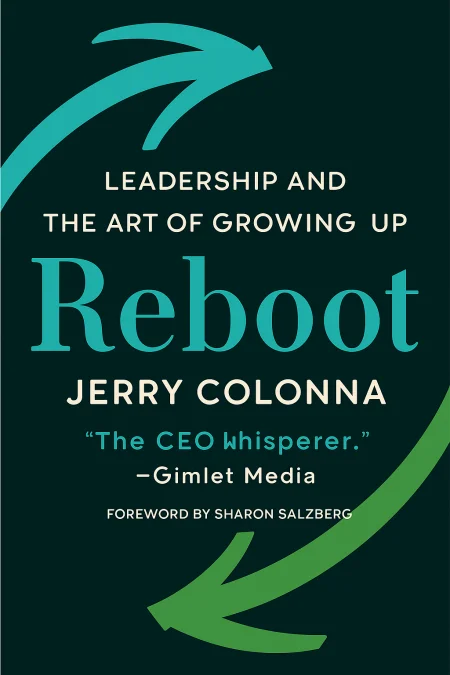
Reboot
Leadership and the Art of Growing Up
Book Edition Details
Summary
In a world driven by relentless ambition, Jerry Colonna emerges as the sage of Silicon Valley, transforming the way leaders see themselves and their work. "Reboot" unveils his riveting approach to leadership, marrying the introspective wisdom of Buddhism with the sharp insights of Jungian therapy. Colonna, the revered "CEO Whisperer," dismantles the myths of professional success by turning the spotlight inward, urging us to confront the very demons that both fuel our drive and corrode our connections. This compelling narrative invites you on a transformative journey of radical self-inquiry, promising not just professional triumph but profound personal growth. Through Colonna's candid storytelling, discover a new paradigm where leadership is not about conquest but compassion, not about power but purpose. Here, work becomes a canvas for realizing our truest selves, crafting leaders who are not only effective but empathetic and bold. "Reboot" is a call to reset, to forge meaningful bonds, and to redefine success on your own terms.
Introduction
There was a moment when everything felt like it was falling apart. Standing on the edge of Ground Zero in 2002, surrounded by the ping-ping-ping of heavy equipment moving debris that had once been the twin towers, a successful venture capitalist found himself gasping for air, choking on panic despite having achieved everything he thought he wanted. He was wealthy, respected, powerful—yet he felt hollow, barely occupying his own life. In that moment of crisis, he reached for his phone and called his therapist: "Get in a cab and come see me. Get here now." This story of breakdown and breakthrough illuminates a profound truth that challenges everything we think we know about leadership. We live in a world that tells us success comes from doing more, moving faster, accumulating wealth and status. But what happens when we achieve all of that and still feel empty inside? What happens when the very strategies that helped us survive childhood—the hypervigilance, the people-pleasing, the relentless drive—become the prison bars that trap us in adulthood? The journey from surviving to thriving requires us to confront uncomfortable truths about ourselves. It demands that we stop running from our fears and instead turn toward them with curiosity and compassion. Most importantly, it asks us to recognize that the path to authentic leadership isn't about perfecting our external performance—it's about courageously exploring our inner landscape and learning to lead from a place of wholeness rather than brokenness. This exploration reveals that better humans make better leaders, and the process of learning to lead well can help us become better humans. By growing to meet the demands of leadership, we're presented with the chance to finally, fully grow up.
From Monopoly to Ground Zero: The False Promise of Success
The boy loved playing Monopoly with his mother, especially on rainy days in their crowded Brooklyn apartment. While other players would lay their money out in neat stacks for all to see, he kept his hidden under the game board, tracking it all in his head. When the moment came, he would surprise everyone by buying up their properties when they went bankrupt. "Look how clever I am," his actions seemed to say. "Look how I can use being unseen to survive and thrive." This childhood game became a metaphor for an entire approach to life. The boy learned that money meant safety—it meant lemon drops from his grandfather's house, the smell of fresh coffee and roses, the feeling of being warm and protected. In a household where his father's job loss created fear and his mother's mental illness created chaos, accumulating resources became synonymous with survival itself. Decades later, that boy had won the ultimate game of Monopoly. He'd become a successful venture capitalist, wealthy beyond his childhood dreams. Yet standing at Ground Zero, surrounded by the wreckage of September 11th, he realized that all his careful accumulation had not filled the hole in his chest. The lemon drops he'd spent his life collecting had not made him feel truly safe, truly seen, truly at peace. The false promise of external success is that it will heal our internal wounds. But our deepest fears and longings cannot be satisfied by achievements alone. The very strategies we developed to feel loved, safe, and that we belong—the hypervigilance, the need to prove ourselves, the belief that our worth depends on what we do rather than who we are—often become the obstacles to genuine fulfillment. True leadership begins when we stop using our work to fill the empty spaces inside us and start leading from a place of authentic wholeness.
Standing Still and Finding the Warrior Within
After years of racing through life at breakneck speed, constantly moving from task to task with sweat beading on his temples, the moment of reckoning came not in a boardroom but in a hospital room. The venture capitalist had collapsed on a beach, struck down by blinding headaches that no medical test could explain. His therapist had a different diagnosis: his body was trying to get his attention, trying to force him to stop and listen to what his soul had been trying to tell him for years. The prescription was radical in its simplicity: stand still. Not just physically, but mentally and spiritually. Learn to be present with whatever arises, even if it's uncomfortable. This meant giving up the addiction to motion that had defined his life—the belief that his worth depended on constant productivity, that stopping would mean falling behind, that being still was somehow dangerous or lazy. Standing still revealed something unexpected: the warrior within. Not the aggressive, domineering figure that popular culture often associates with warriors, but something far more powerful—someone with a strong back and an open heart. A warrior who could face reality without flinching, who could hold space for others' pain without trying to fix it, who could lead from a place of centered calm rather than anxious reactivity. This warrior stance became a practice: feet planted firmly on the ground, back straight but not rigid, arms at the sides with palms open, heart exposed but protected by inner strength. It's the posture of someone who has learned to meet the world as it is rather than as they wish it were, someone who can stay present even when everything feels like it's falling apart. The emergence of the warrior within transforms how we understand strength itself. True strength isn't about never feeling afraid—it's about feeling the fear and choosing to act with integrity anyway. It's about learning that we don't have to choose between being strong and being vulnerable, between being decisive and being open to input, between leading with authority and leading with heart.
Loving the Crow: Embracing Our Shadows as Leaders
Every writer knows about the Crow—that harsh inner critic that sits on your shoulder, squawking about how terrible your work is, how you're not good enough, how everyone will discover you're a fraud. For leaders, this Crow takes on additional responsibilities: questioning every decision, catastrophizing about potential failures, whispering that you don't belong in the room with the real leaders. One CEO described her relationship with her Crow perfectly: "I hate the fucking product. I wake up, grab the app, and feel sick. I want to tear everything apart and start all over." This wasn't about the actual quality of her work—it was about the voice inside her head that could never be satisfied, that turned every achievement into evidence of her inadequacy. The conventional approach is to try to silence the Crow, to push through its criticism with willpower and positive thinking. But this creates an exhausting internal war, and the Crow always wins eventually because it's part of us. The breakthrough comes when we learn to listen to what the Crow is actually trying to do: protect us from the pain of rejection, failure, and abandonment. When we can approach the Crow with curiosity instead of hostility, we discover something remarkable. That harsh inner critic actually carries gifts—heightened awareness, attention to detail, the ability to anticipate problems before they occur. These qualities, when properly integrated, become superpowers for leadership. Learning to love the Crow means embracing our full humanity, including the parts of ourselves we'd rather not acknowledge. It means recognizing that our greatest strengths and our deepest wounds often spring from the same source. The hypervigilance that helped us survive difficult childhoods can become the empathy that makes us great coaches and mentors. The perfectionism that torments us can become the discernment that helps us make excellent decisions. When leaders learn to work with their shadows instead of against them, they stop projecting their disowned qualities onto others and start building organizations where people can bring their whole selves to work. They create cultures of belonging where everyone's humanity is welcomed, not just the polished professional persona.
Heartbreak and Equanimity: The Path to Adult Leadership
The polar explorer had been on the ice for weeks, struggling across the brutal landscape of Antarctica, trying to complete the journey his friend and mentor had died attempting. The wind-carved ridges called sastrugi made every step treacherous, and he was running dangerously low on food. During a satellite phone call from the middle of nowhere, something shifted in his voice as he talked about his fiancée waiting at home: "I've now got someone to come home to." In that moment, he discovered what he'd been searching for in all those expeditions to the most desolate places on Earth. He hadn't been seeking danger or glory—he'd been looking for home. The realization that home wasn't a place but a feeling of belonging, of being known and loved exactly as he was, changed everything about his relationship to risk and adventure. This is the paradox of adult leadership: we must be willing to have our hearts broken open by the everyday challenges of caring for others, of building something meaningful, of taking responsibility for outcomes we can't fully control. Every leader will face moments of devastating disappointment—companies that fail, employees who quit, dreams that don't materialize. The question isn't whether heartbreak will come, but what we'll do with it when it arrives. We can let it close our hearts, making us cynical and defensive, or we can let it deepen our capacity for compassion and wisdom. True resilience isn't about bouncing back to where we were before—it's about integrating the lessons of heartbreak and emerging more whole. Equanimity doesn't mean being emotionally flat or pretending that nothing bothers us. It means developing the capacity to remain centered and responsive rather than reactive, even in the face of uncertainty and loss. It's the quality that allows leaders to hold steady during storms, to make difficult decisions with clarity rather than fear, and to create environments where others feel safe enough to take risks and be creative. The path to this kind of leadership maturity requires us to stop running from difficulty and instead learn to metabolize it into wisdom. When we can sit with our own suffering without drowning in it, we become capable of holding space for others' struggles without trying to fix them or run away. This is how we graduate from managing our fears to leading from our hearts.
Summary
The journey from surviving to thriving as a leader is ultimately the journey from childhood to full adulthood. It requires us to examine the strategies we developed early in life to feel loved, safe, and like we belong, and to recognize when those same strategies have become obstacles to authentic leadership and genuine fulfillment. Standing still in a culture of constant motion takes tremendous courage, but it's the only way to hear what our souls have been trying to tell us beneath all the noise of external expectations and internal criticism. When we learn to listen deeply—to ourselves and others—we discover that our greatest wounds often carry our greatest gifts, and our most shameful secrets often hold the keys to our most powerful contributions. The work of becoming a whole leader is not a destination but a practice. It asks us to show up fully to each moment, to remain curious about our reactions and patterns, to approach our fears and failures with compassion rather than judgment. It challenges us to build organizations that honor the full humanity of everyone involved, creating spaces where people can grow into their best selves while doing meaningful work together. In learning to lead others with authenticity and heart, we finally learn to lead ourselves with the dignity and grace that were our birthright all along.
Related Books
Download PDF & EPUB
To save this Black List summary for later, download the free PDF and EPUB. You can print it out, or read offline at your convenience.
By Jerry Colonna
