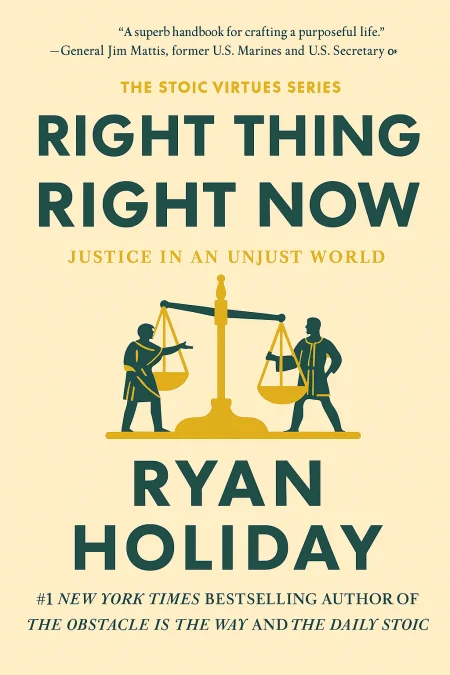
Right Thing, Right Now
Goodness to Greatness
Book Edition Details
Summary
In a world teetering on moral ambiguity, Ryan Holiday’s "Right Thing. Right Now." is a clarion call to the virtue of justice. This compelling installment of the Stoic Virtues series thrusts readers into the minds of historical icons—like Marcus Aurelius and Florence Nightingale—whose lives embody the courage to act justly, even against the odds. Holiday delves into their stories, unraveling the tapestry of integrity that defines their legacies and offering a roadmap for today's ethical dilemmas. Here, justice is not a lofty ideal but a necessary compass guiding us through chaos. With an engaging narrative and vivid storytelling, Holiday’s latest work challenges us to rediscover the courage of our convictions, suggesting that our collective happiness hinges on our willingness to stand firm for what is right, here and now.
Introduction
The ancient crossroads where Hercules chose between vice and virtue presents a timeless dilemma that resonates profoundly in our contemporary world. This fundamental choice between self-interest and moral excellence forms the cornerstone of a comprehensive examination into the nature of justice as both personal virtue and collective responsibility. The exploration delves into justice not merely as an abstract philosophical concept, but as a lived practice that demands courage, temperance, and wisdom in equal measure. The analysis unfolds through a unique lens that bridges classical Stoic philosophy with modern ethical challenges, demonstrating how justice operates across three interconnected spheres of human experience. This approach challenges conventional thinking about moral action by arguing that true justice cannot exist in isolation—it must manifest simultaneously in personal integrity, social engagement, and universal compassion. The investigation reveals that justice serves as the unifying force among all virtues, the cardinal direction that gives meaning to courage, discipline, and wisdom. Through careful examination of historical exemplars and philosophical principles, the discussion illuminates how individuals can navigate the complex moral landscape of contemporary life while maintaining unwavering commitment to ethical action. The progression moves methodically from self-governance to community involvement to transcendent love, showing how each level builds upon and reinforces the others in creating a comprehensive framework for righteous living.
Personal Integrity as Foundation of Justice
Personal integrity serves as the bedrock upon which all meaningful justice must be constructed. Without the discipline of self-governance and the courage to maintain moral standards regardless of external pressures, any attempt at broader social justice becomes hollow performance rather than authentic virtue. This foundation manifests in seemingly mundane decisions—keeping promises, telling truth, accepting responsibility—yet these ordinary moments of choice accumulate into the extraordinary character that can withstand the tests of power and adversity. The cultivation of personal integrity requires a deliberate rejection of the corrupting influences that surround positions of influence and success. History demonstrates repeatedly that those who maintain their moral compass in private moments are the ones capable of making principled decisions when public stakes are highest. This internal consistency creates the credibility necessary for moral leadership, as others recognize the authenticity that comes from alignment between private values and public actions. The practice of personal integrity extends beyond mere rule-following to encompass a deeper commitment to excellence in character. This involves the ongoing work of self-examination, the willingness to acknowledge and correct mistakes, and the courage to hold oneself to standards that may exceed societal expectations. Such dedication to internal justice creates individuals who can be trusted with greater responsibilities precisely because they have proven trustworthy in smaller ones. Personal integrity ultimately serves as both preparation for and protection against the moral challenges that accompany increased influence and responsibility. Those who have developed strong ethical foundations in private life possess the strength necessary to resist temptation and maintain their principles when confronted with complex public dilemmas. This internal fortification enables them to serve others effectively while avoiding the corruption that often accompanies power and success.
Collective Action and Social Responsibility
Justice transcends individual virtue to demand active engagement with the broader community and its systematic inequities. The transition from personal righteousness to social responsibility represents a natural evolution of moral development, as mature individuals recognize their interconnectedness with others and their obligation to contribute to the common good. This collective dimension of justice requires different skills and approaches than personal integrity, involving the ability to build coalitions, navigate political complexities, and maintain long-term vision amid short-term setbacks. Effective social justice emerges from the strategic combination of moral clarity with practical competence. The most successful movements for positive change demonstrate this fusion of idealism with pragmatism, showing how principled individuals can work within existing systems to create meaningful reform. This approach requires the wisdom to distinguish between compromise and corruption, the patience to pursue incremental progress while maintaining ultimate objectives, and the courage to challenge unjust structures while building sustainable alternatives. The collective pursuit of justice demands particular attention to the experiences and needs of those who lack power or voice in existing arrangements. True social responsibility involves the deliberate expansion of concern beyond one's immediate circle to encompass those who are different, distant, or disadvantaged. This expansion requires both emotional maturity and practical skill, as individuals must learn to understand unfamiliar perspectives while developing effective strategies for addressing systemic problems. Social justice ultimately serves as a bridge between personal virtue and universal love, demonstrating how individual excellence can be directed toward collective flourishing. Those who engage in meaningful social action discover that their own character is refined and strengthened through service to others, creating a mutually reinforcing cycle of personal growth and social improvement. This reciprocal relationship reveals the essential unity between self-development and community service, showing how true fulfillment emerges from dedication to something larger than oneself.
Universal Love and Transformative Grace
The highest expression of justice transcends both personal virtue and social reform to embrace a radical love that extends to all existence. This universal dimension requires the complete transformation of perspective, moving from tribal loyalties and conditional care to an expansive compassion that recognizes the fundamental unity of all life. Such love demands the courage to forgive enemies, the wisdom to seek understanding across deep differences, and the grace to maintain hope even in the face of apparent defeat. Universal love manifests through the practice of seeing the divine spark in every person, regardless of their actions or circumstances. This perspective does not require naive optimism about human nature, but rather the mature recognition that everyone contains both potential for good and capacity for redemption. The cultivation of this vision requires tremendous spiritual discipline, as it asks individuals to love not only friends and allies but also those who oppose or harm them. The transformative power of universal love reveals itself in its ability to break cycles of retaliation and create new possibilities for human relationship. When individuals respond to hatred with love, to violence with peace, to injustice with forgiveness, they introduce new energy into situations that previously seemed hopeless. This transformative approach does not guarantee immediate success, but it creates space for healing and reconciliation that would be impossible through purely adversarial methods. Universal love ultimately represents the culmination of the justice journey, as individuals discover that their deepest fulfillment comes through complete self-giving to the welfare of all existence. This final stage of moral development requires the surrender of ego and the embrace of service as the highest form of life. Those who achieve this level of spiritual maturity become sources of healing and hope for others, demonstrating through their lives the possibility of transcendence over the divisions and conflicts that plague human existence.
Living Legacy of Moral Leadership
The ultimate test of justice lies not in temporary achievements but in the enduring influence that moral leaders create through their example and investment in others. Authentic justice creates a multiplying effect, as those who embody virtue inspire and enable others to pursue similar paths of excellence. This legacy dimension of justice requires intentional attention to mentorship, teaching, and the creation of systems that can continue beneficial work beyond any individual's lifespan. Living legacy emerges through the consistent demonstration of values in action, creating a model that others can follow and adapt to their own circumstances. The most influential moral leaders understand that their primary responsibility is not to solve all problems personally but to develop and inspire others who can continue the work of justice in new contexts and generations. This multiplication of influence requires the wisdom to share credit, the humility to invest in others' success, and the patience to trust in long-term impact over immediate recognition. The creation of lasting moral influence depends on the integration of all dimensions of justice—personal integrity provides the foundation of credibility, social engagement demonstrates practical application, and universal love ensures that the legacy serves genuinely beneficial purposes. Leaders who embody this integration create movements that outlast their own lives because they have established principles and practices that others can embrace and continue. The legacy of moral leadership ultimately serves as the bridge between present action and future possibility, showing how individuals can contribute to the ongoing evolution of human consciousness and social organization. Those who dedicate themselves to justice in its fullest sense participate in something eternal, creating ripples of positive influence that extend far beyond their immediate circumstances. This perspective provides both meaning and motivation for the challenging work of virtue, revealing how temporary sacrifices contribute to permanent progress toward a more just and loving world.
Summary
The comprehensive examination of justice reveals it as the master virtue that unifies and gives direction to all other forms of human excellence. Through the systematic exploration of its personal, social, and universal dimensions, justice emerges not as a static principle but as a dynamic practice that demands continuous growth and expanding compassion. The integration of integrity, service, and love creates individuals capable of both authentic leadership and transformative influence, demonstrating how virtue practiced consistently can create lasting positive change in the world. This understanding of justice as both personal discipline and collective responsibility offers a pathway for contemporary individuals seeking to live meaningfully amid complex moral challenges, showing how ancient wisdom can provide practical guidance for modern ethical dilemmas while inspiring dedication to the highest possibilities of human existence.
Related Books
Download PDF & EPUB
To save this Black List summary for later, download the free PDF and EPUB. You can print it out, or read offline at your convenience.
By Ryan Holiday
