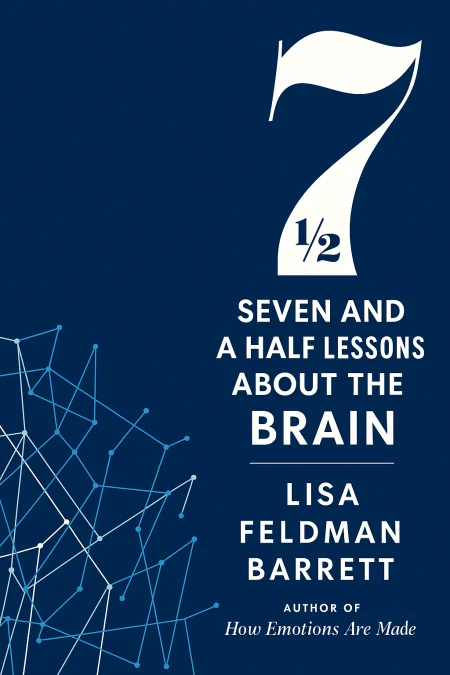
Seven and a Half Lessons about the Brain
Have Your Understanding of Consciousness, Emotions, and Memory Revolutionized
Book Edition Details
Summary
Why do our brains work the way they do? In "Seven and a Half Lessons About the Brain," Lisa Feldman Barrett, a trailblazing neuroscientist, unravels the enigma of the mind with wit and clarity. In this compact collection, she challenges popular misconceptions and reveals the brain's intricate dance with thought, emotion, and experience. With each essay, Barrett invites readers on a journey through the evolutionary history of our brains, explaining their structure and the profound impact they have on our lives. She dispels myths like the infamous "lizard brain" and the nature-versus-nurture debate, offering surprising insights into what it truly means to be human. This book isn't just a read—it's an invitation to rethink everything you thought you knew about your mind.
Introduction
Have you ever wondered why you sometimes see faces in clouds, or why your heart races before you even realize you're afraid? Perhaps you've questioned whether emotions and logic are locked in eternal battle inside your head, or pondered what makes human beings so uniquely capable of building civilizations. The three-pound organ nestled between your ears holds answers that might surprise you. Your brain isn't quite what you think it is, and understanding its true nature reveals profound insights about what it means to be human. This remarkable journey through neuroscience will challenge some of your most basic assumptions about thinking, feeling, and consciousness itself. You'll discover that your brain's primary job isn't actually thinking, that you don't have separate systems for emotion and reason fighting for control, and that much of what you experience as reality is actually a sophisticated construction project happening inside your skull. Perhaps most fascinating of all, you'll learn how human brains secretly cooperate to create the social realities that shape our world, from money to borders to the very concept of civilization itself.
Your Brain's True Purpose: Body Budgeting Not Thinking
Your brain evolved not to think, but to keep your body alive and thriving. This revelation overturns one of our most cherished beliefs about human nature. While we like to imagine our brains as sophisticated thinking machines that elevate us above other animals, the scientific evidence tells a different story entirely. To understand your brain's real job, we need to travel back 550 million years to meet your distant relatives, creatures called amphioxi. These simple, worm-like animals lived perfectly successful lives in ancient oceans without anything resembling a brain. They had just a few cells to detect light and vibration, connected directly to basic movement systems. When food became scarce, they wriggled randomly to find a better spot. When shadows appeared overhead, they darted away. No complex processing required. But then something revolutionary happened during the Cambrian period: hunting emerged. Suddenly, the ocean became a much more dangerous place where creatures needed to predict whether that shape in the distance was food or a threat. This arms race between predators and prey drove the evolution of increasingly sophisticated sensory systems and movement capabilities. More importantly, it created a need for energy-efficient decision-making. Animals that could predict threats and opportunities, rather than simply react to them, gained a crucial survival advantage. Your modern brain is essentially an incredibly sophisticated energy management system. Like a financial advisor for your body, it constantly tracks resources like glucose, water, salt, and oxygen, predicting your future needs and making investments to keep your biological systems running smoothly. This process, called allostasis, happens automatically and continuously. When your brain senses you might need energy for a challenging task ahead, it releases hormones to prepare your body. When it predicts safety and rest, it shifts resources toward repair and maintenance. Every emotion, every thought, every action serves this fundamental mission of keeping your body's budget balanced and your genes moving forward to the next generation.
Networks and Prediction: How Your Brain Actually Works
Your brain is not a collection of separate modules for different functions, but rather a unified network of 128 billion neurons working in constant collaboration. Think of it like a vast transportation system with local clusters connected by major hubs, where information flows continuously in complex patterns that can reconfigure in milliseconds. Unlike the popular metaphor of the brain as a computer with dedicated circuits, your neural network operates through flexibility and redundancy. A single neuron can participate in multiple functions, and different groups of neurons can produce the same result. This arrangement, called degeneracy, means your brain can adapt to damage and changing circumstances with remarkable resilience. The so-called "visual cortex" doesn't just process sight, it also responds to touch and sound. The "emotional brain" is a myth, there's no separate limbic system controlling your feelings while your rational cortex tries to maintain control. What makes human brains special isn't their size alone, but their extraordinary complexity. This complexity emerges from the intricate wiring patterns that allow your 128 billion neurons to create trillions of different activity patterns. Like a jazz ensemble where musicians can play countless combinations of melodies, your brain can recombine elements from past experiences to handle new situations creatively and efficiently. Perhaps most remarkably, your brain operates as a prediction machine. Rather than passively receiving information from the world and then deciding how to respond, your brain actively predicts what will happen next and prepares your body accordingly. When you reach for a glass of water, your brain begins preparing the experience of quenching your thirst before the water even reaches your bloodstream. This predictive processing explains everything from why you might mistake a stick for a snake in dim light to why expectation can actually change how wine tastes. Your everyday experience is essentially a carefully controlled hallucination, constructed by your brain's predictions and constrained by sensory input from the world around you.
Social Minds: How Brains Wire Together and Create Reality
Human beings possess a remarkable ability that appears nowhere else in the animal kingdom: we can collectively create social realities that exist only in our shared imagination, yet have profound effects on the physical world. Money, borders, laws, and governments are all examples of social constructions that emerge from human brains working together. Your brain doesn't develop in isolation. From the moment you're born, other people's brains are actively wiring yours through their interactions with you. When caregivers share attention with babies, pointing at objects and making eye contact, they're teaching infant brains what to focus on and what to ignore. This social wiring continues throughout life, with our brains literally changing their physical structure in response to the people around us. The old nature versus nurture debate misses the point entirely, your brain requires both genetic instructions and social input to develop normally. This interconnectedness has profound implications for human wellbeing. Your nervous system is constantly regulated by other people, and theirs by you. When someone you care about holds your hand, it can literally reduce your experience of pain. Conversely, chronic social stress can damage brain tissue and increase your risk of illness. The words people use around you aren't just communication, they're biological events that affect your heart rate, hormone levels, and immune system. This is why sustained verbal aggression can have measurable health consequences, and why loneliness can shorten lifespan as dramatically as smoking. Perhaps most fascinating is humans' unique ability to create shared abstractions through a combination of creativity, communication, cooperation, copying, and compression. While other animals can learn behaviors from each other, only humans can collectively agree that a piece of paper represents value, that invisible lines divide countries, or that certain sounds strung together carry complex meanings. This capacity for social reality allows human civilization to exist, but it also makes us responsible for the worlds we create together. Understanding that borders, money, and even concepts of race are social constructions rather than natural facts gives us both the power and responsibility to consciously shape the realities we share.
Summary
The human brain's most important job isn't thinking, it's predicting and managing your body's energy needs while navigating a complex social world. This prediction machine operates through flexible networks rather than separate systems for emotion and reason, constantly constructing your experience of reality from memory, expectation, and sensory input. Most remarkably, human brains possess the unique ability to create shared social realities that shape our world in ways both magnificent and troubling. These insights raise profound questions about human nature and responsibility. If your brain constructs much of what you experience, how can you take control of that construction process? If social realities are human creations rather than natural facts, what kind of world do you want to help build? For readers fascinated by the intersection of neuroscience, psychology, and human potential, these discoveries offer both humbling recognition of our biological constraints and inspiring awareness of our collective creative power.
Related Books
Download PDF & EPUB
To save this Black List summary for later, download the free PDF and EPUB. You can print it out, or read offline at your convenience.
By Lisa Feldman Barrett
