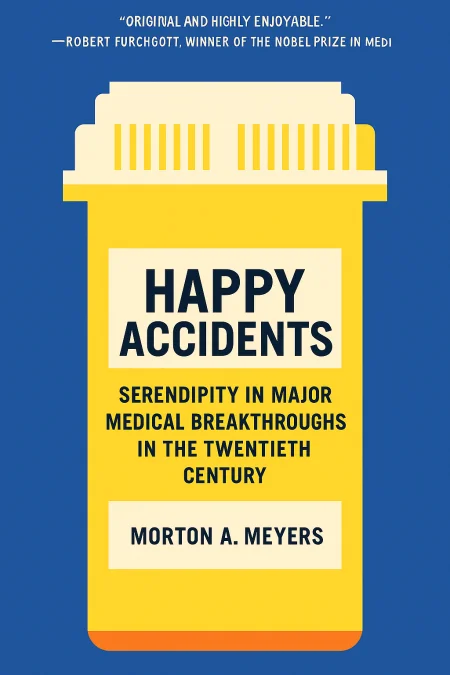
Happy Accidents
Serendipity in Major Medical Breakthroughs in the Twentieth Century
Book Edition Details
Summary
In the unpredictable dance of discovery, where brilliance often masquerades as mere chance, "Happy Accidents" takes center stage. Dr. Morton Meyers invites us to a riveting exploration of the serendipitous pathways that have led to some of medicine's most groundbreaking revelations. From the unassuming origins of life-saving antibiotics to the unexpected rise of Viagra, Meyers artfully unravels the tapestry of medical breakthroughs woven by fortuitous mishaps. This isn't just a tale of luck; it's a testament to the genius that recognizes opportunity in chaos, urging science to embrace creativity over convention. If you've ever marveled at how accidents reshape the world, this book promises a captivating journey through the serendipity that has shaped modern medicine.
Introduction
Picture this: you're a scientist who forgot to clean up your laboratory before going on vacation. When you return, you discover that your "ruined" experiment has actually revealed the key to saving millions of lives. This isn't science fiction—it's exactly how Alexander Fleming discovered penicillin in 1928. Throughout medical history, some of our most life-saving treatments have emerged not from careful planning, but from fortunate accidents that curious minds refused to ignore. A contaminated petri dish led to antibiotics that conquered deadly infections. A wartime disaster involving chemical weapons opened the door to cancer chemotherapy. Failed heart medications became breakthrough treatments for entirely different conditions. These serendipitous discoveries share a common thread: they happened to researchers who possessed what Louis Pasteur called "the prepared mind"—the ability to recognize extraordinary opportunity in seemingly ordinary mishaps. The story of accidental medical breakthroughs reveals a fascinating truth about scientific progress: sometimes the most important discoveries come not from finding what we're looking for, but from paying attention to what we're not. These happy accidents have revolutionized how we treat disease, extending human life and reducing suffering in ways their discoverers never imagined possible.
From Moldy Petri Dishes to Life-Saving Antibiotics
Before 1928, a simple scratch could become a death sentence. Bacterial infections killed more people than wars, and even minor surgeries often ended in fatal complications. This grim reality changed forever because Alexander Fleming made a mistake that he was curious enough to investigate. When Fleming returned from his summer holiday, he found that one of his bacterial culture plates had been contaminated by a blue-green mold that had drifted in through an open window. Most scientists would have discarded the ruined experiment and started fresh, but Fleming noticed something extraordinary: around the mold, all the deadly staphylococcus bacteria had been killed. This observation might have remained a laboratory curiosity if not for the work of Howard Florey and Ernst Chain at Oxford University. More than a decade later, they transformed Fleming's accidental discovery into a practical medicine. They developed methods to purify and mass-produce what they named penicillin, just as World War II created desperate demand for a drug that could save wounded soldiers from infection. American pharmaceutical companies quickly scaled up production using innovative fermentation techniques, and by 1944, there was enough penicillin to treat every wounded Allied soldier. The impact was nothing short of miraculous. Diseases that had terrorized humanity for millennia—pneumonia, scarlet fever, syphilis—suddenly became treatable with a simple injection. The death rate from bacterial infections plummeted almost overnight. Penicillin didn't just save individual lives; it transformed medicine itself, making modern surgery, organ transplants, and cancer treatments possible by eliminating the constant threat of fatal infection. Fleming's accidental discovery launched the antibiotic age and sparked a golden era of drug discovery. Researchers began systematically screening soil samples from around the world, discovering that many microorganisms produce natural antibiotics to compete with their neighbors. This insight led to streptomycin, which conquered tuberculosis, and dozens of other life-saving drugs. All because one scientist was curious enough to examine a contaminated petri dish instead of throwing it away.
Chemical Weapons to Cancer Treatment: Wartime Medical Breakthroughs
One of medicine's most important breakthroughs emerged from one of World War II's most tragic accidents. In December 1943, German bombers attacked the Italian port of Bari, destroying Allied ships loaded with supplies. Among the vessels was the SS John Harvey, secretly carrying 100 tons of mustard gas—a chemical weapon held in reserve for potential retaliation. When the ship exploded, the deadly chemical mixed with oil and seawater, creating a toxic soup that coated hundreds of survivors. Lieutenant Colonel Stewart Alexander, sent to investigate the mysterious deaths and illnesses, noticed something that would change cancer treatment forever. The victims showed dramatic depletion of white blood cells—the very cells that multiply uncontrollably in leukemia and lymphoma. This grim observation sparked a revolutionary idea: if mustard gas could destroy white blood cells so effectively, perhaps it could be used to treat blood cancers. Researchers at Yale University began testing nitrogen mustard—a chemical cousin of the gas weapon—on laboratory mice with tumors. The results were encouraging enough to try the treatment on human patients. The first was a silversmith dying of lymphoma whose tumors had grown so large they were crushing his vital organs. After treatment with nitrogen mustard, his tumors shrank dramatically, giving him precious additional months of life. This marked the birth of cancer chemotherapy, based on a simple but profound principle: use toxic substances that preferentially kill rapidly dividing cancer cells while sparing normal tissues. From this foundation grew an entire arsenal of cancer-fighting drugs. The vinca alkaloids were discovered when researchers investigating a folk remedy for diabetes noticed that laboratory animals developed infections due to white blood cell depletion. Cisplatin emerged from studies on bacterial growth where scientists accidentally discovered that platinum compounds prevented cell division. The tragedy at Bari had inadvertently opened a new front in the war against cancer, proving that even the most devastating accidents can lead to life-saving discoveries.
Heart Medicine's Lucky Accidents and Unexpected Discoveries
Heart disease remains the world's leading killer, yet many of our most effective treatments arose from research aimed at completely different problems. The cardiovascular system has revealed its secrets through a series of fortunate accidents and unexpected observations that transformed how we understand and treat the human heart. The discovery of nitric oxide's crucial role in heart health exemplifies this pattern perfectly. In the 1970s, scientists studying blood vessel function noticed that vessels behaved differently when their inner lining was intact versus when it was damaged. This led to the identification of a mysterious substance that blood vessel walls produced to keep themselves relaxed and open. That substance turned out to be nitric oxide—a simple molecule that revolutionized our understanding of circulation and led to treatments for heart disease, stroke, and even erectile dysfunction. Many of our most important heart medications were discovered through similar accidents. Researchers studying high blood pressure would notice unexpected benefits for heart attack prevention. Scientists investigating chest pain treatments would discover powerful therapies for heart failure. The blood-thinning properties of aspirin were recognized when a doctor observed excessive bleeding in patients who had been chewing aspirin gum after tonsil surgery. These serendipitous discoveries revealed the interconnected nature of cardiovascular function and opened therapeutic possibilities that targeted research might never have uncovered. Even diagnostic techniques emerged from unexpected directions. Cardiac catheterization—now routine for diagnosing and treating heart disease—began with a reckless young German physician who experimented on himself, threading a catheter through his own arm vein directly into his heart. His colleagues thought he was dangerously irresponsible, but his technique eventually enabled everything from coronary angiography to life-saving balloon angioplasty procedures. These accidental discoveries remind us that the heart, despite being studied for centuries, continues to surprise researchers who remain alert to the unexpected and willing to follow where their observations lead.
Summary
The greatest lesson from medical history is that breakthrough discoveries rarely follow the paths we expect them to take. While systematic research and careful planning certainly have their place, some of our most transformative medical advances have come from scientists who remained alert to anomalies, asked "what if?" when confronted with unexpected results, and possessed the courage to pursue leads that seemed unrelated to their original goals. These stories of accidental discovery suggest profound questions about how we approach medical research today: in our age of targeted drug development and precision medicine, are we creating enough space for serendipitous findings? The tales of penicillin emerging from a contaminated culture, chemotherapy arising from a wartime disaster, and heart treatments discovered through unrelated research remind us that the next great medical breakthrough might be hiding in a failed experiment, an unexpected observation, or a mistake that someone is curious enough to investigate further. For anyone interested in science or medicine, these stories offer both inspiration and instruction, revealing that discovery remains fundamentally a human enterprise dependent not just on sophisticated equipment and methodology, but on the irreplaceable qualities of curiosity, persistence, and the wisdom to recognize extraordinary opportunity in seemingly ordinary accidents.
Related Books
Download PDF & EPUB
To save this Black List summary for later, download the free PDF and EPUB. You can print it out, or read offline at your convenience.
By Morton A. Meyers
