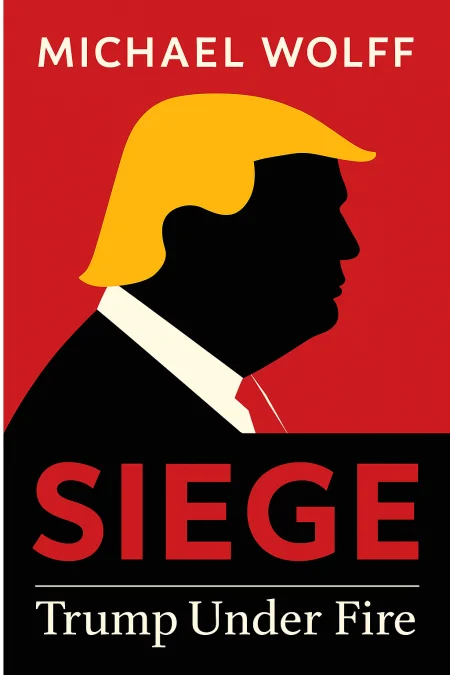
Siege
Trump Under Fire
Book Edition Details
Summary
In the turbulent corridors of power, Michael Wolff returns with "Siege," a riveting exposé of a presidency on the precipice. As the second year of Donald Trump’s tenure unfolds, chaos reigns supreme, with a White House beset by relentless investigations and a leader whose unpredictability knows no bounds. Wolff, acclaimed for his incisive storytelling, captures this tempestuous era with unmatched clarity, guiding readers through the maelstrom of political upheaval. With the Mueller report looming large, the narrative crescendos into a portrait of an administration in perpetual crisis, teetering at the edge of implosion. For those who seek a gripping behind-the-scenes glimpse into a presidency under relentless fire, "Siege" stands as an essential chronicle of our times.
Introduction
In the annals of American political history, few periods have witnessed such a dramatic collision between individual ambition and institutional resilience as the final phase of Donald Trump's presidency. This was an era when the very foundations of democratic governance faced their most severe test in generations, as personal vendettas, legal investigations, and constitutional crises converged to create a perfect storm of political chaos. The events that unfolded during this tumultuous period revealed not just the character of one man, but the true nature of American democracy itself when pushed to its absolute limits. The story that emerges from this extraordinary time illuminates three fundamental questions that continue to shape our political landscape today. First, how do democratic institutions respond when confronted by a leader who views traditional norms as obstacles rather than guardrails? Second, what happens when the pursuit of personal interests becomes indistinguishable from the exercise of presidential power? And finally, can the American system of checks and balances survive when tested by someone willing to challenge its very legitimacy? This account will particularly resonate with readers seeking to understand the intersection of personality and politics in modern America, as well as those concerned with the health of democratic institutions in an age of unprecedented polarization. It offers crucial insights for anyone grappling with questions of leadership, accountability, and the delicate balance between executive power and constitutional constraints that defines American governance.
Legal Storm: Mueller's Investigation and Presidential Defiance (2018)
The opening months of 2018 found the Trump White House operating under a cloud of legal uncertainty that would fundamentally reshape the presidency. Robert Mueller's special counsel investigation had evolved from a probe into Russian election interference into something far more comprehensive and threatening to the president's political survival. The investigation's expanding scope created an atmosphere of paranoia and siege mentality within the administration, as staffers found themselves hiring expensive legal representation and carefully documenting their every interaction to avoid becoming unwitting participants in potential criminal charges. Trump's response to this mounting legal pressure revealed both his combative instincts and his fundamental misunderstanding of how the justice system operates in a constitutional democracy. Unlike his previous business dealings, where aggressive posturing and personal relationships could often resolve disputes, the president now faced an institutional machinery designed to operate independently of political influence. His repeated attacks on the investigation as a "witch hunt" and his threats against the Justice Department represented an unprecedented challenge to the principle of prosecutorial independence that had governed American law enforcement for decades. The investigation had already ensnared several key figures from Trump's inner circle, including former campaign manager Paul Manafort and former National Security Advisor Michael Flynn. Each new indictment seemed to tighten the circle around the president himself, creating a cascade of legal jeopardy that extended far beyond the original scope of Russian interference. The president's legal team, a collection of television personalities and aging practitioners rather than the elite white-collar defense attorneys typically associated with presidential representation, struggled to manage their client's expectations while containing the damage from his public statements. This period established a pattern that would define the remainder of Trump's presidency: an ongoing tension between his instinct to fight publicly and his advisers' desperate attempts to limit his legal exposure. The legal storm of 2018 demonstrated how personal legal troubles could consume a presidency and how the American system of justice, despite intense political pressure, continued to operate according to its own logic and constitutional mandate.
Political Crisis: Midterm Elections and Institutional Breakdown (2018)
As the 2018 midterm elections approached, the Trump administration faced a political landscape transformed by two years of unprecedented controversy and institutional conflict. The president's historically low approval ratings, combined with energized Democratic opposition and a wave of Republican retirements, created conditions that threatened to fundamentally alter the balance of power in Washington. Yet Trump himself seemed remarkably detached from the electoral mathematics that consumed his party's leadership, viewing the midterms through the lens of personal loyalty rather than strategic political necessity. The internal dynamics of the Republican Party during this period revealed deep fractures that extended far beyond mere policy disagreements. Senate Majority Leader Mitch McConnell and House Speaker Paul Ryan, while maintaining public support for the president, privately expressed grave concerns about his impact on down-ballot races across the country. Their strategy of campaigning on the party's tax reform achievements rather than Trump's populist agenda reflected a calculated attempt to distance themselves from a president they viewed as politically toxic in many suburban districts. The campaign season exposed the fundamental tension between Trump's base-mobilization strategy and the broader electoral coalition necessary for maintaining Republican control of Congress. His inflammatory rhetoric about immigration, culminating in his obsessive focus on a migrant caravan approaching the southern border, energized his core supporters while further alienating the suburban voters who had been drifting away from the party since his election. The president's rallies drew massive crowds, creating an echo chamber that convinced him of his continued popularity even as polling data suggested a very different reality. The midterm results, which handed control of the House of Representatives to the Democrats, represented more than a typical electoral correction. They marked the beginning of a new phase in Trump's presidency, one in which he would face genuine institutional opposition for the first time. The election demonstrated that electoral accountability could still function as a check on executive power, even in an era of intense polarization and media fragmentation.
Constitutional Confrontation: Shutdown and Congressional Warfare (2018-2019)
The longest government shutdown in American history emerged from Trump's desperate attempt to fulfill his signature campaign promise of building a border wall, transforming a routine budget negotiation into a constitutional crisis that paralyzed the federal government for thirty-five days. What began as a political miscalculation quickly escalated into a test of wills between the executive and legislative branches, revealing the president's fundamental misunderstanding of how democratic governance actually functions in practice. Nancy Pelosi's return as Speaker of the House marked a dramatic shift in the balance of power in Washington, bringing to bear decades of legislative experience against Trump's improvisational approach to governance. Her masterful handling of the shutdown negotiations demonstrated the difference between seasoned political leadership and the president's transactional worldview. When she effectively disinvited Trump from delivering the State of the Union address in the House chamber, she delivered a humiliating blow that underscored his weakened political position. The human cost of the shutdown mounted as federal workers went without paychecks and essential government services ground to a halt. Trump's initial bravado about taking responsibility for the shutdown quickly gave way to desperate attempts to blame Democrats, but polling consistently showed that Americans held him accountable for the crisis. His political isolation became complete when even Republican senators began publicly distancing themselves from his strategy, recognizing the damage it was inflicting on their own political standing. The shutdown's resolution through Trump's capitulation, followed by his declaration of a national emergency to fund the wall, marked a turning point in his presidency. Rather than demonstrating strength, the emergency declaration was widely seen as an admission of political defeat and constitutional overreach. This episode revealed how a president's personal obsessions could paralyze the entire federal government, raising serious questions about the concentration of power in the executive branch and the urgent need for institutional safeguards against future presidential overreach.
Final Reckoning: Mueller Report and Democratic Resilience (2019)
The long-awaited release of the Mueller Report in April 2019 represented the culmination of nearly two years of investigation, speculation, and political warfare that had consumed Washington and captivated the nation. When Attorney General William Barr's initial summary suggested that Trump had been cleared of collusion charges, it marked a stunning reversal of fortune for a president who had seemed perpetually on the brink of potential impeachment. However, the report's actual contents painted a far more complex and troubling picture of a campaign that had welcomed Russian interference and a president who had repeatedly attempted to obstruct the investigation into that interference. Mueller's decision not to reach a definitive conclusion on obstruction of justice charges left the American political system in an unprecedented state of limbo. His careful deference to Justice Department guidelines against indicting a sitting president meant that Congress would ultimately have to decide whether Trump's documented actions warranted impeachment proceedings. This constitutional punt to the legislative branch ensured that the president's fate would be determined through the political process rather than the criminal justice system, highlighting the inherent tensions between legal and political accountability in American democracy. The report's public release did little to resolve the fundamental questions about Trump's fitness for office that had dominated his presidency from its earliest days. His supporters claimed complete vindication, pointing to the absence of criminal charges, while his critics highlighted the numerous instances of potential obstruction detailed in Mueller's meticulous findings. The American public remained deeply divided in their interpretations, with reactions to the report falling largely along predictable partisan lines that reflected the broader polarization of the political landscape. Perhaps most significantly for the long-term health of American democracy, the Mueller investigation had exposed the vulnerability of democratic institutions to both foreign interference and domestic disruption. The report documented extensive Russian efforts to influence the 2016 election while revealing how a presidential campaign had been willing to benefit from such interference without reporting it to law enforcement. These revelations would have lasting implications for election security, democratic norms, and the integrity of American political institutions, ensuring that the questions raised during this tumultuous period would persist long after Trump's eventual departure from office.
Summary
The final siege of Trump's presidency reveals a fundamental tension at the heart of American democracy between the disruptive force of unconventional leadership and the stabilizing power of institutional resilience. Throughout this extraordinary period, we witness the collision between a president who viewed himself as above traditional constitutional constraints and a system of government specifically designed to check and balance executive power. This unprecedented clash exposed both the remarkable durability and the alarming fragility of democratic institutions when confronted by a leader willing to challenge their very legitimacy and foundational principles. The events chronicled during these tumultuous years demonstrate how personal character and institutional integrity are inextricably linked in the functioning of democratic governance. Trump's persistent inability to separate his personal interests from national interests created a cascade of constitutional crises that weakened American democracy from within while simultaneously damaging the country's credibility and standing on the world stage. The investigations, government shutdowns, and political battles that defined this period were not merely partisan conflicts but fundamental tests of whether democratic norms and constitutional principles could survive sustained assault from the highest office in the land. For current and future generations of Americans, these years offer three crucial lessons about preserving democratic governance in an age of polarization and institutional stress. First, robust civic education and public engagement remain essential bulwarks against the erosion of democratic values, as an informed citizenry represents the ultimate check on governmental overreach. Second, democratic institutions must be continuously strengthened and reformed to prevent future abuses of power while maintaining their ability to adapt to changing circumstances. Finally, the media, civil society, and ordinary citizens must remain vigilant guardians of constitutional principles, holding leaders accountable regardless of party affiliation and remembering that democracy requires constant effort and commitment from each generation to preserve it for the next.
Related Books
Download PDF & EPUB
To save this Black List summary for later, download the free PDF and EPUB. You can print it out, or read offline at your convenience.
By Michael Wolff
