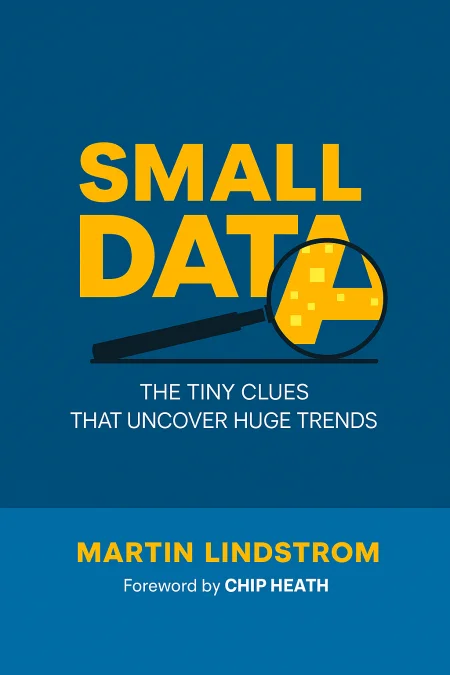
Small Data
The Tiny Clues That Uncover Huge Trends
byChip Heath, Martin Lindstrom
Book Edition Details
Summary
In the thrilling tapestry of human lives, Martin Lindstrom emerges as a maestro of the mundane, transforming overlooked details into the symphonies of commercial triumphs. This modern-day detective of consumer behavior dedicates his nights to unlocking the secrets behind everyday objects—like a seemingly trivial fridge magnet in Siberia sparking a U.S. supermarket revolution, or a humble stuffed bear revolutionizing fashion across continents. In "Small Data," each artifact reveals whispers of hidden desires, guiding brands like LEGO and Pepsi to resounding success. Lindstrom’s globe-spanning quest is a masterclass for marketers and the curious alike, offering a captivating glimpse into the subtle art of turning the ordinary into the extraordinary.
Introduction
In an age where corporations worship algorithmic predictions and massive datasets, a revolutionary perspective emerges to challenge fundamental assumptions about understanding human behavior. The prevailing wisdom suggests that sophisticated statistical models and digital tracking systems hold the keys to unlocking consumer desires and market trends. Yet this approach consistently fails to capture the nuanced, emotional, and deeply personal drivers that actually motivate human decision-making across cultures and contexts. The central argument presented challenges the supremacy of big data analytics by demonstrating that small data—tiny, seemingly insignificant behavioral clues found in people's homes, habits, and daily rituals—provides far more valuable insights than aggregate statistics ever could. These micro-observations, gathered through direct human interaction and careful ethnographic study, reveal the emotional DNA that drives consumer behavior worldwide. While digital analytics can track what people do, only behavioral observation can explain why they do it, uncovering unconscious desires and cultural imbalances that create genuine business opportunities. Through a forensic approach to human observation, the methodology reveals that profound insights often emerge from mundane details: refrigerator door arrangements, playground wear patterns, or smartphone positioning habits. These behavioral fragments, when connected across cultures and contexts, form a comprehensive understanding of universal human truths and unmet needs that traditional market research consistently overlooks. This exploration guides readers through a systematic deconstruction of conventional research wisdom while building a compelling case for human-centered investigation as the superior path to authentic consumer understanding.
The Methodology Revolution: From Digital Analytics to Human Observation
The fundamental flaw in contemporary market research lies in its obsession with digital breadcrumbs while ignoring the rich tapestry of human behavior unfolding in physical spaces. Big data excels at identifying correlations but fails catastrophically at understanding causation. Digital tracking can monitor clicks, purchases, and search patterns, but remains blind to emotional triggers, cultural contexts, and unconscious motivations driving these behaviors. The methodology operates on statistical significance while missing emotional significance entirely. Small data methodology operates on an entirely different premise: humans are fundamentally storytelling creatures whose deepest desires manifest in the physical arrangement of their personal spaces. Family photograph positioning, refrigerator shelf contents, and wear patterns on everyday objects constitute an unfiltered autobiography revealing more about consumer psychology than surveys or focus groups ever could. This approach recognizes that people rarely tell the truth about their motivations, not from deliberate deception, but because they themselves don't fully understand what drives their choices. The conscious mind constructs rational narratives to explain decisions actually driven by unconscious emotional needs. Only by observing behavior in natural settings, away from artificial research constraints, can investigators glimpse authentic motivations. The power lies in identifying cultural imbalances—gaps between what societies provide and what people actually crave. These imbalances create tension that drives innovation and market opportunity, transforming statistical noise into whispers of unmet human needs. The investigative process treats homes and personal spaces as archaeological sites rich with behavioral artifacts. Environmental details that consumers would never think to mention—bedroom object arrangements, kitchen cabinet contents, everyday item wear patterns—constitute a vocabulary of unconscious communication. This forensic anthropology approach requires abandoning preconceived notions and embracing cultural outsider perspectives, as familiarity breeds blindness to details that matter most.
Evidence from Global Markets: Cultural Patterns and Behavioral Insights
Every culture develops unique restrictions, taboos, and limitations that create corresponding desires for compensation and escape. These cultural imbalances manifest as observable behaviors and preferences that, when properly decoded, reveal massive business opportunities. What cultures lack or suppress inevitably surfaces in other forms, creating predictable patterns of compensatory consumption that transcend individual preferences to reflect collective psychological needs. Russian households demonstrate this principle through colorful refrigerator magnets depicting tropical beaches and foreign landmarks. These decorative choices represent more than aesthetic preferences—they constitute psychological portals to dreams of travel and freedom that harsh climate and restrictive political environments systematically deny. Similarly, Saudi Arabian homes obsessed with water imagery reflect deep psychological thirst for emotional and spiritual fluidity within rigid social structures. These compensatory desires operate according to universal psychological principles where societal conformity pressure creates individual uniqueness seeking. The most successful global brands intuitively understand these cultural compensation patterns. They export emotional solutions to culturally specific problems rather than merely products. McDonald's succeeds in France not despite culinary traditions, but because it provides socially acceptable rebellion against rigid traditional dining formality. The brand offers liberation from cultural constraints while maintaining plausible deniability about this subversive function, demonstrating how identical behaviors serve completely different emotional functions across cultures. Chinese households reveal cultural emphasis on speed and directness through absent bedspreads, rapid tooth-brushing techniques, and standing toothbrush positioning. These observations challenge Western assumptions about quality and luxury, informing automotive feature development where fast-opening doors and immediate feedback systems communicate superior quality more effectively than traditional European approaches emphasizing gradual, controlled movements. Understanding these patterns requires abandoning Western-centric assumptions about universal human nature while recognizing that identical products might represent status in one culture, rebellion in another, and comfort in a third.
Beyond Algorithmic Limitations: Individual Clues versus Aggregate Statistics
While big data excels at identifying correlations across massive populations, it fundamentally cannot access emotional nuances driving individual decision-making. Algorithms track purchasing behavior but cannot interpret why teenagers position shoes in specific arrangements or why businessmen display certain living room objects. These behavioral details contain emotional information that no digital tracking system can capture or quantify, representing the crucial gap between correlation and causation that statistical analysis cannot bridge. The limitation becomes particularly apparent when dealing with cultural differences and emotional complexity. Statistical analysis might reveal Chinese consumer feature preferences but cannot explain psychological foundations of those preferences or predict their evolution. Only direct observation of lived environments can uncover cultural values and personal needs shaping authentic consumer behavior. Individual behavioral clues possess richness and specificity that aggregate data necessarily obscures through averaging and generalization. When single consumer refrigerator contents reveal aspiration and compensation patterns, that insight often applies to millions sharing similar cultural circumstances. The key lies in recognizing which individual observations reflect broader human truths rather than mere personal idiosyncrasies. This requires developing sensitivity to differences between surface-level preferences and deeper psychological needs, as consumers might claim to want convenience while behavioral patterns reveal deeper needs for control, connection, or transformation. The methodology trains observers to read underlying emotional signals and translate them into business strategies addressing authentic human desires rather than stated preferences. This approach recognizes that the most transformative business insights emerge from observations initially appearing unrelated to commercial concerns. Environmental details seeming irrelevant to business objectives actually contain keys to authentic consumer connection, requiring researchers to maintain curiosity about mundane details while remaining open to unexpected connections between human behavior and market opportunities.
Strategic Implementation: Transforming Insights into Business Solutions
The transition from small data insights to actionable business strategies requires systematic approaches maintaining emotional authenticity of original observations while scaling them into commercially viable solutions. Implementation begins with recognizing that successful brands must operate simultaneously on rational and emotional levels, addressing functional needs while fulfilling deeper psychological desires revealed through behavioral observation. This dual approach ensures that business solutions connect with genuine human motivations rather than superficial preferences. Effective integration demands that business leaders personally experience their products and services from consumer perspectives. Executives must abandon protective boardroom distance and market research report barriers to engage directly with environments where customers make real decisions. This direct exposure often reveals gaps between intended brand messages and actual consumer experiences that no amount of data analysis could uncover, highlighting the irreplaceable value of human-centered investigation. The methodology requires ongoing commitment to observational research rather than treating it as one-time diagnostic tools. Consumer behaviors and cultural needs evolve continuously, and brands must maintain sensitivity to these shifts through regular environmental investigation. Success comes from developing organizational cultures that value curiosity about human behavior over reliance on statistical projections, creating sustainable competitive advantages through authentic human connection rather than algorithmic optimization. Implementation also involves training teams to recognize and interpret behavioral signals in daily consumer interactions. When employees understand how to read environmental clues and emotional indicators, they become more effective at creating authentic customer connections. This human-centered approach to business strategy ultimately generates more sustainable competitive advantages than purely data-driven approaches because it addresses fundamental human needs driving all consumer behavior, creating deeper and more meaningful brand relationships.
Summary
The most profound business insights emerge not from analyzing massive datasets, but from carefully observing small behavioral details that reveal authentic human desires and cultural needs. This investigative approach to understanding consumer behavior demonstrates that emotional truth lies hidden in plain sight within everyday environments where people actually live and make decisions. By learning to read the unspoken language of human behavior through environmental observation, businesses can develop strategies that connect with genuine human needs rather than stated preferences, creating more meaningful and sustainable relationships with their customers while uncovering revolutionary opportunities that algorithmic analysis consistently overlooks.
Related Books
Download PDF & EPUB
To save this Black List summary for later, download the free PDF and EPUB. You can print it out, or read offline at your convenience.
By Chip Heath
