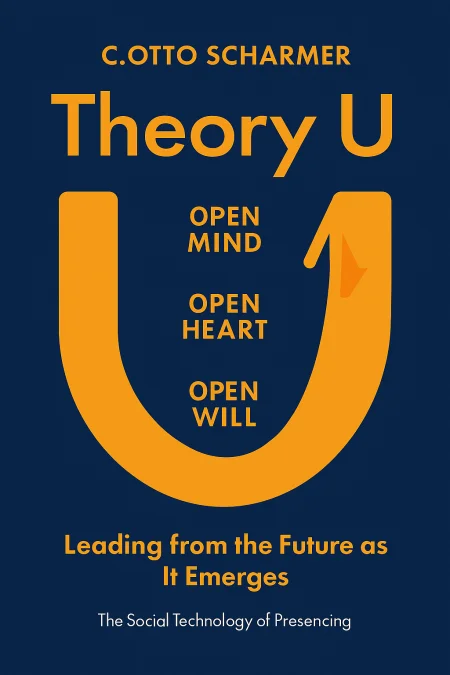
Theory U
Leading From the Future as it Emerges
Book Edition Details
Summary
In the realm of transformative thought, Otto Scharmer's "Theory U" beckons readers to transcend conventional problem-solving. At the heart of Scharmer's vision lies the elusive "blind spot," a hidden inner vantage point that shapes our perception and action. Through the innovative U-process, Scharmer guides us to engage with this blind spot, fostering a profound awakening that merges our present reality with the future's potential. This narrative intertwines personal anecdotes and diverse case studies, forging a path toward collective innovation. As societal shifts challenge today's leaders, Scharmer offers a roadmap to harness our deepest creative instincts, inspiring a shift from mere awareness to proactive creation. Readers will find themselves on a journey of introspection and societal impact, as the book unfolds principles and practices for co-creating a vibrant future.
Introduction
In an era of unprecedented complexity and accelerating change, traditional leadership approaches often prove inadequate when confronting challenges that have no historical precedent. How do we navigate uncertainty when our established frameworks no longer provide reliable guidance? How do we create meaningful transformation when reactive problem-solving merely perpetuates existing patterns? This groundbreaking exploration introduces a revolutionary consciousness-based framework that fundamentally shifts our understanding of leadership from managing the past to sensing and actualizing emerging futures. Through extensive research across diverse organizations and cultures, the work reveals a systematic process for accessing deeper sources of knowing and creativity that transcend conventional analytical approaches. The theory addresses three fundamental questions that define effective leadership in complex systems: How can we learn to see our situations with fresh awareness rather than through the lens of past assumptions? How do we access the collective intelligence that emerges when groups operate from their deepest source of purpose? How can we transform not just our actions, but the inner place from which we operate to serve the highest possibilities seeking to emerge?
The U Process: Seven Stages of Transformational Leadership
The U Process represents a comprehensive journey of transformation that maps how profound change occurs through seven distinct movements, forming the characteristic shape of the letter U. This framework reveals that breakthrough innovation and authentic change emerge not from analyzing past patterns, but from learning to sense and actualize emerging possibilities. The process begins with "downloading," our habitual tendency to operate from familiar mental models and reactive patterns that simply reproduce existing results. The descent down the left side of the U involves three progressive movements of opening that require releasing increasingly deeper layers of attachment to familiar ways of being. "Seeing" involves suspending our judgments to observe reality with fresh eyes, moving beyond our assumptions to encounter what is actually happening. "Sensing" opens our hearts to feel the situation from within the whole system, developing empathic connection with other perspectives and the larger field of relationships. At the bottom of the U lies "presencing," the moment of connecting to our deepest source of knowing and authentic purpose, where we touch the place from which genuine innovation emerges. The ascent up the right side focuses on manifesting new realities through "crystallizing" clear vision and intention from this deeper source, "prototyping" through rapid experimentation and learning, and "performing" by embedding new practices in larger systems. Unlike conventional change processes that impose solutions from the outside, the U Process enables transformation to emerge from within the system itself. Consider a healthcare team that moves beyond treating symptoms to sensing the deeper patterns affecting patient wellbeing, then prototyping innovative approaches that address root causes. This journey transforms not just outcomes but the very consciousness from which action arises, enabling leaders to operate as instruments of emerging possibility rather than prisoners of past experience.
From Ego-System to Eco-System Consciousness
The fundamental shift underlying all transformational leadership involves moving from ego-system awareness, focused on the success and wellbeing of oneself or one's immediate group, to eco-system awareness that naturally includes the wellbeing of the whole. This transition represents an evolution in consciousness that enables leaders to perceive and act from a fundamentally different source of awareness and intention. Ego-system consciousness operates from the perspective of separate, competing interests where success is measured by individual or organizational advantage over others. Eco-system consciousness emerges when we recognize our deep interconnection with larger systems and begin to operate from concern for the health and vitality of the whole. This shift is not merely intellectual but involves a lived experience of expanded identity and purpose. Leaders operating from eco-system awareness naturally consider the impact of their decisions on all stakeholders, including future generations and the environment itself. They move beyond zero-sum thinking toward creating value that serves multiple levels of the system simultaneously. This consciousness shift manifests differently across individual, organizational, and societal levels. Individuals experience it as a movement from self-centered concerns toward authentic service to something larger than themselves. Organizations evolve from maximizing shareholder value toward creating stakeholder value that includes employees, customers, communities, and the environment. At the societal level, this represents the evolution toward what the framework describes as Society 4.0, organized around the collective capacity to sense and actualize emerging possibilities for the benefit of all. The transition requires developing new capacities for systems thinking, empathic connection, and collaborative action that transcends traditional boundaries and competitive dynamics.
Presencing as Social Technology for Collective Intelligence
Presencing functions simultaneously as a state of consciousness and a practical methodology for facilitating profound change in complex systems. As a state of consciousness, presencing involves operating from our highest future possibility while remaining fully grounded in present reality. As a social technology, it provides specific principles and practices that enable groups to access collective wisdom and generate breakthrough solutions to seemingly intractable challenges. The methodology works by helping systems develop the capacity for collective self-awareness, enabling conscious evolution rather than unconscious reaction to external pressures. Presencing creates conditions where new possibilities can emerge from within the system itself, rather than being imposed from outside authorities or experts. The approach includes practices for deep listening, generative dialogue, collective sensing journeys, and rapid prototyping of emerging solutions that engage the creativity and commitment of all participants. The transformative power of presencing becomes evident when groups move beyond debate and discussion toward genuine collective intelligence. In such moments, participants report experiencing connection to something larger than themselves while simultaneously becoming more authentically themselves. Solutions emerge that no individual could have conceived alone, and action arises from shared commitment rather than external pressure or manipulation. Whether applied in corporate boardrooms, community organizing, international diplomacy, or educational settings, presencing offers a pathway for transforming conflict into creativity and fragmentation into coherent action. The methodology recognizes that our most pressing challenges cannot be solved from the same level of consciousness that created them, requiring instead a fundamental shift in how we attend to and engage with complex situations.
Applying Theory U Across Individual and Organizational Systems
The framework operates as a fractal pattern that manifests coherently across all levels of human systems, from personal transformation to global change initiatives. At the individual level, the U Process guides personal development through the same seven movements, helping people shift from reactive patterns toward authentic self-expression and purposeful action. This involves learning to suspend the inner voices that limit perception, developing capacity to see circumstances with fresh awareness, and accessing the deeper source of creativity and purpose that emerges when we release limiting identities and assumptions. Organizational applications address the fundamental challenge of creating cultures capable of sensing and responding to emerging opportunities rather than merely reacting to past patterns or external pressures. This requires developing collective capacities for deeper listening, shared sensing of emerging possibilities, and rapid prototyping of innovative approaches. Organizations practicing the framework create what can be understood as "innovation infrastructures" that support ongoing experimentation and learning, moving beyond traditional change management toward continuous transformation that serves all stakeholders. The methodology provides practical tools for each stage of organizational transformation, including techniques for co-initiating around shared purpose, co-sensing current reality across boundaries, co-presencing to access collective wisdom, co-creating through experimentation, and co-evolving by embedding successful innovations in larger systems. At the societal level, the framework offers hope for addressing complex challenges like climate change, inequality, and social fragmentation that require coordinated action across multiple sectors and stakeholders. The power lies in its recognition that transformation at any level requires the same fundamental shift in the source of attention and action, creating coherence across levels and enabling small groups of committed individuals to catalyze much larger transformations by modeling new ways of operating and creating spaces for others to access their own deeper sources of creativity and commitment.
Summary
The essence of transformational leadership lies not in managing change from past experience, but in learning to sense and actualize the future that seeks to emerge through us. This consciousness-based approach reveals that the quality of results we create depends fundamentally on the quality of attention and awareness we bring to any situation, offering a systematic pathway for shifting from reactive patterns toward the capacity to operate as instruments of positive transformation. By mastering the journey through presencing, leaders develop the ability to access deeper sources of wisdom and creativity that serve not just immediate goals but the wellbeing of the whole system, providing hope for addressing the unprecedented challenges of our time through the awakening of our collective intelligence and the alignment of human action with the highest possibilities available to us.
Related Books
Download PDF & EPUB
To save this Black List summary for later, download the free PDF and EPUB. You can print it out, or read offline at your convenience.
By C. Otto Scharmer
