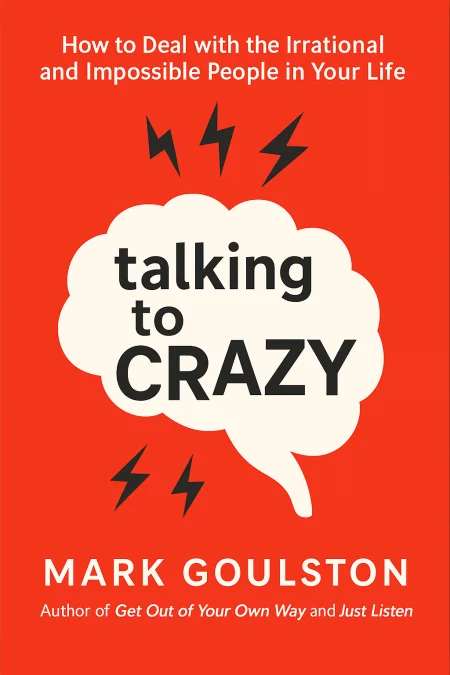
Talking to Crazy
How to Deal with the Irrational and Impossible People in Your Life
Book Edition Details
Summary
When logic fails and emotions surge, how do you navigate the storm? Mark Goulston, acclaimed psychiatrist, offers an insightful guide to managing the chaos of irrational behavior in "Talking to Crazy." Forget futile arguments—Goulston invites you to embrace the madness with empathy, transforming conflict into connection. Learn to decipher the unpredictable, defuse emotional time bombs, and decide when to engage or step back. Through innovative techniques like Time Travel and the Fish-bowl, this book equips you with tools to reach those who seem unreachable. It's not about taming the crazy, but understanding it—and, in doing so, preserving your own sanity.
Introduction
Every day, you encounter someone whose behavior defies logic. Whether it's a colleague who explodes over minor issues, a family member who refuses to listen to reason, or a neighbor whose reactions seem completely out of proportion, these encounters leave you frustrated and drained. Traditional approaches like arguing with facts or trying to calm them down often make things worse, leaving you feeling helpless and wondering what went wrong. The truth is, irrational behavior isn't something you can reason away with logic or fix with good intentions. When people are trapped in their emotional reactions, their brains literally can't process rational information the same way. But here's the surprising insight: instead of fighting against their irrationality, you need to lean into it. By understanding the psychology behind crazy behavior and learning specific techniques that work with the emotional brain rather than against it, you can transform impossible conversations into breakthroughs. This approach has helped hostage negotiators, therapists, and everyday people turn their most challenging relationships into opportunities for real connection and positive change.
Understanding and Preparing for Irrational Behavior
At its core, irrational behavior stems from a fundamental misalignment in how the brain processes reality. When people can't see the world clearly, say things that don't make sense, or make decisions that aren't in their best interest, they're not choosing to be difficult. Their three-part brain system has become locked in what's called "triunal rigidity," where past experiences override present reality. Consider the story of Mr. Harding, a hospital patient who was thrashing violently against his restraints with wild, desperate eyes. The medical team labeled him psychotic and administered tranquilizers. However, when a psychiatry resident took time to truly observe and listen, he discovered that Mr. Harding wasn't delusional at all. A piece of the respirator tubing had broken off and lodged in his throat, causing excruciating pain and terror. What appeared to be crazy behavior was actually a completely rational response to a life-threatening situation that no one had bothered to investigate. This case illustrates a crucial principle: what looks like insanity often makes perfect sense once you understand the person's internal experience. The key is learning to recognize that irrational people aren't broken or malicious, they're operating from a different reality based on their past experiences and current emotional state. When you approach them with curiosity rather than judgment, seeking to understand rather than to correct, you create the foundation for real communication. Start by identifying the specific patterns in how people express their irrationality. Do they become emotional and overwhelmed, withdraw into cold logic, or try to manipulate situations to feel safer? Each pattern reveals important information about what's driving their behavior and how you can respond more effectively.
Essential Strategies for Breaking Through Barriers
The most counterintuitive yet powerful approach to reaching irrational people is called "assertive submission," where you acknowledge their dominance while maintaining your own dignity and purpose. This technique mirrors what happens in nature when one dog shows its belly to another, transforming conflict into protection and cooperation. A perfect example occurred during a road rage incident where a driver, filled with fury, approached a car ready to inflict violence. Instead of arguing or trying to escape, the targeted driver said something unexpected: "Have you ever had such an awful day that you're just hoping to meet someone who will pull out a gun, shoot you, and put you out of your misery? Are you that someone?" This startling honesty immediately shifted the dynamic. The aggressive driver's entire demeanor changed as he went from attacker to protector, reassuring the other person that everything would be okay. The transformation happened because assertive submission does something remarkable to the human psyche. When you acknowledge someone's power over you rather than fighting it, you remove the very resistance they're pushing against. Their brain, no longer in fight mode, can shift into its protective instincts. They begin to see you as part of their pack rather than as a threat, which triggers an unconscious desire to help rather than harm. To implement this strategy, resist your natural urge to defend or counterattack when someone becomes irrational. Instead, acknowledge their position and even put them in charge of the outcome. You might say, "You're absolutely right, and I don't know what to do about it. What would you suggest?" This approach requires courage and humility, but it can instantly defuse even the most volatile situations by turning adversaries into allies.
Managing Personal Relationships and Difficult Family Dynamics
Personal relationships require a different approach because the stakes are higher and the emotional history runs deeper. When dealing with family members or romantic partners, you're not just managing a single interaction but working to heal patterns that may have developed over years or decades. The story of Elena and Sam illustrates this perfectly. During their bitter divorce proceedings, they were trapped in endless cycles of blame and recrimination that were traumatizing their 12-year-old daughter, Grace. Instead of focusing on who was right or wrong, they learned to ask a simple but powerful question: "Do we want to raise Child A or Child B?" Child A was described as focused, resilient, and able to handle disappointments maturely. Child B was scattered, fragile, and easily upset. When Elena and Sam realized their fighting was creating Child B, everything changed. This shift from present grievances to future consequences transformed their entire approach to co-parenting. Instead of arguing about makeup or bedtimes, they began evaluating every decision based on what would help Grace develop into a strong, capable adult. When emotions ran high, one parent would simply ask, "A or B?" and they would refocus on their shared goal rather than their personal resentments. The key to managing difficult family dynamics is creating shared vision that transcends individual wounds. Whether you're dealing with an aging parent who refuses help, a rebellious teenager, or a partner who's become emotionally distant, focus on what you both ultimately want rather than what's currently going wrong. Ask yourself what kind of relationship you want to have in five or ten years, then work backward to identify what needs to change today.
When Professional Help Is Needed
Some forms of irrationality go beyond what you can handle alone and require professional intervention. Mental illness, addiction, personality disorders, and any hint of suicidal or violent thinking demand immediate expert assistance. The difference between challenging behavior and serious mental health issues isn't always obvious, but your own emotional reactions can provide important clues. The case of Alice, who suffered from delusional depression, demonstrates the careful approach needed with serious mental illness. She was terrified of treatment because five years earlier, police had forcibly taken her to a psychiatric hospital where she felt her life was in danger. Her resistance wasn't stubbornness but a symptom of her condition combined with traumatic memories of previous treatment. Working with Alice required a five-step process similar to hostage negotiation: listening without judgment, empathizing with her fears, agreeing where possible, understanding her specific needs, and only then suggesting action. Instead of arguing about her delusions or pushing medication immediately, the focus was on building trust and helping her feel heard and understood. This patient approach eventually led to her accepting treatment and achieving significant improvement in her symptoms. When dealing with potential mental illness, resist the urge to diagnose or fix the problem yourself. Instead, focus on maintaining connection and safety while seeking appropriate professional help. Look for psychiatrists, psychologists, or counselors who understand that medication or therapy alone isn't enough. The most effective treatment often includes ongoing support, practical life skills training, and community connections that help people maintain their progress long-term.
Summary
The path to reaching irrational people lies not in fighting their crazy but in understanding it, leaning into it, and finding the sane person hidden beneath the emotional storm. As one key insight from this approach reveals: "When you look into people's eyes with the sole purpose of understanding them instead of judging or maneuvering them, they no longer have a reason to keep their guard up." Every difficult person in your life is dealing with fears, disappointments, or past wounds that make perfect sense to them, even if their behavior seems impossible to you. The techniques you've learned here, from assertive submission to focusing on future outcomes rather than past grievances, work because they address the emotional brain first and the logical brain second. Start today by choosing one difficult relationship in your life and approaching that person with genuine curiosity about their experience rather than frustration about their behavior. Ask yourself what they might be afraid of losing or desperate to gain, and let that understanding guide your next conversation toward connection rather than conflict.
Related Books
Download PDF & EPUB
To save this Black List summary for later, download the free PDF and EPUB. You can print it out, or read offline at your convenience.
By Mark Goulston
