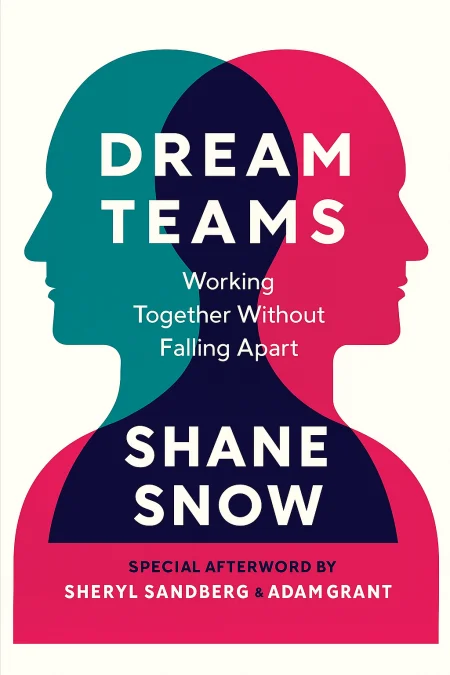
Dream Teams
Working Together Without Falling Apart
Book Edition Details
Summary
In the chaotic dance of human collaboration, where do alliances falter and why do some soar? Shane Snow's "Dream Teams" spins a tapestry of insight from the unexpected corners of history and science, revealing why some groups thrive against the odds. From pirate crews defying the seas to the explosive synergy of Wu-Tang Clan, Snow uncovers the magic ingredient that turns mere cooperation into a symphony of progress. What can the daily sparring of the Wright Brothers teach us about innovation? How do pioneering women and unlikely allies forge paths in the pursuit of justice? This is a thrilling exploration into the alchemy of teamwork, destined to reshape our understanding of unity and achievement.
Introduction
Picture this: You're sitting in a conference room, watching yet another team meeting dissolve into awkward silence or heated arguments. Sound familiar? Most of us have been there, witnessing the painful gap between what teamwork promises and what it actually delivers. We're told that collaboration is the key to success, yet statistics show that most teams underperform compared to individuals working alone. It's a paradox that has puzzled leaders, managers, and team members for decades. But what if everything we've been taught about successful teamwork is fundamentally wrong? What if the very differences that make us uncomfortable, the tensions that we try so hard to smooth over, and the conflicts we desperately avoid are actually the secret ingredients of breakthrough collaboration? This exploration takes us on a journey through history's most unlikely partnerships and unexpected victories, from Soviet hockey dynasties to hip-hop collectives, from detective duos to social movements that changed the world. Through these remarkable stories, we'll discover that the teams that truly change everything aren't the ones filled with people who think alike, but rather those brave enough to harness the creative power of their differences. The path to extraordinary collaboration isn't about eliminating friction—it's about learning to dance with it.
The Power of Cognitive Diversity: From Buddy Cops to Hockey Champions
In 1856, a young widow named Kate Warne walked into Allan Pinkerton's detective agency in Chicago and did something unprecedented: she applied to become America's first female detective. Pinkerton was skeptical—it simply wasn't done. But Warne had a compelling argument. She could infiltrate places and gather information that would be impossible for male detectives. Her different perspective, she insisted, would be an asset, not a liability. Warne proved her worth spectacularly. When President-elect Abraham Lincoln faced an assassination plot in Baltimore, it was Warne who devised the ingenious plan that saved his life. Disguised as an invalid's sister, she helped Lincoln slip through the city undetected while would-be assassins waited at the wrong station. Her success wasn't despite her differences from typical detectives—it was because of them. Fast-forward to the height of the Cold War, when the Soviet hockey team dominated international competition for three decades. Their secret wasn't superior individual talent; many Western teams had better statistics. Instead, their coach made them study ballet, chess, and martial arts. This unconventional approach created players who thought differently about the game, turning hockey into what opponents called "a deadly ballet." When these Soviet players later joined American teams individually, they struggled. But when Detroit's Red Wings reunited several of them in the 1990s, magic happened again. Together, they won back-to-back Stanley Cups. Their cognitive diversity—different ways of seeing and solving problems—created a synergy that transcended individual ability. The pattern emerges clearly: breakthrough performance isn't about assembling the most talented individuals or the most harmonious teams. It's about bringing together people whose minds work differently, whose life experiences have given them unique perspectives and problem-solving approaches. Like Kate Warne infiltrating spaces closed to men, or Soviet players seeing hockey through the lens of dance and strategy, cognitive diversity turns ordinary groups into extraordinary teams.
Navigating Team Tension: Wu-Tang Clan and the Zone of Progress
Robert Diggs grew up in New York's housing projects, surrounded by violence and despair. After a close call with the law in Cleveland, he had a vision: he would bring together the best rappers from rival neighborhoods and create something the world had never heard. The problem? These weren't just different personalities—some were literally enemies who had been feuding for years. When the nine young men who would become Wu-Tang Clan first gathered in 1992, the tension was palpable. Raekwon thought Ghostface was a crook. Method Man and RZA argued constantly. Their different styles, backgrounds, and loyalties created friction that could have exploded into violence at any moment. But Diggs, now calling himself The RZA, channeled this tension into something productive: musical battles where each rapper had to compete for spots on the album. The result was "Enter the Wu-Tang: 36 Chambers," a groundbreaking album that changed hip-hop forever. Their combined talents created a sound no individual could have produced alone. But success required staying in what we might call "The Zone"—that delicate space between destructive conflict and stagnant harmony where creative friction generates breakthrough results. Consider the opposite extreme: the failed merger of Daimler and Chrysler, which destroyed $50 billion in value. Despite having complementary skills and resources, the German and American employees couldn't handle their cultural differences. Instead of engaging productively with their diverse perspectives, they retreated into organizational silence, avoiding the very tensions that could have created innovation. The Wright brothers understood this balance instinctively. Their heated daily arguments were legendary, but they had a crucial technique: they would switch sides mid-debate, forcing themselves to see problems from their opponent's perspective. This kept their conflicts focused on finding solutions rather than winning ego battles. The lesson is profound: cognitive friction isn't something to be eliminated—it's the engine of progress. Teams that achieve extraordinary results learn to stay in The Zone, where differences create energy rather than destruction. They understand that steel sharpens steel, and that the discomfort of engaging with different viewpoints is the price of breakthrough innovation.
Building Unity Through Stories: From Pirates to Social Change
When British forces threatened New Orleans in 1814, General Andrew Jackson faced an impossible task: defending America's gateway with a ragtag army that included Tennessee frontiersmen, free men of color, local militia, Choctaw warriors, and a gang of pirates led by Jean Laffite. These groups had every reason to mistrust each other—some were traditional enemies. Yet together, they achieved one of the most stunning military victories in American history, defeating 20,000 trained British soldiers while suffering minimal casualties themselves. The secret wasn't shared values or cultural similarity. Jackson's army succeeded because they found a superordinate goal that mattered more than their differences: protecting their home from invasion. The pirates' knowledge of local waterways, the Choctaws' guerrilla tactics, the sharpshooters' precision, and the militia's local knowledge combined to create an unbeatable defense strategy. But here's the twist: after the victory, the coalition fell apart. Jackson refused to give the pirates proper credit, the government seized their property, and old prejudices resurged. Their unity had been temporary because it was built solely on shared opposition to a common enemy. Compare this to the story of Malcolm X, whose transformation from militant separatist to champion of human rights illustrates a different kind of unity. Through travel and exposure to different cultures, particularly during his pilgrimage to Mecca, Malcolm's perspective expanded dramatically. He learned to see people not through the lens of racial categories but as individuals worthy of respect and dignity. Malcolm's change of heart wasn't just personal—it helped bridge different factions of the civil rights movement. His intellectual humility, his willingness to reconsider deeply held beliefs based on new experiences, allowed him to contribute to a dream team of social change that included both radical and moderate voices. The deeper truth about unity emerges: lasting collaboration requires more than shared goals or similar backgrounds. It demands what researchers call "intellectual humility"—the ability to hold our beliefs lightly enough to change them when confronted with compelling evidence. It requires seeing our differences not as threats to overcome but as assets to leverage. Most powerfully, it happens when we share our stories with each other, creating the empathy and understanding that transforms strangers into teammates and adversaries into allies.
Summary
The greatest breakthroughs in history—from scientific discoveries to artistic masterpieces, from military victories to social movements—happened not when like-minded people worked together, but when different kinds of people found ways to combine their unique perspectives, experiences, and approaches. The Soviet hockey players who revolutionized their sport, the unlikely coalition that saved New Orleans, the hip-hop collective that created a new sound, and the detectives who prevented an assassination all succeeded because they harnessed rather than eliminated their differences. The path forward isn't about building teams where everyone thinks alike or eliminating the discomfort of working with people unlike ourselves. Instead, it's about developing what we might call "collaborative courage"—the willingness to stay in the productive tension between conflict and conformity, the intellectual humility to change our minds when we encounter compelling new perspectives, and the storytelling skills to build bridges of understanding across the chasms of difference. When we stop seeing diversity as a problem to manage and start seeing it as fuel for innovation, when we learn to navigate the delicate balance between creative friction and destructive conflict, and when we develop the emotional intelligence to unite around shared humanity while celebrating our unique contributions, we unlock the true power of human collaboration. The choice is ours: we can continue building teams that merely get along, or we can dare to create the kind of dream teams that change the world.
Related Books
Download PDF & EPUB
To save this Black List summary for later, download the free PDF and EPUB. You can print it out, or read offline at your convenience.
By Shane Snow
