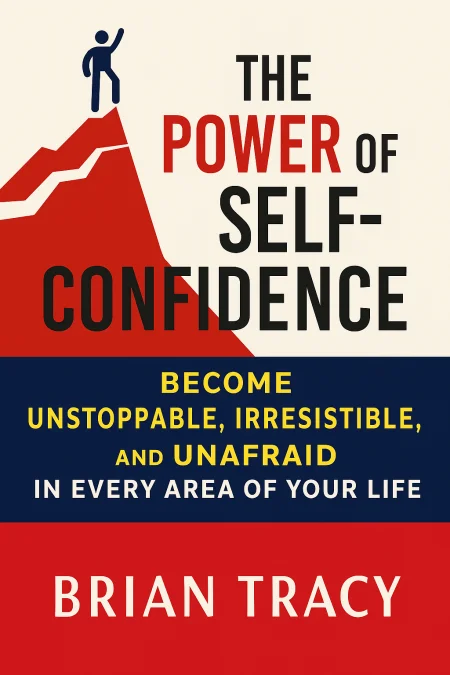
The Power of Self-Confidence
Become Unstoppable, Irresistible, and Unafraid in Every Area of Your Life
Book Edition Details
Summary
In the labyrinth of success, what if self-confidence is the secret key? Brian Tracy’s "The Power of Self-Confidence" invites you to reimagine your potential and redefine your limits. This transformative guide doesn't just suggest you dream bigger—it equips you with the mental toolkit to turn those dreams into reality. From the boardrooms of multinational corporations to the aspiring entrepreneur’s first pitch, the book reveals how unwavering belief in oneself can catapult you over obstacles and into the realm of extraordinary achievement. With strategies honed from interactions with millions across the globe, Tracy empowers you to tap into your deepest values, craft precise goals, and cultivate resilience that defies doubt. Ready to become unstoppable? Your journey to unshakable confidence begins here.
Introduction
What if the only thing standing between you and an extraordinary life is the strength of your belief in yourself? Every day, millions of people wake up with dreams that remain unfulfilled, not because they lack talent or opportunity, but because they doubt their own capability to achieve greatness. The invisible barrier of self-doubt keeps us trapped in mediocrity, watching others succeed while we remain on the sidelines of our own lives. True self-confidence isn't about positive thinking or motivational mantras. It's about developing an unshakable inner knowing that you can handle whatever life throws at you. It's the difference between those who merely survive and those who truly thrive. When you possess genuine self-confidence, you don't just set bigger goals—you achieve them. You don't just dream of success—you create it. The world responds to your energy, opportunities appear, and what once seemed impossible becomes inevitable.
Build Your Foundation of Values and Goals
The cornerstone of unshakable self-confidence lies in crystal-clear values and purposeful goals that align with your deepest beliefs. Without this foundation, even the most talented individuals drift aimlessly, their potential untapped and their confidence fragile. Values serve as your internal compass, guiding decisions and providing stability when challenges arise. Consider the story of a young man who worked at a computer sales company in New Jersey. She was an accounting clerk earning modest wages, watching salespeople around her earn significantly more. Despite being told repeatedly that accounting and sales were completely different skill sets and that her chances of success were minimal, she had a clear value system centered on growth and contribution. She believed deeply that she could serve customers better by understanding their needs and providing solutions. Her persistence paid off when she was finally given a chance to replace a vacationing salesman. What happened next was remarkable. Her clear values of integrity and service, combined with her accounting background's attention to detail, created a unique approach to sales. Today, she accounts for over fifty percent of her company's seventeen million dollars in annual software and computer peripheral sales, earning nearly half a million dollars per year. The transformation began with values clarification. Write down your core values and organize them by priority. When you know what you stand for, decision-making becomes effortless, and your confidence grows because you're acting in alignment with your authentic self. Create your personal mission statement and let it guide every choice you make.
Master Your Skills and Develop Excellence
Excellence isn't a destination—it's a journey of continuous improvement that builds confidence through competence. The most self-assured people in any field share one common trait: they are exceptionally good at what they do, and they know it. This knowledge creates a foundation of positive knowing rather than mere positive thinking. A powerful example emerges from a young salesman in Pittsburgh who started his career with no experience and no knowledge of his product. In his first year, earning only twenty-two thousand dollars, he discovered an audio program on selling psychology. Instead of making excuses about his circumstances, he committed to becoming excellent. He listened repeatedly, bought additional programs, read voraciously, and attended seminars. The results were extraordinary. His second year brought forty-eight thousand dollars, his third year ninety-four thousand, and his fourth year over one hundred seventy-five thousand dollars. Same products, same market, same conditions—but a completely different person. He had developed what researchers call "integrative complexity," the ability to recognize patterns and respond effectively based on accumulated knowledge and experience. The law of incremental improvement states that small, consistent efforts compound over time. Identify your key result areas—the five to seven core skills that determine success in your field. Grade yourself honestly on each, then systematically work to strengthen your weakest areas. Remember, your weakest important skill determines the height of your success. Invest three percent of your income in personal development, read for an hour daily in your field, and turn your car into a mobile classroom with educational audio programs.
Control Your Mind and Transform Your Beliefs
Your mind is the control center of your confidence, and taking charge of your thoughts is perhaps the most crucial skill you can develop. The law of belief states that your beliefs become your realities, and by consciously directing your mental focus, you can transform your inner world and, consequently, your outer circumstances. There's a remarkable story of a businessman whose company was failing, suppliers closing in, and bankruptcy looming. During a desperate walk through a park, he encountered an elderly man who listened to his troubles and wrote him a check for five hundred thousand dollars, signed by John D. Rockefeller. Rather than cash the check immediately, the businessman placed it in his safe, using the knowledge of its existence to negotiate with confidence and close important deals. A year later, when he returned to meet the man and express gratitude for his business turnaround, he discovered the elderly gentleman was a mental patient who regularly escaped from a rest home, pretending to be Rockefeller. The check was worthless, yet his belief in its value had created real results. His self-confidence, built on this belief, had generated the behaviors and decisions that saved his business. This illustrates the power of controlled thinking. Begin each day by writing your goals in present tense, as if already achieved. Use the law of substitution—your conscious mind can only hold one thought at a time—to replace negative thoughts with positive affirmations. Practice mental rehearsal before important events, visualizing successful outcomes in vivid detail. Create a positive suggestive environment by controlling what enters your mind through books, audio programs, and associations with optimistic people.
Take Action and Triumph Over Adversity
The ultimate test of self-confidence comes not in moments of ease, but in times of challenge and adversity. Your ability to maintain composure and take constructive action when facing setbacks determines whether obstacles become stepping stones or stumbling blocks. True confidence is forged in the crucible of difficulty. History teaches us that all great achievements are preceded by great challenges. Thomas Edison, perhaps the most prolific inventor of all time, failed thousands of times before perfecting the electric light bulb. He understood that success is a numbers game, and each failure brought valuable knowledge. When asked about his failures, Edison replied that he had not failed—he had simply found thousands of ways that didn't work. The challenge-response theory of civilization applies to individuals as well. Each time you face adversity and respond positively, you grow stronger and more capable. The key is preparation. Conduct crisis anticipation exercises, identifying potential problems and developing contingency plans. When challenges arise, immediately shift your focus from what went wrong to what can be done now. Develop what Olympic athletes call "stress inoculation" by deliberately challenging yourself in controlled ways. Take calculated risks, volunteer for difficult assignments, and push beyond your comfort zone regularly. Each act of courage builds additional courage, creating an upward spiral of confidence and capability. Remember that persistence is the ultimate demonstration of self-belief. As Calvin Coolidge observed, "Nothing in the world can take the place of persistence. Talent will not; nothing is more common than unsuccessful men with talent. Education will not; the world is full of educated derelicts. Persistence and determination alone are omnipotent."
Summary
Self-confidence is not a mysterious quality reserved for the chosen few—it is a learnable skill that can be developed through specific, proven methods. As this exploration reveals, "Your thoughts and feelings about yourself are the sum total result of a lifetime of experience and conditioning, and usually have little relationship to what is truly possible for you." The journey from self-doubt to unshakable confidence requires commitment to four fundamental areas: establishing clear values and goals, developing genuine competence, controlling your mental environment, and responding courageously to challenges. The transformation begins today with a simple but powerful decision: choose to act as if success is inevitable. Write down your three most important goals, identify the key skills needed to achieve them, and take one concrete action immediately. Your future self is counting on the choices you make in this moment.
Related Books
Download PDF & EPUB
To save this Black List summary for later, download the free PDF and EPUB. You can print it out, or read offline at your convenience.
By Brian Tracy
