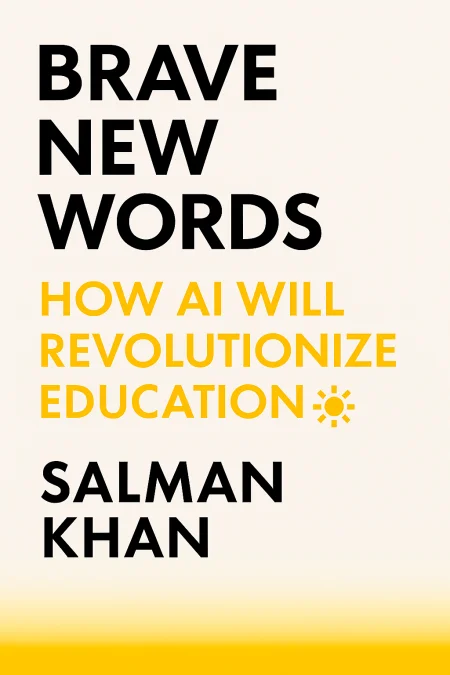
Brave New Words
How AI Will Revolutionize Education (and Why That's a Good Thing)
Book Edition Details
Summary
In a rapidly evolving digital landscape, Salman Khan, the visionary educator who revolutionized online learning, unveils a captivating exploration into the fusion of artificial intelligence and education. "Brave New Words" isn't just a glimpse into the future; it's a bold manifesto for harnessing AI's potential to reshape learning. With his insider's perspective, Khan challenges educators and parents to move beyond apprehension and embrace AI's transformative power. This isn't merely about tech upgrades; it's about reimagining education's core. From personalizing student experiences to redefining classroom dynamics, Khan illuminates pathways to a more inclusive, creative, and impactful learning environment. He deftly navigates the ethical considerations, offering a thoughtful dialogue on how these innovations could democratize education globally. Engaging and insightful, this book invites readers to rethink what learning could be in the age of AI, blending technological possibilities with human potential.
Introduction
Picture an eleven-year-old girl sitting at her kitchen counter on New Year's Day, fingers poised over a laptop keyboard, about to embark on an adventure that would have seemed impossible just months before. She begins typing a story about a sassy influencer named Samantha stranded on a deserted island. But then something extraordinary happens—the fictional character begins responding directly to the young writer, offering suggestions, asking questions, and helping craft the narrative in real-time. This isn't science fiction; it's the reality of artificial intelligence transforming how we learn, create, and engage with knowledge. We stand at the threshold of an educational revolution that promises to democratize learning on a scale never before imagined. For too long, quality education has been the privilege of the few—those with access to excellent schools, private tutors, or supportive family resources. Millions of brilliant minds around the world have been left behind, their potential unrealized due to circumstances beyond their control. But artificial intelligence is changing this equation fundamentally. This transformation brings both unprecedented opportunities and legitimate concerns. How do we harness AI's power to enhance human learning rather than replace it? How do we ensure that technology serves to connect rather than isolate, to inspire creativity rather than stifle it? The answers lie not in fear, but in what we might call educated bravery—the courage to embrace change while thoughtfully addressing its challenges. The future of education is being written now, and each of us has a role in shaping whether that future uplifts human potential or diminishes it.
The AI Awakening: From Khan Academy to Khanmigo
When Khan Academy first launched as a simple tutoring tool for family members, few could have predicted it would serve over 150 million learners worldwide. But even this remarkable reach felt limited—students could watch videos and complete exercises, but they couldn't ask follow-up questions or engage in the dynamic conversations that make learning truly come alive. That changed dramatically when OpenAI reached out with an early version of GPT-4, the most advanced language model ever created. The demonstration was nothing short of breathtaking. When asked to solve an Advanced Placement biology question, GPT-4 not only provided the correct answer but explained its reasoning step by step. More remarkably, when prompted to explain why other answer choices were wrong, it delivered clear, pedagogically sound explanations. The AI didn't just know the material—it could teach it. Within seconds, it generated ten original AP-level questions, each one demonstrating sophisticated understanding of biological concepts and testing methodology. This moment crystallized a profound realization: we were witnessing the birth of the first truly intelligent tutoring system. Unlike previous educational technologies that could only deliver pre-programmed responses, this AI could engage in genuine Socratic dialogue, adapting its teaching style to each student's needs and interests. When a struggling student mentioned loving soccer, the AI seamlessly wove soccer analogies into complex mathematical concepts, making abstract ideas suddenly accessible. The implications extend far beyond individual learning experiences. For the first time in human history, we have the technology to provide every student on Earth with access to what Benjamin Bloom called the "two-sigma" advantage—the dramatic learning improvements typically seen only with one-on-one tutoring. This isn't just about making education more efficient; it's about fundamentally reimagining what becomes possible when every learner has a patient, knowledgeable, and endlessly available personal tutor by their side.
Transforming Learning: AI in Classrooms and Beyond
When Professor Darren Hick discovered that one of his students had used ChatGPT to write a philosophy paper, his first instinct was alarm. The paper was suspiciously polished, confidently presenting incorrect information as fact—a telltale sign of AI generation. His Facebook post warning about AI's threat to education went viral, capturing the fears that many educators felt as they grappled with this new reality. Students could now generate essays, solve problems, and complete assignments with unprecedented ease. But Hick's story didn't end with condemnation. As he wrestled with the implications of AI in education, he began to see a different path forward. Rather than ban the technology, he started exploring how it might enhance rather than undermine genuine learning. This shift in perspective reflects a broader awakening happening across education: the realization that AI's power lies not in replacing human creativity but in amplifying it. Consider Saanvi, a ninth-grade student reading "The Great Gatsby" for class. When she struggled to understand Jay Gatsby's obsession with the green light, she did something that would have been impossible just months earlier—she asked to speak directly with the character himself. Through AI simulation, Gatsby explained his yearning for Daisy, his dreams of the past, and the symbolism of that distant green light. This wasn't cheating; it was a new form of literary engagement that brought fiction to life in ways traditional textbooks never could. The transformation extends beyond individual subjects to the very nature of creative collaboration. Students now work alongside AI tutors that refuse to give away answers but instead ask probing questions that guide discovery. They engage in debates with historical figures, conduct experiments with simulated scientists, and receive immediate feedback on their writing—all while developing deeper understanding and genuine ownership of their learning. We're witnessing the emergence of education that is finally as dynamic and responsive as the young minds it seeks to nurture.
Preparing for Tomorrow: Future of Education and Work
In a Stanford computer science office, a young student sat across from her professor with tears in her eyes. She had just learned to code, dedicating countless hours to mastering programming skills, only to discover that artificial intelligence could now write software better than many human programmers. Her question haunted the conversation: "What's the point of learning skills that AI can do better?" This moment encapsulates the anxiety many feel about AI's impact on human capability and purpose. The professor's response revealed a crucial insight: while AI can indeed write code, creating meaningful solutions requires understanding how pieces fit together, knowing what problems to solve, and having the vision to direct AI tools effectively. The student's coding skills weren't becoming obsolete—they were becoming the foundation for wielding AI as a powerful creative instrument. Like a conductor who doesn't play every instrument but orchestrates beautiful symphonies, tomorrow's innovators will blend deep knowledge with AI collaboration. This evolution mirrors broader changes reshaping the workplace. Early studies show that workers using AI tools demonstrate 30 to 80 percent performance improvements across analytical tasks, writing, and problem-solving. The most successful professionals aren't those who resist AI but those who learn to dance with it—using the technology to tackle more ambitious projects, explore creative possibilities, and solve problems that were previously beyond reach. The implications for education are profound. Rather than drilling students in tasks that AI can perform, schools must focus on developing uniquely human capabilities: creative thinking, emotional intelligence, ethical reasoning, and entrepreneurial vision. Students need to become orchestrators of intelligence—both artificial and human—capable of directing AI tools toward meaningful goals while maintaining their own agency and creativity.
Building the AI-Enhanced Educational Future
The numbers tell a sobering story: three hundred thousand teacher positions remain unfilled across America, with educators working an average of fifty-four hours per week while spending less than half their time actually interacting with students. The remainder disappears into lesson planning, grading papers, writing progress reports, and countless administrative tasks that drain passion from the profession. Meanwhile, students in the same classroom span six grade levels of ability—an impossible range for any human teacher to address effectively. Yet within this crisis lies unprecedented opportunity. Imagine every teacher suddenly having access to three brilliant assistants who never tire, never call in sick, and work around the clock to support both instruction and student learning. These AI teaching assistants can generate lesson plans in minutes, provide real-time feedback on student work, facilitate small group discussions, and offer personalized support to every learner simultaneously. A teacher who once spent hours crafting a World War II lesson plan can now request an AI assistant to create an engaging curriculum that incorporates current events, local interests, or specific learning objectives. The magic happens when AI handles routine tasks, freeing teachers to do what they do best: build relationships, inspire curiosity, and guide human development. Students receive immediate, patient tutoring from AI while teachers focus on facilitating rich discussions, managing group projects, and providing the emotional support that only humans can offer. Rather than replacing teachers, AI elevates their role from information delivery to learning facilitation and mentorship. This vision extends beyond traditional classrooms to alternative education models, homeschooling families, and underserved communities worldwide. A homeschooled student in rural Montana can access the same quality tutoring as a child in Silicon Valley. A teacher in Bangladesh can provide world-class instruction supported by AI tools that adapt to local languages and cultural contexts. For the first time in history, we have the technology to ensure that every child, regardless of circumstances, has access to personalized, world-class education.
Summary
Standing at this pivotal moment in educational history, we face a choice that will echo through generations. We can embrace artificial intelligence as the great equalizer—a technology capable of providing every learner with access to patient, knowledgeable tutoring regardless of their economic circumstances or geographic location. Or we can allow fear to hold us back, perpetuating educational inequities that have persisted for centuries. The path forward requires what we might call educated bravery: the wisdom to acknowledge legitimate concerns about AI while courageously exploring its potential to transform human learning. This means implementing thoughtful safeguards against cheating while recognizing that students who learn to collaborate effectively with AI will be better prepared for tomorrow's world. It means using AI to strengthen rather than replace human connections, freeing up time for the rich interpersonal experiences that make education meaningful. Most importantly, it means recognizing that this technology offers us an unprecedented opportunity to realize human potential on a global scale. Instead of having one Mozart every few centuries, we might nurture thousands. Rather than leaving brilliant minds underdeveloped due to lack of educational access, we can provide every child with the support they need to flourish. The future of education isn't about choosing between human and artificial intelligence—it's about orchestrating both in service of the most important goal we can imagine: helping every person discover and develop their unique gifts. The revolution has begun, and each of us has a role in shaping whether it leads to a world of unprecedented human flourishing.
Related Books
Download PDF & EPUB
To save this Black List summary for later, download the free PDF and EPUB. You can print it out, or read offline at your convenience.
By Salman Khan
