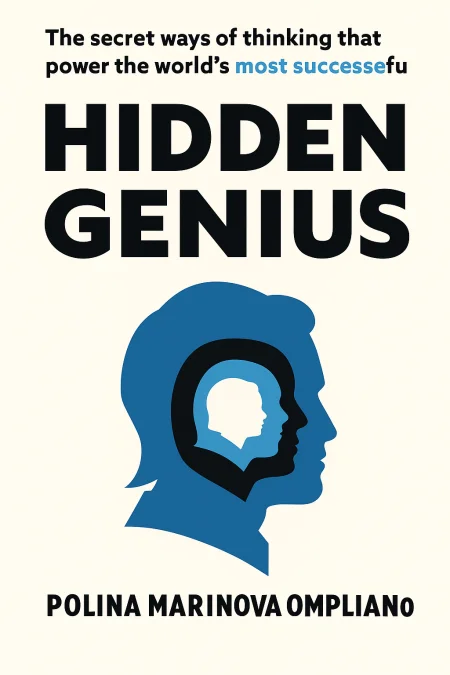
Hidden Genius
The secret ways of thinking that power the world's most successful people
Book Edition Details
Summary
In a world obsessed with shortcuts to success, "Hidden Genius" reveals the true alchemy of brilliance lies in the mental blueprints of the extraordinary. Through the seasoned eyes of Polina Marinova Pompliano, who has meticulously charted the minds of innovators and leaders over half a decade, we discover that the road to unparalleled achievement is paved not with tricks, but with transformative perspectives. These mental frameworks, the secret sauce behind creativity under pressure and problem-solving finesse, are laid bare in this insightful tome. As you turn each page, gain a mental toolkit designed to revolutionize how you tackle challenges, harness creativity, and thrive amidst uncertainty, tapping into your latent genius along the way.
Introduction
Picture this: A young chef stands in his world-renowned restaurant, preparing to taste a dish that could make or break the evening's service. But there's one devastating problem—he can't taste anything. Stage-four tongue cancer has stolen his most essential sense, the very foundation of his culinary genius. Most would surrender, accepting that their career was over. But Grant Achatz wasn't most people. Instead of giving up, he developed a revolutionary approach to cooking that relied not on his tongue, but on his mind. He created visual maps of flavor, drawn on paper like constellations, connecting ingredients through logic and science rather than instinct alone. This story captures something profound about human potential. We often assume that extraordinary achievement requires extraordinary talent, perfect circumstances, or natural-born gifts. But what if that's not true? What if the most successful people in the world have simply learned to think differently—to see obstacles as opportunities, to find creative solutions where others see dead ends, and to tap into capabilities that exist within all of us? After years of studying the world's most remarkable individuals, from Olympic champions to Nobel laureates, from Fortune 500 CEOs to groundbreaking artists, a pattern emerges. These exceptional people don't just work harder or get luckier than the rest of us. They've developed distinct ways of thinking, unique mental frameworks, and hidden strategies that allow them to consistently perform at levels that seem impossible to others. They've discovered their hidden genius—and more importantly, they've learned how to cultivate it. This exploration will take you inside the minds of people who have achieved the seemingly impossible, not to worship them as heroes, but to understand the practical thinking patterns and strategies that drive their success. You'll discover that genius isn't a fixed trait you're born with or without—it's a way of thinking that can be developed, practiced, and applied to transform your own life.
Unleashing Creative Potential: From Grant Achatz to Mental Toughness Masters
When Grant Achatz lost his sense of taste to cancer, he faced what seemed like an insurmountable challenge. How does a chef create extraordinary dishes without being able to taste them? Rather than abandoning his dream, Achatz developed what he called "flavor bouncing"—a systematic approach to creativity that relied on logic rather than intuition. He would draw circles on paper, placing one central ingredient in the middle and mapping complementary flavors around it like satellites orbiting a planet. Each supporting ingredient had to work with the central element and at least one other component, creating a web of harmony that existed first on paper, then on the plate. This methodical approach to creativity challenges everything we believe about artistic inspiration. We've been taught to wait for the muse to strike, to hope for moments of divine inspiration. But Achatz proved that creativity isn't magic—it's a skill that can be systematized, practiced, and perfected. Leonardo da Vinci understood this centuries ago when he developed his technique of "connecting the unconnected," deliberately focusing on two unrelated subjects until his mind found unexpected relationships between them. A stone hitting water at the same moment a church bell rang led him to discover that sound travels in waves. The most creative people in the world share a common approach: they manufacture creativity rather than waiting for it. They create friction, embrace failure as feedback, and understand that original work requires pushing beyond the comfortable and familiar. Ed Catmull of Pixar built this philosophy into his company's DNA, encouraging teams to "aim to fail the elevator test." If you can explain your idea in thirty seconds, he argued, it's probably not original enough. The most groundbreaking concepts—like "a rat that wants to cook" or "an old man who floats away with balloons"—seem absurd at first but become compelling through persistent refinement. Mental toughness follows a similar pattern of deliberate development. David Goggins, who transformed from an overweight pest control worker into one of the world's most formidable endurance athletes, didn't stumble upon mental strength—he systematically built it. His "40% rule" reveals that when our minds tell us we're finished, we're typically only 40% done. Our brains create artificial limits to protect us from discomfort, but we can override these safety mechanisms through training and practice. The most mentally tough individuals don't just endure suffering—they manufacture it intentionally. They create "elective hardship" in their daily lives, choosing the difficult path when easier options exist. Ultra-runner Courtney Dauwalter talks about entering "the pain cave" not with dread, but with curiosity and even excitement. By reframing pain as information rather than torment, she transforms one of life's most universal negatives into a source of strength and insight.
Building Relationships and Leading Through Stories: The Human Connection
Trust, the foundation of all meaningful relationships, follows a deceptively simple formula: consistency plus time equals trust. Naval Ravikant describes trust as compound interest for human connections—small, reliable actions that build exponentially over time. But most relationships don't collapse from dramatic betrayals; they erode slowly through countless tiny disappointments and unmet expectations. Chris Voss, former FBI hostage negotiator, discovered that even in life-or-death situations, the key to connection isn't talking—it's listening with extraordinary precision. When facing armed bank robbers, Voss employed three critical techniques: controlling his tone to create neurochemical calm, mirroring his counterpart's words to build unconscious rapport, and labeling emotions to help people feel truly heard and understood. These same tools that save lives in crisis situations can transform everyday relationships, turning conflict into connection and misunderstanding into mutual respect. The world's most effective leaders understand that their role isn't to be the smartest person in the room, but to create conditions where others can do their best thinking. Daniel Ek of Spotify calls this "inverting the pyramid"—seeing himself not at the top of the organizational chart, but at the bottom, supporting everyone above him. When his team proposed Discover Weekly, a feature he personally doubted, Ek stepped back and let them proceed. The feature became one of Spotify's most beloved innovations, proving that the best ideas often come from the edges, not the center. This principle extends beyond business into the art of storytelling. We are all unreliable narrators of our own lives, emphasizing certain details while minimizing others, often unconsciously distorting reality to protect our ego or maintain our self-image. The most compelling storytellers understand that conflict drives narrative—not just external obstacles, but the internal tensions that make characters human. Aaron Sorkin's genius lies not in creating perfect heroes, but in showing us flawed people pursuing meaningful goals despite the barriers in their way. Great leaders and storytellers share this understanding: people don't connect with perfection, they connect with authentic struggle and genuine growth. Whether you're managing a team, raising children, or building a marriage, the ability to create psychological safety—where people feel free to fail, learn, and grow—becomes your greatest source of influence and impact.
Taking Smart Risks and Clarifying Thought: The Decision-Making Edge
Risk isn't the enemy of success—unexamined thinking is. The world's most successful risk-takers aren't daredevils who ignore danger; they're methodical analysts who understand the difference between calculated risk and reckless gambling. Big wave surfer Garrett McNamara doesn't just paddle out into 80-foot waves hoping for the best. He spends hours preparing his body and mind, studying weather patterns, and developing contingency plans for every scenario he can imagine. The key insight from master risk-takers is that competence breeds confidence, not the reverse. Astronaut Chris Hadfield went temporarily blind during a spacewalk outside the International Space Station, but instead of panicking, his years of preparation kicked in. He had rehearsed this exact scenario countless times in training, turning a potentially fatal emergency into just another problem to solve methodically. As Hadfield puts it, "Fear is just a symptom of lack of preparation." But even perfect preparation can't eliminate uncertainty entirely. The most sophisticated risk management acknowledges that life contains irreducible randomness—what Morgan Housel calls "tail-end consequences," low-probability events that change everything. Conrad Anker survived an avalanche that killed his climbing partners not through superior skill, but through split-second luck. He went left; they went right. Sometimes the difference between triumph and tragedy comes down to factors completely beyond our control. This reality makes clear thinking even more crucial. We must constantly examine our beliefs, updating them as new information emerges rather than clinging to outdated mental models. The most dangerous phrase in human thinking might be "I've always believed this," because it suggests we've stopped questioning, stopped learning, stopped growing. Julia Galef's distinction between "soldier mindset" and "scout mindset" illuminates this challenge perfectly. Soldiers defend territory at all costs, even when that territory no longer serves them. Scouts explore new terrain with curiosity, mapping reality as accurately as possible regardless of whether they like what they find. The scout's question isn't "How can I prove I'm right?" but "What would it take to change my mind?" Charlie Munger's "iron prescription" embodies this principle: he won't express an opinion on any subject until he can argue the opposing position better than its advocates can. This intellectual humility isn't weakness—it's the foundation of wisdom, the prerequisite for making decisions based on truth rather than ego or wishful thinking.
Creating Community and Discovering Your Hidden Genius: The Path Forward
Loneliness isn't about being alone—it's about the gap between the relationships we want and the relationships we feel we have. Even billionaire entrepreneurs like Elon Musk can feel profoundly isolated despite being surrounded by people constantly. The antidote to loneliness isn't more social contact; it's meaningful connection built around shared purpose and mutual care. The most vibrant communities form not around geography or demographics, but around common values and shared missions. Brandon Stanton's Humans of New York became more than a photography project; it became a global community united by curiosity about human experience and compassion for human struggle. When Stanton featured Tanqueray, a 76-year-old former burlesque dancer facing medical hardship, complete strangers donated $2.7 million in weeks because they felt genuine connection to her story and wanted to help. This reveals something profound about human nature: we're desperate to matter, to contribute, to be part of something larger than ourselves. The communities that thrive understand this deep hunger and create opportunities for members to serve each other, not just consume content or products. Your identity isn't fixed—it's fluid, malleable, constantly evolving based on the stories you tell yourself about who you are and who you're becoming. Francis Ngannou grew up in extreme poverty in Cameroon, working sand mines for $1.90 a day while dreaming of becoming a world champion boxer. Everyone told him he was delusional, but Ngannou understood something crucial: he wasn't tied to other people's definitions of his potential. The journey from his village to UFC heavyweight champion took him across the Sahara Desert, through Moroccan jails, into Parisian parking lots where he slept rough while training. At every step, he faced a choice: accept the limitations others placed on him, or bet on his own vision of what was possible. The secret to his transformation wasn't physical strength—it was mental flexibility, the willingness to reject labels, start over, and rebuild himself around his deepest values and highest aspirations.
Summary
The hidden genius that powers extraordinary success isn't a mysterious gift granted to a chosen few—it's a set of learnable thinking patterns and deliberate practices that anyone can develop. From Grant Achatz systematizing creativity while battling cancer to David Goggins manufacturing mental toughness through voluntary hardship, from Julia Galef teaching intellectual humility to Francis Ngannou refusing to accept others' limitations, these remarkable individuals share common approaches to life's challenges. They understand that creativity can be manufactured through systematic connection-making rather than waiting for inspiration. They build mental resilience by choosing difficulty when easier paths exist, reframing pain as information rather than suffering. They create trust through consistent small actions over time, knowing that relationships are investments that compound. They take calculated risks after thorough preparation, accepting that uncertainty is permanent but manageable. They examine their beliefs constantly, updating their thinking as new evidence emerges. And perhaps most importantly, they refuse to let others define their potential, instead betting on themselves and their ability to learn, grow, and adapt. Your own hidden genius lies not in discovering some special talent you didn't know you possessed, but in adopting these same thinking patterns and practices. Start small: manufacture a moment of creativity by connecting two unrelated ideas. Choose one difficult thing to do today instead of taking the easy path. Listen more carefully to someone you disagree with, seeking to understand rather than to win. Question one belief you've never examined. Take one calculated risk in service of a meaningful goal. Most importantly, begin tying your identity to your own name and values rather than external titles or others' expectations. The path to extraordinary achievement isn't about being chosen—it's about choosing to think and act in ways that unlock the potential that already exists within you.
Related Books
Download PDF & EPUB
To save this Black List summary for later, download the free PDF and EPUB. You can print it out, or read offline at your convenience.
By Polina Marinova Pompliano
