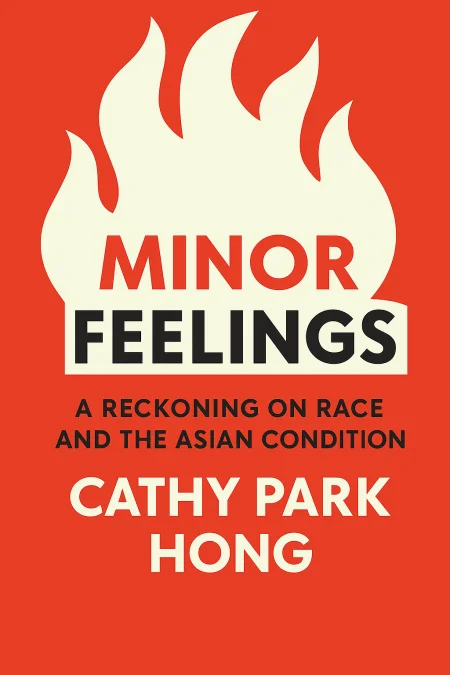
Minor Feelings
A Reckoning on Race and the Asian Condition
Book Edition Details
Summary
Cathy Park Hong’s "Minor Feelings" serves as a resonant mirror to the often invisible struggles of Asian American identity, unraveling the dissonance between the rosy hues of American optimism and the stark shades of personal reality. Hong, a poet and daughter of Korean immigrants, navigates the labyrinth of racial consciousness with incisive wit and raw honesty, crafting a narrative that is as intimate as it is expansive. Her exploration dives deep into the interplay of language, art, and identity, exposing the haunting weight of shame and melancholy woven into her cultural tapestry. This book is not just a memoir, but a clarion call for truth, capturing the essence of an Asian American experience often sidelined in the broader cultural discourse. With an artistry that is both fierce and tender, "Minor Feelings" beckons readers into a world of nuanced introspection and transformative insight.
Introduction
Asian Americans occupy a peculiar space in American racial discourse—simultaneously hypervisible and invisible, successful yet silenced, praised yet perpetually foreign. This complex emotional terrain gives rise to what can be called "minor feelings": the racialized range of emotions that are negative, dysphoric, and therefore untelegenic, built from the sediments of everyday racial experience. These feelings emerge when American optimism is enforced upon individuals whose lived reality contradicts the dominant narrative of progress and meritocracy. The exploration of these minor feelings reveals how the model minority myth functions as both a shield and a prison, protecting certain privileges while constraining authentic expression and political solidarity. Through personal narrative interwoven with cultural criticism, this examination challenges readers to confront the ways that racial identity intersects with art, language, friendship, and family in contemporary America. The analysis demonstrates how silence and complicity can be forms of survival, while also showing how breaking that silence becomes an act of resistance against structures that demand gratitude from those they have historically excluded and exploited.
The Architecture of Asian American Invisibility and Racial Trauma
Asian Americans exist within a racial paradox that renders them simultaneously hypervisible as foreigners and invisible as individuals with distinct experiences of discrimination. This contradictory positioning creates a unique form of psychological distress rooted in what can be understood as "racial self-hatred"—seeing oneself through the degrading lens of white supremacy while being denied the vocabulary to articulate this harm. The phenomenon of Asian American invisibility operates through several mechanisms. Unlike other racial groups whose oppression is acknowledged through historical narratives of slavery or genocide, Asian Americans are positioned as perpetual immigrants whose struggles are minimized by their supposed economic success. This erasure is compounded by the tendency to collapse diverse Asian ethnicities into a monolithic identity, ignoring the vast differences in class, history, and experience among communities from East Asia, Southeast Asia, and South Asia. The trauma inflicted by this invisibility manifests in chronic hypervigilance and a persistent questioning of one's own perceptions. When discriminatory incidents occur, the victims find themselves doubting their reality as others dismiss their experiences as oversensitivity or paranoia. This gaslighting creates a psychological state where individuals become alienated from their own sensory experiences, leading to what might be called "reality fatigue." The consequences extend beyond individual psychology to shape broader patterns of political engagement. The myth of Asian American success breeds isolation from other communities of color and prevents the formation of meaningful coalitions against systemic racism. This isolation serves the interests of white supremacy by fragmenting potential resistance movements and positioning Asian Americans as a buffer group that legitimizes claims about America's colorblind meritocracy.
Challenging the Model Minority Myth Through Personal Narrative
The model minority stereotype functions as a sophisticated form of racial control that weaponizes partial truths to obscure systemic inequalities and prevent solidarity among communities of color. Rather than representing genuine progress toward racial equality, this myth serves to discipline both Asian Americans and other racial groups by creating false hierarchies based on compliance and assimilation. Personal experience reveals the psychological toll of living under the weight of model minority expectations. Asian Americans find themselves caught between the demand to represent their entire community through individual success and the knowledge that such representation is ultimately impossible and dehumanizing. The pressure to embody perfection creates a chronic sense of impostor syndrome and emotional suppression that distorts authentic self-expression. The myth's power lies in its ability to transform victims of racial discrimination into its unwitting agents. By suggesting that success is simply a matter of hard work and cultural values, the model minority narrative obscures the role of structural racism while implying that other communities of color are responsible for their own oppression. This divide-and-conquer strategy prevents meaningful coalition-building and allows white supremacist systems to persist unchallenged. Breaking free from the model minority trap requires recognizing how it functions as what might be called "conditional belonging"—a system that grants limited privileges in exchange for political passivity and cultural assimilation. True liberation demands rejecting the false choice between invisibility and tokenism, instead insisting on the right to be both complex and political, both successful and angry, both grateful and demanding of justice.
Language, Identity, and the Politics of Cultural Expression
The relationship between language and identity for Asian Americans reveals the complex negotiations required to exist authentically within a linguistic system that was never designed to accommodate their experiences. English, as the dominant colonial language, carries within it the imperial power structures that have historically excluded and dehumanized Asian communities, making authentic self-expression a constant struggle against the medium itself. The concept of "bad English" emerges as a form of resistance against linguistic imperialism. Rather than viewing imperfect English as a deficit, it becomes a creative force that exposes the limitations of standard linguistic conventions. This artistic othering of English creates space for new forms of expression that honor the multilingual reality of immigrant communities while challenging monolingual assumptions about communication and meaning. The pressure to achieve linguistic perfection reflects broader anxieties about belonging and acceptance in American society. Asian Americans often find themselves caught between multiple linguistic identities—the heritage languages that connect them to family and community, and the English proficiency that grants access to educational and professional opportunities. This linguistic code-switching becomes a daily performance of cultural negotiation. Cultural expression through "othered" English creates possibilities for cross-racial solidarity that transcend traditional identity categories. By embracing linguistic imperfection and creative deviation from standard forms, artists can create work that speaks to shared experiences of marginalization while avoiding the trap of cultural authenticity that often constrains minority artistic production. This approach allows for both cultural specificity and universal resonance without sacrificing either for the other.
Breaking Free from Conditional Belonging and White Supremacy
The path toward genuine liberation requires dismantling the psychological structures of conditional belonging that have shaped Asian American consciousness for generations. This conditional existence—always promised full acceptance while never quite achieving it—creates a perpetual state of striving that serves the interests of existing power structures while preventing authentic political engagement and self-determination. Recognition of this condition reveals how Asian Americans have been systematically positioned as a buffer between white supremacy and other communities of color. This positioning creates benefits that come with strings attached—economic advancement in exchange for political silence, cultural tolerance in exchange for grateful compliance. Breaking these arrangements requires accepting the loss of certain privileges while gaining the possibility of authentic freedom. The process of liberation involves developing what might be called "ungrateful consciousness"—a willingness to critique the systems that have provided limited opportunities while demanding something more substantial than conditional tolerance. This ungrateful stance challenges the narrative of America as a benevolent nation of immigrants by insisting on a reckoning with the violence and exploitation that have shaped the Asian American experience. True freedom emerges through solidarity with other communities that have been similarly positioned within systems of racial capitalism and imperial violence. Rather than seeking individual escape from racial categories, liberation comes through collective action that challenges the fundamental structures creating racial hierarchies. This approach recognizes that dismantling white supremacy benefits everyone, including those who have been granted conditional privileges within existing arrangements.
Summary
The exploration of minor feelings reveals how emotional experiences that are dismissed as insignificant actually expose the fundamental contradictions within American racial discourse and the psychological costs of living within systems of conditional belonging. Rather than seeking integration into existing structures, authentic freedom requires developing new forms of consciousness that refuse the false choices between invisibility and tokenism, gratitude and resistance, individual success and collective liberation. This work offers essential insights for anyone seeking to understand how racial identity intersects with art, politics, and personal authenticity in contemporary America.
Related Books
Download PDF & EPUB
To save this Black List summary for later, download the free PDF and EPUB. You can print it out, or read offline at your convenience.
By Cathy Park Hong
