
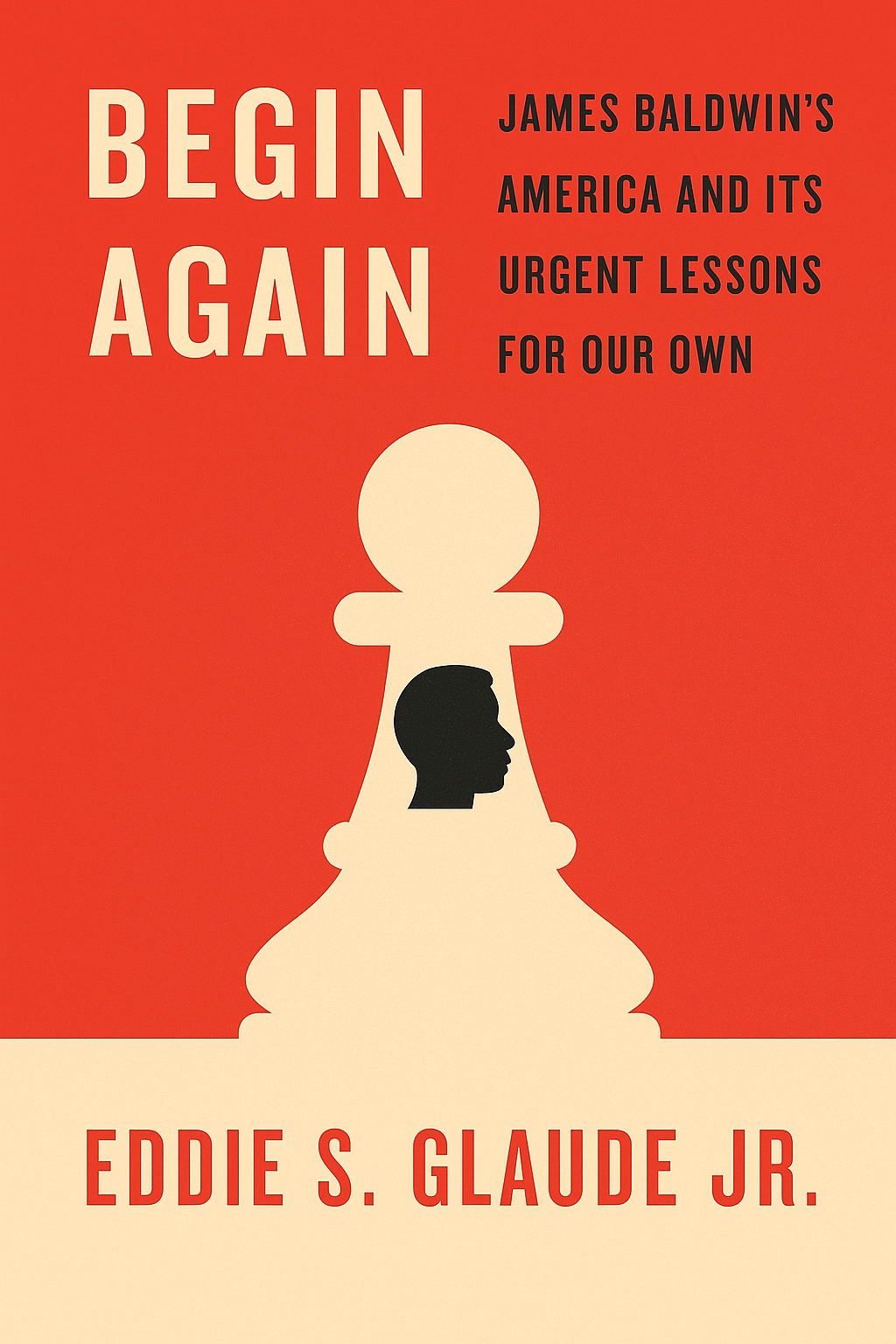
Begin Again
James Baldwin's America and Its Urgent Lessons for Our Own
Book Edition Details
Summary
What if the ghosts of America's past could guide us through today's turbulent times? Eddie S. Glaude Jr. poses this compelling question in "Begin Again," weaving the legacy of literary giant James Baldwin with the urgent realities of our present. As Baldwin once navigated the disillusionment following the civil rights movement, Glaude finds echoes of that struggle in the era of Trump and Black Lives Matter. Through a blend of newly unearthed interviews, historical insight, and personal reflection, Glaude explores the persistent specter of racial inequality that haunts the nation. This book is a clarion call, urging readers to confront uncomfortable truths and rediscover hope amidst chaos. It’s an intimate, provocative journey through the shadows of history, challenging us to envision a more equitable future.
Introduction
America stands at a crossroads, confronting the same racial contradictions that have plagued the nation since its inception. The promise of equality remains unfulfilled, while cycles of progress and betrayal continue to define the American experience. Through the lens of James Baldwin's prophetic witness during the civil rights era and its aftermath, a deeper understanding emerges of why meaningful change has proven so elusive and what fundamental transformation truly requires. Baldwin's insights transcend his historical moment, offering a framework for understanding how nations can genuinely confront their foundational lies rather than merely managing their symptoms. His concept of "beginning again" represents more than reform—it demands a complete reimagining of national identity built on truth rather than myth. The examination of Baldwin's evolution from hopeful advocate to clear-eyed critic reveals the psychological and moral demands of authentic democratic transformation. This exploration moves beyond conventional civil rights narratives to examine the deeper spiritual and psychological dimensions of racial justice. Baldwin's unflinching analysis of American self-deception provides tools for understanding contemporary political upheavals and the recurring patterns of racial backlash. The path forward requires not just policy changes but a fundamental shift in national consciousness—a third founding that finally delivers on democracy's unfulfilled promise.
The Lie: America's Fundamental Racial Deception
The foundation of American racial dynamics rests upon what Baldwin identified as "the lie"—a comprehensive system of false assumptions that maintains white supremacy while preserving national innocence. This lie operates on multiple levels: it debases black people as inherently inferior, rewrites history to obscure racial violence, and transforms America's worst crimes into evidence of its essential goodness. The lie serves as the mechanism by which the nation avoids confronting the contradiction between its democratic ideals and its racist practices. Baldwin understood that this deception was not merely about individual prejudice but constituted the very architecture of American identity. The lie creates what he termed the "value gap"—the belief that white lives matter more than others—and embeds this hierarchy so deeply into national consciousness that it becomes invisible to those who benefit from it. This system of assumptions shapes everything from criminal justice to education, from housing policy to electoral politics. The persistence of the lie explains why legal victories and symbolic progress fail to produce lasting change. Each apparent step toward equality is accompanied by new mechanisms of exclusion and control. The lie adapts and evolves, maintaining the essential structure of racial hierarchy while appearing to embrace reform. Baldwin's analysis reveals how this dynamic trapped even well-meaning white liberals who sought progress without surrendering their fundamental advantages. Understanding the lie's operation is crucial for comprehending why American democracy remains incomplete. The nation cannot achieve genuine equality while maintaining the foundational deception about its own character. Only by confronting this fundamental dishonesty can America begin the work of creating a truly multiracial democracy.
Witness: Baldwin's Role as Truth-Teller in Dark Times
Baldwin conceived his role as a writer in explicitly moral terms—to serve as a witness who would "make real" the suffering that America preferred to ignore. This witnessing demanded more than documentation; it required the courage to speak truths that challenged the nation's most cherished myths. Baldwin understood that his task was to force America to see itself clearly, stripping away the comforting illusions that allowed racial violence to continue unchallenged. The burden of bearing witness exacted a tremendous psychological toll. Baldwin carried the trauma of a nation that refused to acknowledge its crimes, and this trauma shaped both his artistic vision and his personal struggles. His writing became a means of processing collective pain while maintaining hope for transformation. The fragmented narrative structure of his later works reflected the way trauma disrupts linear memory, creating a form that matched the content of his witness. Baldwin's witness evolved as the civil rights movement collapsed and the nation's true intentions became clear. Initially, he had hoped that moral appeals might awaken white America's conscience. As this hope faded, his role shifted from prophet calling for repentance to chronicler documenting the consequences of America's refusal to change. This evolution marked not a failure of nerve but a deepening understanding of the forces arrayed against genuine transformation. The power of Baldwin's witness lay in its refusal to offer false comfort or easy absolution. He demanded that readers confront the full reality of American racial violence without the buffer of redemptive narratives. This unflinching honesty created the possibility for authentic change by refusing to allow the nation to hide behind its myths. His witness remains essential for understanding how truth-telling functions as both artistic practice and political necessity.
The After Times: Cycles of Progress and Betrayal
The concept of "after times" captures the recurring pattern in American history where moments of potential racial transformation are followed by violent backlash and renewed oppression. Baldwin lived through the aftermath of the civil rights movement's collapse, witnessing how the promise of the 1960s gave way to the Reagan era's coded racism and mass incarceration. This cycle revealed the nation's inability to sustain progress toward genuine equality. Each period of apparent advancement—Reconstruction, the civil rights movement, the Obama presidency—generated white anxiety that ultimately led to retrenchment. The "after times" are characterized by the systematic dismantling of gains, often through new mechanisms that maintain racial hierarchy while appearing race-neutral. Baldwin recognized that these cycles would continue until America addressed the fundamental lie about its own character. The psychological dimension of the "after times" involves collective trauma and disillusionment among those who believed change was possible. Baldwin documented how this disappointment affected both individual activists and entire communities, creating a crisis of faith in democratic institutions. The challenge was to maintain hope and continue organizing while acknowledging the depth of white resistance to meaningful change. Understanding these cycles is essential for contemporary movements seeking lasting transformation. Baldwin's analysis suggests that superficial reforms will always be reversed unless accompanied by fundamental changes in national consciousness. The "after times" serve as a warning about the persistence of racial hierarchy and the need for more radical approaches to achieving justice.
Begin Again: The Call for America's Third Founding
Baldwin's concept of "beginning again" represents a call for America's third founding—a complete reimagining of national identity based on truth rather than mythology. This vision goes beyond reform to demand a fundamental transformation of the values and structures that shape American life. The first founding established the nation on the contradiction of slavery and freedom; the second founding after the Civil War failed to resolve this contradiction; the third founding must finally create a genuinely multiracial democracy. This transformation requires what Baldwin called "doing your first works over"—returning to fundamental questions about American identity and purpose without the comfort of inherited myths. It means acknowledging that the price of "becoming white" in America has been the dehumanization of others, and that this bargain has corrupted the souls of all Americans. Beginning again means creating new stories, new symbols, and new institutions that reflect the full diversity of American experience. The process of beginning again cannot be accomplished through electoral politics alone but requires a "revolution of value" that transforms how Americans understand themselves and their relationships to one another. This involves building what Baldwin called the "New Jerusalem"—a beloved community where human worth is not determined by race, class, or other hierarchical categories. Baldwin's vision challenges Americans to choose between the safety of familiar lies and the uncertainty of authentic transformation. The path forward requires extraordinary moral courage, as it means surrendering the psychological and material benefits of racial hierarchy. Yet only through this surrender can America achieve the democratic ideals it has always claimed to embody. The alternative is continued cycles of progress and betrayal that diminish everyone's humanity.
Summary
Baldwin's prophetic witness reveals that America's racial problems stem from fundamental contradictions in national identity that cannot be resolved through incremental reform alone. His call to "begin again" represents both a diagnosis of American spiritual crisis and a prescription for authentic transformation—one that requires abandoning the foundational lie of white supremacy in favor of a more honest and inclusive national story. This analysis provides essential tools for understanding contemporary racial dynamics and the persistent cycles of progress and retrenchment that characterize American history. The path toward genuine democracy remains open, but it demands the moral courage to surrender comforting illusions in favor of difficult truths about power, identity, and justice in American life.
Related Books
Download PDF & EPUB
To save this Black List summary for later, download the free PDF and EPUB. You can print it out, or read offline at your convenience.
By Eddie S. Glaude Jr.
