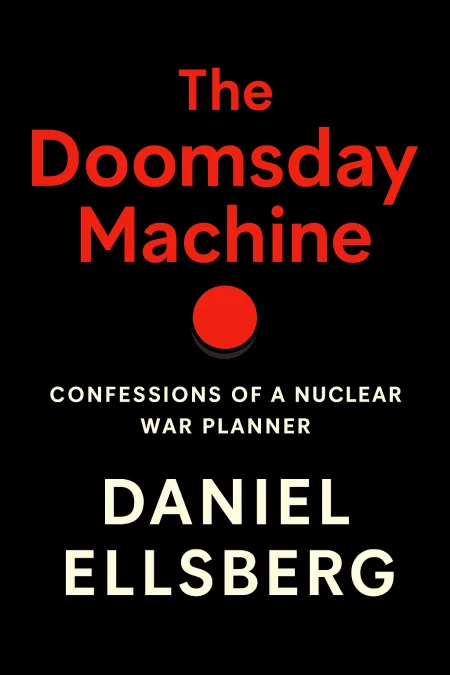
The Doomsday Machine
Confessions of a Nuclear War Planner
Book Edition Details
Summary
When Daniel Ellsberg cracked open the vault of American secrets, he unearthed a chilling narrative that stretches from the Cold War to the present day. "The Doomsday Machine" thrusts readers into the clandestine world of nuclear strategy, where power and peril collide with the fate of humanity hanging in the balance. Ellsberg, a once-trusted presidential advisor turned legendary whistleblower, pulls back the curtain on a saga of armageddon narrowly averted and policies stubbornly unchanged. This is no dry history lesson; it’s a high-stakes thriller where the stakes are nothing less than our survival. With the precision of a surgeon and the insight of an insider, Ellsberg not only reveals the past but also charts a hopeful course away from catastrophe. His narrative, laced with intrigue and urgency, is a stark reminder of the thin line between peace and annihilation. A real-life "Dr. Strangelove" that demands attention, this book is both a warning and a beacon of hope.
Introduction
In the spring of 1961, a young analyst named Daniel Ellsberg was handed a single sheet of paper that would forever change his understanding of American nuclear strategy. The document, classified at the highest levels, contained casualty projections that defied comprehension: 275 million dead within hours of executing U.S. nuclear war plans, rising to 325 million within six months. This moment marked the beginning of a decades-long journey into the most classified corners of Cold War nuclear planning, revealing secrets that would challenge everything the public believed about deterrence and presidential control. What emerges from this insider's account is a chilling portrait of how rational leaders created an irrational system of potential global destruction. Through unprecedented access to war rooms, classified briefings, and top-secret documents, we discover the terrifying gap between public assurances about nuclear safety and the hair-trigger reality of weapons systems designed to operate beyond human control. The revelations span from the missile gap hysteria of the late 1950s through the Cuban Missile Crisis, exposing how close humanity came to accidental annihilation during the Cold War's most perilous moments. For anyone seeking to understand how the world survived its brush with nuclear extinction, or why these dangers persist today, this account offers both sobering warnings and essential insights into the machinery of potential doom that continues to operate in the shadows of international relations.
Nuclear War Planner: The Making of Strategic Plans (1958-1961)
The transformation from academic economist to nuclear war planner began in the summer of 1958, when the Soviet launch of Sputnik shattered American assumptions about technological superiority. At the RAND Corporation in Santa Monica, a small group of brilliant analysts worked with an almost religious fervor, believing they were literally saving the world from nuclear annihilation. The atmosphere crackled with urgency as intelligence estimates suggested the Soviets were rapidly deploying intercontinental ballistic missiles, creating what became known as the "missile gap." The work was both intellectually stimulating and morally troubling. Days were spent calculating the vulnerability of Strategic Air Command bases, designing fail-safe procedures for nuclear alerts, and wrestling with the paradoxes of deterrence theory. The researchers lived in a world of classified studies and top-secret briefings, where abstract strategic concepts translated into plans for unprecedented destruction. They worked seventy-hour weeks, driven by the belief that Soviet analysts were working just as hard to exploit America's perceived weaknesses. What emerged from this intense period was a new understanding of nuclear strategy that would shape American planning for decades. The concept of "damage limitation" through counterforce targeting, the importance of survivable second-strike capabilities, and the need for flexible response options all took root during these crucial years. Yet beneath the sophisticated strategic thinking lay a troubling reality: the actual war plans called for attacks on every major city in the Soviet Union and China, regardless of the circumstances that might trigger nuclear conflict. The human cost of these plans remained largely abstract until that fateful briefing in 1961 when the Joint Chiefs provided their casualty estimates. The realization that American planners knew exactly what their weapons would do, and proceeded anyway, marked a turning point in understanding the true nature of nuclear deterrence. The machinery of potential global destruction was not an accident of technology, but a deliberate creation of rational minds convinced they were serving a higher purpose.
Command Crisis: Berlin, Missiles, and Nuclear Brinkmanship (1961-1962)
The Berlin Crisis of 1961 brought the world closer to nuclear war than most people realized, revealing dangerous flaws in America's nuclear command system that persisted throughout the Cold War. When Khrushchev renewed his ultimatum to turn control of Berlin access over to East Germany, President Kennedy faced a stark choice: back down or risk nuclear escalation. The crisis exposed the gap between public assurances about presidential control and the reality of delegated nuclear authority scattered throughout the military hierarchy. Investigation into nuclear command and control revealed a shocking truth that would haunt policymakers for decades: President Eisenhower had secretly delegated launch authority to theater commanders around the world, who in turn had sub-delegated that authority to lower-level officers. The famous "football" carried by presidential aides was largely theatrical; in reality, dozens of military commanders possessed the ability to initiate nuclear attacks under various circumstances, including communication outages that occurred almost daily. The Cuban Missile Crisis of October 1962 demonstrated how quickly events could spiral beyond anyone's control, even when both leaders desperately wanted to avoid war. While the public witnessed what appeared to be a carefully managed confrontation between Kennedy and Khrushchev, the classified reality involved multiple near-misses, communication failures, and moments when individual commanders came within minutes of launching nuclear weapons. The discovery that Soviet forces in Cuba possessed tactical nuclear weapons, unknown to American decision-makers at the time, added another layer of danger to an already precarious situation. Perhaps most disturbing was the revelation that there were no reliable mechanisms for stopping nuclear weapons once launched. The military had deliberately designed the system to prevent presidential interference with nuclear operations once they began, fearing that civilian leaders might lose their nerve at the crucial moment. This meant that any nuclear exchange, however limited its initial scope, could rapidly escalate beyond anyone's ability to control, creating a momentum toward total war that no human authority could halt.
The Real Doomsday Machine: Plans for Global Annihilation
The Single Integrated Operational Plan represented the ultimate expression of nuclear madness: a coordinated attack involving thousands of thermonuclear weapons aimed at every city and military target in the Soviet Union and China simultaneously. Unlike the fictional Doomsday Machine in "Dr. Strangelove," this was real, approved by multiple presidents, and ready for execution at a moment's notice. The plan made no distinction between the Soviet Union and China, offered no options for limiting damage, and provided no mechanism for terminating the war short of complete mutual annihilation. What made the SIOP particularly horrifying was its inflexibility and automation. Years of complex coordination had produced a single, massive attack plan that could not be modified or limited once set in motion. The military had convinced themselves that any nuclear war would inevitably escalate to maximum levels, so they designed their plans accordingly. This meant that any conflict involving Soviet forces anywhere in the world could trigger the complete destruction of both superpowers and their allies, turning local disputes into global catastrophes. The environmental consequences of executing such plans remained unknown to planners at the time, but later scientific research revealed an even more terrifying reality. The massive firestorms created by nuclear attacks on cities would loft millions of tons of smoke into the stratosphere, blocking sunlight and causing a "nuclear winter" that would destroy agriculture worldwide. The result would be the death by starvation of most of the human population, including those in countries never directly attacked. The persistence of such plans through multiple administrations reflected a deeper problem in the nuclear age: the gap between the rational calculations of deterrence theory and the irrational reality of weapons too destructive to use rationally. Presidents from Eisenhower through the end of the Cold War maintained these genocidal capabilities while privately hoping never to use them, creating a system that combined maximum destructive potential with minimal meaningful control. The Doomsday Machine had become self-perpetuating, operating according to its own logic rather than human intention.
Summary
The central paradox of the nuclear age emerges clearly from this insider's account: weapons designed to preserve civilization by deterring war actually created the machinery for ending it. The gap between public assurances about nuclear safety and the classified reality of hair-trigger alert systems, delegated launch authority, and inflexible war plans reveals how close humanity came to accidental annihilation during the Cold War's most dangerous moments. The discovery that even the most sophisticated military establishments could create systems beyond their own control serves as a permanent warning about the inherent dangers of nuclear weapons. Three crucial insights emerge for contemporary policymakers and citizens that remain urgently relevant today. First, the technical complexity of nuclear systems creates multiple pathways to catastrophic failure that no amount of planning can eliminate, making accidents increasingly likely as these systems age and proliferate. Second, the secrecy surrounding nuclear operations prevents the democratic oversight necessary to ensure these weapons serve rather than threaten human survival, allowing dangerous policies to persist without public scrutiny. Third, the environmental consequences of nuclear war mean that any large-scale nuclear exchange would effectively end human civilization regardless of who initiates it or claims victory. The historical lessons demand immediate action on multiple fronts: removing nuclear weapons from hair-trigger alert status, establishing genuine civilian control over nuclear operations, and ultimately working toward the elimination of these weapons entirely. Only by acknowledging the full scope of nuclear dangers revealed in this account can we begin the difficult work of dismantling the doomsday machine that continues to threaten our species' future, transforming the machinery of potential extinction into a catalyst for unprecedented international cooperation and human survival.
Related Books
Download PDF & EPUB
To save this Black List summary for later, download the free PDF and EPUB. You can print it out, or read offline at your convenience.
By Daniel Ellsberg
