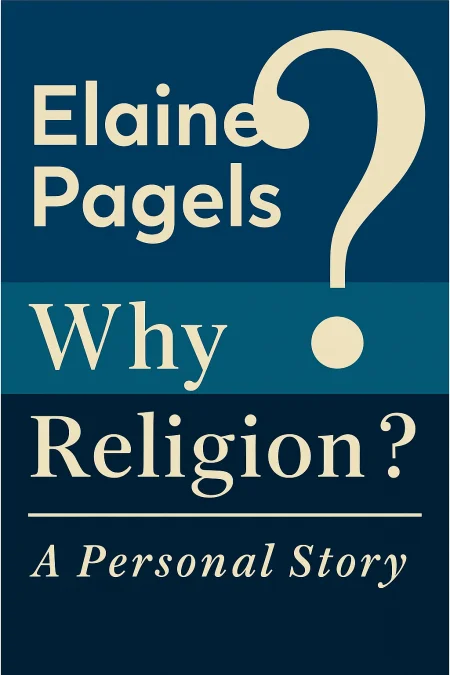
Why Religion?
A Personal Story
Book Edition Details
Summary
Grief wields a profound influence, reshaping our perception of life's most enduring mysteries. Elaine Pagels, grappling with the unimaginable loss of her son and husband, turns to the ancient wisdom of religion for solace and insight. In "Why Religion?", she crafts a narrative that interlaces personal tragedy with a scholarly journey, probing the enduring power of faith in our modern world. Through a tapestry of intimate experiences and rigorous research—drawing from neuroscience, anthropology, and history—Pagels illuminates how religious traditions continue to mold our identities and relationships, offering pathways through life's darkest hours. Her memoir, both heart-rending and intellectually invigorating, beckons readers to reconsider the profound role spirituality plays in our lives, regardless of personal belief.
Introduction
In the landscape of American religious scholarship, few figures have navigated the treacherous waters between faith and doubt with as much courage and intellectual rigor as Elaine Pagels. Born into a world where science and religion seemed locked in eternal combat, she emerged as a bridge-builder who refused to accept easy answers to life's most profound questions. Her journey began in the suburban conformity of 1950s California, where a teenage encounter with evangelical Christianity shattered the neat boundaries of her secular upbringing and set her on a path that would revolutionize our understanding of early Christian history. What makes Pagels' story extraordinary is not just her groundbreaking scholarship on the Gnostic Gospels and early Christianity, but the deeply personal crucible in which her academic insights were forged. Through devastating personal losses that would have crushed a lesser spirit, she transformed private anguish into scholarly illumination, showing how the ancient questions of suffering, meaning, and transcendence remain urgently relevant today. Her life demonstrates that true intellectual honesty requires not just rigorous methodology but the willingness to allow one's deepest experiences to inform one's understanding of human nature and spiritual longing. Through her remarkable journey, readers discover how academic pursuit can become a form of spiritual practice, how personal tragedy can deepen rather than destroy faith, and how the most ancient texts can speak with startling relevance to contemporary seekers. Her story reveals that the scholar's calling, at its highest expression, is not merely to understand the past but to help illuminate the eternal human struggle to find meaning in the face of suffering and loss.
From Evangelical Awakening to Academic Calling
The transformation that would define Elaine Pagels' intellectual and spiritual life began on a clear April afternoon when she was fifteen years old. Drawn by curiosity rather than devotion to a Billy Graham crusade at San Francisco's Cow Palace, she found herself among eighteen thousand fervent believers witnessing something that would shatter her comfortable suburban assumptions. Graham's fiery condemnation of America's moral failings, his passionate plea for spiritual awakening, and his promise of eternal life through accepting Jesus struck her with unexpected force. In a moment that surprised even herself, she walked forward with thousands of others, tears streaming down her face, to be "born again." This evangelical awakening opened up vast spaces of imagination that had been closed to her in the emotionally constricted world of her family. Her scientist father, who had converted from strict Presbyterianism to Darwinism, was horrified by what he saw as his daughter's regression into pre-scientific superstition. Her mother was simply annoyed at the family disruption. But for young Elaine, evangelical Christianity offered something her secular upbringing had failed to provide: a language for the spiritual dimension of existence, a community of passionate believers, and a cosmic drama in which ordinary individuals could play meaningful roles. The intellectual contradictions that would eventually drive her from this community were present from the beginning. When her fellow believers declared that unbaptized Jews, including Jesus himself before his supposed rebirth, were destined for hell, she found herself asking uncomfortable questions that the community could not answer satisfactorily. These early theological disputes planted seeds of doubt that would eventually blossom into a scholarly career dedicated to understanding the origins and development of Christian thought. Her departure from evangelical certainty did not represent a retreat from spiritual seeking but rather its deepening and sophistication. The questions that had driven her to that altar call at fifteen—Why do we suffer? How should we live? What happens when we die?—would continue to animate her scholarship for decades to come, though she would seek answers in ancient manuscripts rather than contemporary pulpits.
Love, Marriage, and the Shadow of Mortality
The personal foundation that would sustain Elaine Pagels through her most challenging years was laid during her graduate studies at Harvard, where she met physicist Heinz Pagels. Their relationship embodied the best kind of intellectual partnership: two brilliant minds engaged in rigorous pursuit of truth in their respective fields, each challenging and supporting the other's work. Heinz's grounding in scientific methodology provided a valuable counterpoint to her immersion in religious studies, while her explorations of meaning and transcendence offered him perspectives beyond the purely empirical. Their marriage represented more than personal happiness; it was a union of complementary ways of understanding the world. When Heinz challenged her choice to study religion rather than something with "real-world impact," she helped him see how ancient texts and religious traditions continue to shape contemporary politics and culture. When she struggled with the emotional dimensions of religious experience, he offered the scientist's appreciation for mystery and complexity without requiring premature closure or false certainty. The shadow that would define much of their marriage appeared early, in the form of their son Mark's congenital heart defect. The diagnosis of a hole in his heart wall required delicate surgery and introduced the young family to the fragility that underlies all human existence. This experience of medical uncertainty, of hoping and waiting and making impossible choices between equally risky alternatives, prepared them in ways they could not then understand for the greater trials that lay ahead. Their love deepened rather than weakened under pressure. The summers spent in Colorado, where Heinz pursued his physics research while Elaine worked on her revolutionary scholarship about the Gnostic Gospels, represented a kind of golden age of intellectual and personal fulfillment. They were building something together: a family, careers that mattered, and a shared understanding that life's meaning emerges not from easy answers but from the willingness to engage its deepest questions with both rigorous intelligence and open hearts.
Confronting Unimaginable Loss and Finding Meaning
The cruel education in grief that would transform Elaine Pagels' understanding of human existence began with their son Mark's diagnosis of pulmonary hypertension at age six. The doctors' verdict was unambiguous: the condition was invariably fatal, with no treatment and no cure available. This confrontation with medical helplessness in the face of their beloved child's terminal illness forced both parents to grapple with questions that their comfortable academic lives had allowed them to approach only theoretically. Mark's response to his situation revealed a wisdom that humbled his accomplished parents. Despite his youth, he seemed to understand his predicament with remarkable clarity, once telling his mother, "I don't want to talk yet," when asked about his delayed speech development, suggesting an inner life too rich for easy verbal expression. His engagement with stories of heroic struggle, from Prince Adam transforming into He-Man to the dragons that populated his father's bedtime tales, showed a child actively constructing meaning from his circumstances rather than succumbing to them. The family's final summer together in Colorado took on a quality of almost unbearable poignancy. Every ordinary moment—riding in the stroller through Central Park, building with blocks, sharing bedtime stories—carried the weight of its potential finality. When Mark died at age six during what should have been a routine medical procedure, his parents faced the ultimate test of their philosophical and spiritual resources. The immediate aftermath of Mark's death revealed both the inadequacy of conventional consolations and the surprising resilience that can emerge from complete devastation. Well-meaning friends who spoke of God's will or suggested that suffering teaches spiritual lessons found themselves confronted with a mother's rage at such facile explanations. Yet alongside the anger came unexpected moments of transcendence: a sense of Mark's continued presence, a vision of interconnectedness that sustained her even as conventional faith crumbled. This experience would prove to be preparation for an even more devastating blow that would arrive just as the family seemed to be finding its footing in the aftermath of their loss.
Wrestling with Ancient Texts and Modern Questions
The intellectual framework that sustained Elaine Pagels through her deepest personal crises was constructed through decades of wrestling with some of Christianity's most challenging and controversial documents. Her discovery of the Gnostic Gospels at Harvard opened up a lost world of early Christian diversity that directly contradicted the unified narrative promoted by orthodox church leaders. These alternative gospels, buried in the Egyptian desert for nearly two thousand years, revealed forms of Christianity that encouraged individual spiritual seeking rather than institutional obedience. The Gospel of Thomas, in particular, spoke to her condition with startling directness. Its saying "If you bring forth what is within you, what you bring forth will save you" suggested a form of Christianity focused not on external salvation but on the discovery of inner spiritual resources. This emphasis on personal revelation rather than institutional authority resonated deeply with someone whose own spiritual journey had led her away from the certainties of evangelical faith toward a more complex and nuanced understanding of religious experience. Her scholarship on these alternative Christian texts was simultaneously deeply personal and rigorously academic. The controversies that surrounded her work—including harsh criticism from established biblical scholars who accused her of misleading the public—revealed how threatening these ancient documents remained to contemporary religious authority. By allowing silenced voices from the past to speak again, she was implicitly challenging modern assumptions about religious truth and institutional power. The ancient questions addressed by these texts—Why do we suffer? How should we understand evil? What happens after death?—took on urgent personal relevance as she confronted the deaths of her son and husband. Her investigation of how early Christians developed the figure of Satan as an explanation for inexplicable suffering provided a framework for understanding her own experience without resorting to easy blame or false comfort. Through her scholarly work, she discovered that the most profound religious insights often emerge not from systematic theology but from the raw encounter with life's deepest mysteries.
Summary
Elaine Pagels' life demonstrates that authentic intellectual inquiry is never merely academic but emerges from the deepest human experiences of love, loss, and the search for meaning. Her journey from teenage evangelical convert to groundbreaking religious scholar reveals how personal crisis can become the catalyst for insights that illuminate not only individual experience but the broader human condition. Through her willingness to allow devastating personal losses to inform rather than derail her scholarly work, she has shown how ancient wisdom traditions continue to offer resources for contemporary seekers. The courage she displayed in facing unimaginable grief while maintaining both intellectual honesty and spiritual openness offers a model for anyone struggling to make sense of suffering without resorting to easy answers or cynical despair. Her scholarship suggests that the most valuable religious insights emerge not from dogmatic certainty but from the willingness to remain open to mystery while engaging life's deepest questions with both rigorous intelligence and compassionate understanding. For readers seeking to understand how scholarship and spirituality can enrich rather than contradict each other, her story provides both inspiration and practical wisdom for navigating the complex relationship between faith and reason in contemporary life.
Related Books
Download PDF & EPUB
To save this Black List summary for later, download the free PDF and EPUB. You can print it out, or read offline at your convenience.
By Elaine Pagels
