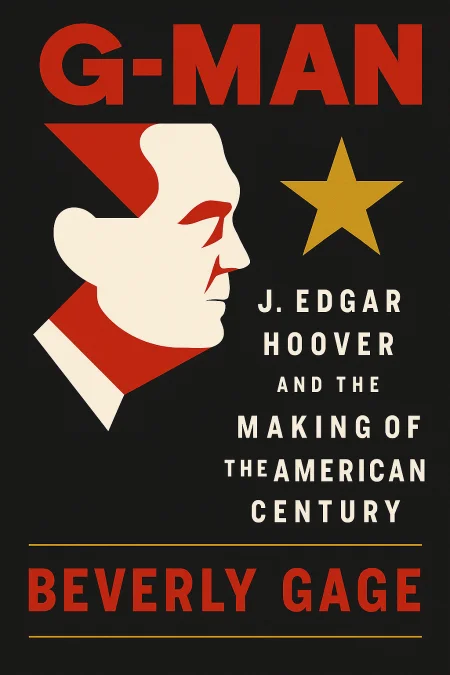
G-Man
J. Edgar Hoover and the Making of the American Century
Book Edition Details
Summary
J. Edgar Hoover: the name conjures images of power, intrigue, and an iron grip on American politics. In this revelatory biography, Beverly Gage dismantles the myth of Hoover as merely a tyrannical puppeteer, revealing a complex figure who reshaped the FBI and, by extension, the nation itself. From his meteoric rise as a sharp, reform-driven administrator to his unyielding dominance over eight presidential administrations, Hoover's story is woven with threads of ambition, ideology, and control. Gage unearths fresh insights from newly discovered sources, painting a vivid portrait of a man who didn't just uphold conservative values—he was their architect. As you journey through the corridors of power, you’ll discover how Hoover’s legacy forged the political landscape we navigate today. This is not just a biography; it’s a critical exploration of governance, race, and ideology in 20th-century America, centered around one of its most formidable figures.
Introduction
On May 2, 1972, the most powerful unelected official in American history died alone in his Washington home, taking with him secrets that had shaped five decades of American politics. J. Edgar Hoover's death marked the end of an extraordinary era in which one man wielded unprecedented influence over presidents, congressmen, and ordinary citizens alike. For forty-eight years, he had served as director of the Federal Bureau of Investigation, transforming a corrupt and ineffective agency into the world's most formidable law enforcement organization while accumulating power that would have made medieval monarchs envious. Hoover's life story unfolds against the backdrop of America's most turbulent century, from the Red Scare of the 1920s through two world wars, the Great Depression, the Cold War, and the civil rights movement. He was present at every major domestic crisis, often playing a decisive role in shaping the government's response. His methods were controversial, his motivations complex, and his legacy deeply contested, yet few would dispute that he fundamentally altered the relationship between American citizens and their government. Through Hoover's remarkable journey from ambitious young clerk to master of surveillance, readers will discover the intricate mechanics of how modern law enforcement was forged in the crucible of national crisis, the profound ways in which one individual's vision can reshape entire institutions, and the enduring lessons about the delicate balance between security and freedom that continue to challenge democratic societies today.
Building the Modern FBI: From Corruption to Excellence
When twenty-nine-year-old J. Edgar Hoover walked into his new office as acting director of the Bureau of Investigation in May 1924, he inherited an organization in shambles. The agency had been tainted by the Teapot Dome scandal and other corruption cases that had devastated the Justice Department's credibility. Agents were political appointees with little training, investigations were haphazard, and the Bureau's reputation was so poor that many local police departments refused to cooperate with federal investigators. Hoover's transformation of this dysfunctional agency into the legendary FBI represents one of the most remarkable institutional achievements in American government history. He began by establishing rigorous standards for agents, requiring college degrees, impeccable character references, and extensive training. The old system of political patronage was replaced with merit-based hiring, and Hoover created a culture of discipline that bordered on the obsessive. Every detail mattered, from the proper way to file reports to the shine on an agent's shoes. The 1930s crime wave provided Hoover with the perfect opportunity to showcase his reformed Bureau. The dramatic pursuits of notorious criminals like John Dillinger, "Pretty Boy" Floyd, and "Machine Gun" Kelly captured the public imagination and transformed FBI agents into American folk heroes. Hoover masterfully orchestrated publicity campaigns that portrayed his "G-Men" as incorruptible warriors against lawlessness, working closely with Hollywood and radio producers to create a mythology that enhanced both the Bureau's reputation and his own power. By the decade's end, Hoover had created something unprecedented in American law enforcement: a truly national police organization equipped with cutting-edge scientific capabilities. The FBI's crime laboratory became the envy of police departments worldwide, its fingerprint collection grew into the largest repository of its kind, and its training academy set the standard for professional law enforcement. More importantly, Hoover had established the FBI as an institution that transcended partisan politics, earning the trust and admiration of Americans across the political spectrum.
Cold War Warrior: Anticommunism and Political Power
The onset of the Cold War transformed Hoover from America's top cop into its chief domestic warrior against communism, a role that would define the remainder of his career and cement his position as one of the most influential figures in Washington. Drawing on intelligence networks he had built during World War II, Hoover launched an unprecedented campaign to identify and neutralize what he saw as a vast communist conspiracy threatening American democracy from within. Hoover's anti-communist crusade was both methodical and ruthless. His agents infiltrated the Communist Party so thoroughly that by the 1950s, some estimates suggested that one in five party members was actually working for the FBI. The Bureau's COINTELPRO operations went far beyond simple surveillance, actively working to disrupt and destroy organizations deemed subversive through disinformation campaigns, harassment, and psychological warfare. These techniques reflected Hoover's conviction that traditional law enforcement methods were inadequate to combat what he viewed as an ideological war for America's soul. The spectacular espionage cases of the early Cold War years elevated Hoover to the status of a national hero among conservatives and anti-communist liberals alike. His investigations helped expose Soviet spy rings that had penetrated the highest levels of government, including the cases that led to the convictions of Alger Hiss and Julius and Ethel Rosenberg. Hoover's mastery of classified information and his ability to selectively leak details to favored journalists gave him enormous leverage over elected officials who depended on his cooperation and feared his opposition. Yet Hoover's anti-communist fervor also revealed the darker aspects of his character and methods. His definition of subversion gradually expanded to include anyone who challenged the status quo or criticized government policies. Civil rights leaders, antiwar protesters, and even some mainstream politicians found themselves targets of FBI surveillance and harassment. By the 1960s, Hoover had accumulated secret files on hundreds of thousands of Americans, using this vast repository of personal information to maintain his own power and influence while claiming to protect national security.
Civil Rights Adversary: Surveillance and Social Control
The civil rights movement of the 1950s and 1960s presented Hoover with his greatest moral and political challenge, ultimately exposing the extent to which his personal prejudices had corrupted his professional judgment. Convinced that communist agents were manipulating the struggle for racial equality, Hoover authorized extensive surveillance of civil rights leaders and organizations, viewing them not as legitimate advocates for justice but as threats to social order and national security. Hoover's obsession with Martin Luther King Jr. represented the nadir of his career, revealing how his anti-communist paranoia intersected with deep-seated racial prejudices. Beginning in 1961, the FBI subjected King to intensive surveillance that included wiretapping his phones, bugging his hotel rooms, and compiling detailed dossiers on his personal life. When this surveillance revealed King's extramarital affairs, Hoover attempted to use the information to destroy the civil rights leader's reputation and influence, even going so far as to send King an anonymous letter suggesting he commit suicide. The FBI's campaign against the civil rights movement extended far beyond King to encompass virtually every major organization and leader in the struggle for racial equality. Hoover's agents infiltrated civil rights groups, spread disinformation designed to create internal conflicts, and worked to discredit the movement in the eyes of white Americans. These operations reflected Hoover's fundamental inability to distinguish between legitimate social protest and subversive activity, as well as his determination to preserve what he saw as the natural order of American society. Despite his personal hostility to civil rights, Hoover was occasionally forced by political pressure to investigate racial violence, particularly in cases that attracted national attention. The FBI's investigations of Ku Klux Klan activities and lynchings demonstrated the Bureau's formidable investigative capabilities, yet these efforts were often half-hearted and came only after intense pressure from the Justice Department and civil rights organizations. This selective enforcement revealed the extent to which Hoover's personal views had compromised the FBI's mission to enforce federal law impartially.
Legacy of Power: Final Years and Democratic Accountability
The final decade of Hoover's career was marked by mounting criticism and growing questions about his methods and motivations, as a new generation of Americans began to challenge the assumptions that had guided his approach to law enforcement. The social upheavals of the 1960s exposed the limitations of his worldview, while the revelation of FBI abuses sparked the first serious congressional oversight of the Bureau in its history. Hoover's relationship with the Kennedy administration marked the beginning of his decline, as Attorney General Robert Kennedy sought to assert greater control over the FBI and its operations. The clash between these two strong-willed men represented more than a personality conflict; it was a struggle over the proper role of federal law enforcement in American democracy. Kennedy's efforts to make the FBI more responsive to Justice Department priorities and civil rights enforcement met fierce resistance from Hoover, who viewed such interference as a threat to the Bureau's independence and effectiveness. The revelation of COINTELPRO operations in 1971 shocked the American public and exposed the extent to which the FBI had exceeded its legitimate law enforcement mandate. Stolen documents revealed a systematic program of surveillance, harassment, and disruption targeting not only violent extremists but also peaceful protesters, civil rights organizations, and antiwar activists. These revelations sparked congressional investigations that would fundamentally reshape the FBI and establish new mechanisms for oversight and accountability. When Hoover died in May 1972, he left behind an institution that was both his greatest achievement and his most troubling legacy. The FBI he had built was undeniably powerful and effective, with capabilities that far exceeded those of any other law enforcement agency in the world. Yet the methods he had employed and the culture he had created raised serious questions about the concentration of power in the hands of unelected officials and the need for democratic oversight of intelligence and law enforcement activities.
Summary
J. Edgar Hoover's extraordinary life embodies the fundamental tension between security and liberty that lies at the heart of democratic governance, demonstrating how the pursuit of order and safety can both protect and threaten the very values it claims to defend. His transformation of a corrupt federal agency into the world's most powerful law enforcement organization represents a remarkable achievement in public administration, yet his willingness to abuse that power for personal and political ends serves as a cautionary tale about the dangers of unchecked authority. From Hoover's complex legacy, we can extract crucial lessons about the importance of institutional accountability, the need for regular oversight of government power, and the recognition that in a democracy, the means we use to protect our society must themselves reflect our values. His story reminds us that vigilance against the abuse of power is not just the responsibility of elected officials but of every citizen who cherishes freedom, and that the price of liberty truly is eternal watchfulness against tyranny in all its forms.
Related Books
Download PDF & EPUB
To save this Black List summary for later, download the free PDF and EPUB. You can print it out, or read offline at your convenience.
By Beverly Gage
