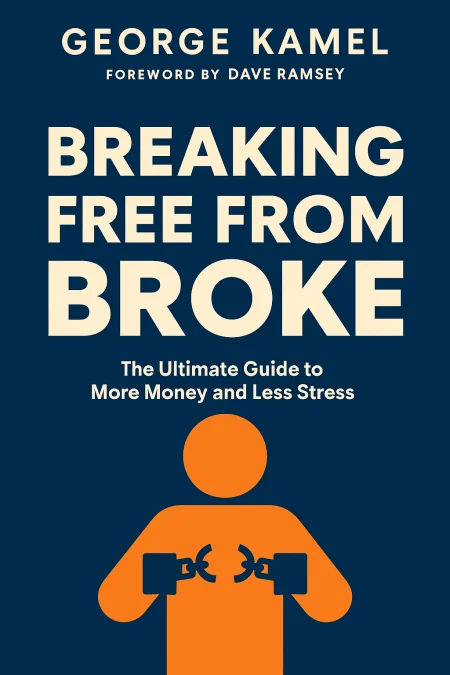
Breaking Free From Broke
The Ultimate Guide to More Money and Less Stress
Book Edition Details
Summary
Amidst the clamor of financial despair, where debt shackles dreams and cynicism reigns, a beacon of hope emerges. In "Breaking Free from Broke," George Kamel, with a wit as sharp as his financial acumen, recounts his transformative journey from drowning in $40,000 debt to soaring as a debt-free millionaire. This isn't your typical financial sermon; it's a revelation that dismantles the myths of modern money traps. Through the eyes of a millennial, Kamel exposes a rigged system designed to keep you tethered to mediocrity. Yet, he offers more than critique—he provides a roadmap to liberation, proving that with strategic shifts and unwavering resolve, anyone can transcend the cycle of brokenness and claim financial independence. Here lies a manifesto for those daring to defy the norm and rewrite their financial destiny.
Introduction
The modern American financial landscape presents itself as a pathway to prosperity, yet millions find themselves trapped in cycles of debt, anxiety, and diminished purchasing power. This systematic examination reveals how seemingly beneficial financial products—from credit scores to student loans—function as instruments of wealth extraction rather than wealth building. The conventional wisdom surrounding money management, perpetuated by financial institutions and reinforced through cultural messaging, creates a framework where consumers believe they are making smart choices while actually surrendering their financial autonomy. The analysis presented here challenges fundamental assumptions about debt, credit, and financial "tools" by examining their actual mechanisms and outcomes. Rather than accepting the narrative that debt can be "good" or that credit scores represent financial health, this investigation traces how these concepts serve institutional interests at the expense of individual wealth accumulation. The approach combines behavioral economics, historical analysis, and practical case studies to demonstrate how alternative strategies—often dismissed as outdated or impractical—consistently produce superior long-term results. Readers will encounter a systematic deconstruction of financial mythology followed by a reconstruction based on principles that prioritize genuine wealth building over the appearance of financial sophistication. This methodology of challenging conventional wisdom through logical analysis and empirical evidence provides a framework for evaluating financial decisions based on their actual rather than perceived benefits.
The System's Design to Keep You Broke
American financial institutions have constructed an interconnected web of products and services that, while marketed as beneficial, systematically extract wealth from consumers while creating the illusion of financial progress. Credit scores exemplify this mechanism perfectly—they measure not financial health, but rather how profitable a customer is to lenders. The scoring system rewards ongoing debt relationships and punishes debt elimination, creating a perverse incentive structure where financial improvement according to the score actually represents wealth destruction. The credit card industry demonstrates another layer of this extraction system. Despite marketing messages about rewards and convenience, the fundamental business model depends on consumer behavioral manipulation. Companies spend billions researching psychological triggers that increase spending frequency and amounts, while the rewards offered represent only a fraction of the additional spending they generate. The illusion of "beating the system" through rewards optimization masks the reality that users consistently spend more than they would with cash, negating any reward benefits. Student loan structures reveal perhaps the most predatory aspects of this system. By partnering with educational institutions and government agencies, lenders have created a pipeline that channels young adults into decades of debt payments under the premise of investment in their future. The actual outcomes—delayed homeownership, reduced entrepreneurial capacity, and diminished lifetime wealth accumulation—demonstrate how this "investment" primarily benefits lenders rather than borrowers. The housing market completes the cycle through mortgage products designed to maximize interest payments over time. Thirty-year loans, while appearing more affordable through lower monthly payments, transfer enormous wealth from homeowners to lenders through extended interest payments. The promotion of minimal down payments and various mortgage alternatives ensures maximum leverage and risk while generating maximum profits for financial institutions.
Debunking Financial Myths and Marketing Traps
The mythology surrounding "good debt" represents one of the most effective marketing campaigns in financial history, convincing consumers that borrowing money can somehow create wealth. This narrative requires ignoring the mathematical reality that debt payments represent guaranteed negative returns, while any potential benefits remain speculative and dependent on market conditions beyond borrower control. Student loans, despite being labeled as investments in human capital, statistically delay major life milestones and reduce lifetime wealth accumulation for the majority of borrowers. Credit score worship demonstrates how successfully financial institutions have convinced consumers to optimize for lender profitability rather than personal wealth building. The scoring algorithms explicitly reward behavior that generates profits for lenders—maintaining balances, avoiding complete payoffs, and continuously seeking new credit products. Meanwhile, behaviors that actually build wealth, such as eliminating debt and avoiding borrowing, are penalized within this scoring system, revealing its true purpose. The rewards credit card industry exemplifies sophisticated behavioral manipulation masquerading as customer benefits. Research consistently shows that payment method affects spending behavior, with credit cards reducing the psychological pain of purchases and increasing both frequency and amounts of spending. The reward structures are carefully calibrated to provide positive reinforcement while ensuring that increased spending far exceeds any rewards earned, creating a net negative outcome for users who believe they are gaming the system. Investment product marketing exploits natural human tendencies toward complexity bias and get-rich-quick thinking. The promotion of exotic investment vehicles, cryptocurrency, and trading strategies capitalizes on the desire for sophisticated solutions to simple problems. Historical data demonstrates that complex investment approaches consistently underperform simple, diversified index investing, yet the financial services industry continues promoting higher-fee, more complex products that primarily benefit providers rather than investors.
The Proven Path to Financial Freedom
Financial independence emerges from a systematic approach that prioritizes cash flow control, debt elimination, and consistent wealth building through proven mechanisms. The foundation begins with budgeting—not as restriction, but as a tool for intentional resource allocation that ensures every dollar serves the owner's interests rather than disappearing into unconscious spending patterns. This awareness creates the margin necessary for implementing wealth-building strategies. Debt elimination follows a psychologically-optimized sequence that builds momentum through early victories while mathematically eliminating the guaranteed negative returns that debt payments represent. The debt snowball method prioritizes behavioral sustainability over pure mathematical optimization, recognizing that personal finance success depends more on consistency than on perfect calculations. This approach has demonstrated superior completion rates compared to purely mathematical alternatives. Emergency fund establishment transforms the relationship with risk and opportunity. Rather than depending on credit products for unexpected expenses, substantial cash reserves eliminate the need for debt while creating space for opportunistic decisions. This buffer allows for strategic choices—career changes, investment opportunities, or major purchases—without the constraints imposed by payment obligations or credit availability. Investment strategies based on diversified index funds capitalize on broad market growth while avoiding the fees and risks associated with active management or exotic investment products. Historical data spanning decades demonstrates that consistent contributions to low-cost, diversified funds outperform the vast majority of alternative approaches, while requiring minimal time investment or specialized knowledge from the investor.
Building Wealth Through Disciplined Generosity
The culmination of financial freedom lies not in accumulation for its own sake, but in the capacity for meaningful generosity without financial strain. This represents the ultimate expression of financial independence—the ability to impact others' lives substantially without compromising one's own security or comfort. Wealth building thus becomes a tool for expanding personal agency and positive influence rather than an end in itself. Systematic generosity, implemented through planned giving incorporated into monthly budgeting, creates a framework for intentional impact while developing the psychological patterns associated with abundance thinking. Regular giving, even in small amounts during wealth-building phases, establishes habits and perspectives that scale naturally as financial capacity grows. This practice counteracts the scarcity mindset that often accompanies debt and financial stress. The progression from financial survival to financial freedom to outrageous generosity represents a transformation of relationship with money from anxiety-inducing necessity to tool for personal values expression. Individuals operating from this paradigm make decisions based on alignment with their principles rather than financial constraints, fundamentally altering their approach to career, relationships, and life choices. Legacy building through generational wealth transfer and community impact becomes possible when individuals escape the consumer debt cycle and build substantial assets. This represents the multiplication of impact beyond individual lifetime limitations, creating positive feedback loops that can affect entire communities and future generations. The strategies that enable this level of impact remain accessible to individuals with modest incomes who apply consistent, principled approaches to money management.
Summary
The financial freedom that most Americans seek requires rejecting the conventional wisdom promoted by institutions whose profitability depends on consumer indebtedness and embracing strategies that prioritize genuine wealth building over the appearance of financial sophistication. The systematic analysis reveals that products marketed as beneficial—credit scores, reward cards, extended mortgages—primarily serve institutional interests while creating psychological satisfaction that masks actual wealth destruction. The alternative approach, emphasizing cash flow control, debt elimination, and straightforward investing, consistently produces superior outcomes while reducing stress and increasing personal agency. This transformation enables individuals to progress from financial anxiety to meaningful generosity, ultimately using money as a tool for expressing values rather than as a source of limitation and worry.
Related Books
Download PDF & EPUB
To save this Black List summary for later, download the free PDF and EPUB. You can print it out, or read offline at your convenience.
By Dave Ramsey
