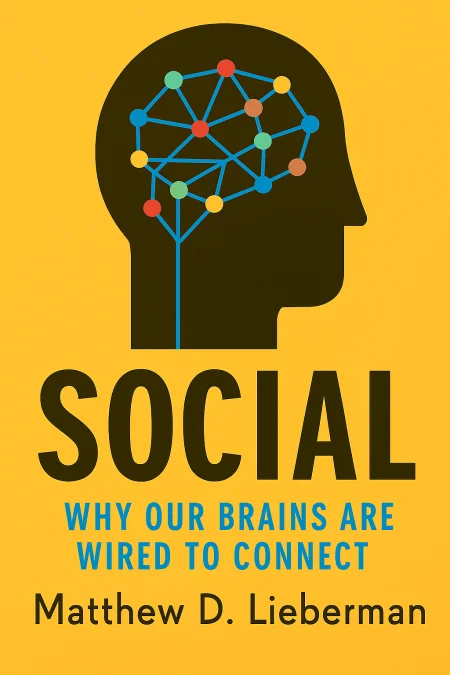
Social
Why Our Brains Are Wired to Connect
Book Edition Details
Summary
Connections weave the fabric of our lives, and in "Social," celebrated psychologist Matthew Lieberman unravels the neural tapestry that compels us to seek out one another. Transporting readers into the heart of his UCLA laboratory, Lieberman illuminates how evolution has intricately wired our brains for social survival. This is not merely a study of the mind; it's an exploration of our shared humanity, revealing that our deepest instincts drive us towards community and collaboration. Filled with groundbreaking research and vivid insights, "Social" offers an eye-opening look at the primal forces shaping our interactions and why getting along is not just a skill, but a fundamental human drive.
Introduction
Picture yourself walking into a crowded cafeteria where you don't recognize a single face. Your heart starts racing, your palms grow sweaty, and you feel a genuine ache in your chest as you scan for somewhere to sit. Now imagine accidentally touching a hot stove. Remarkably, your brain processes both experiences using nearly identical neural circuits. This isn't just a poetic comparison—when we say rejection "hurts," we're describing a literal neurological reality that reveals something profound about human nature. For centuries, we've viewed ourselves as rational, independent beings who occasionally choose to be social when it suits our purposes. But cutting-edge neuroscience is overturning this assumption entirely. Our brains didn't evolve primarily to solve math problems or build tools—they evolved to navigate the intricate world of human relationships. The same neural networks that activate when we're physically injured also respond to social exclusion, while our brain's "screensaver" mode constantly runs social simulations, preparing us for our next human encounter. This fundamental misunderstanding of our nature has shaped everything from our schools to our workplaces, often working against rather than with our deepest biological drives to connect, cooperate, and care for one another.
Social Pain: When Rejection Triggers Physical Hurt
When someone says "you really hurt my feelings," they're being more scientifically accurate than they realize. Inside your skull, the experience of social rejection activates the dorsal anterior cingulate cortex and anterior insula—the exact same brain regions that process the emotional aspects of physical pain. This isn't merely an interesting coincidence; it's the result of millions of years of evolution that literally wired social connection into our survival systems. The story begins with early mammals, whose babies were born helplessly immature compared to reptiles or birds. While a baby turtle can fend for itself within hours of hatching, mammalian infants require years of intensive care to survive. This created an evolutionary crisis: how could nature ensure that parents and offspring would stay together long enough for the young to reach independence? Evolution's solution was elegant and profound—it hijacked the existing pain system that already motivated animals to avoid physical harm and seek healing. By making separation feel genuinely painful, evolution ensured that both parents and children would be motivated to maintain their crucial bonds. The infant's cries of distress when separated from its mother aren't just communication—they're expressions of real pain that motivates reunion. This system proved so successful that it never disappeared as we matured into adults. Today, when you feel the sting of being excluded from a group or the ache of a broken relationship, you're experiencing the activation of this ancient mammalian attachment system. Modern research has confirmed this connection in remarkable ways. Studies using brain imaging show that people who are given over-the-counter pain medication like acetaminophen report less distress from social rejection, just as the medication reduces physical discomfort. Meanwhile, people with chronic pain conditions often experience increased sensitivity to social rejection, suggesting these systems influence each other bidirectionally. Understanding that our need for social connection is as fundamental as our need for physical safety helps explain why loneliness can be as damaging to our health as smoking or obesity, and why social support is one of the strongest predictors of recovery from illness and trauma.
Mindreading Networks: The Neuroscience of Understanding Others
Every day, you perform what might be the most sophisticated cognitive feat in the animal kingdom: you read minds. Not through supernatural powers, but through an intricate network of brain regions that allows you to peer into the thoughts, feelings, and intentions of everyone around you. When you see someone reach for a glass of water, you don't just observe arm movements—you instantly understand that the person feels thirsty and intends to drink. This remarkable ability, which scientists call "theory of mind" or "mentalizing," relies on neural circuits that are completely separate from those we use for logical reasoning or mathematical thinking. The brain accomplishes this mindreading through two complementary systems. The first operates through mirror neurons, specialized cells that fire both when you perform an action and when you observe someone else performing the same action. When you watch someone smile, corresponding neurons in your brain activate as if you were smiling yourself, creating an automatic, intuitive understanding of what others are experiencing. This system excels at understanding the immediate, observable aspects of behavior—the "what" and "how" of actions. But human social understanding goes far beyond simple mimicry. We constantly think about people's beliefs, desires, and complex emotional states that aren't directly visible. We understand that someone might smile while feeling sad inside, or that someone's actions might be motivated by beliefs we know to be false. This is where the second system takes over—the mentalizing network, centered in the medial prefrontal cortex and temporoparietal junction. This network allows for deliberate reasoning about mental states, enabling us to navigate complex social situations that require understanding multiple perspectives simultaneously. Perhaps most remarkably, this mentalizing network is also our brain's default mode. When neuroscientists put people in brain scanners and simply let their minds wander, these social cognition regions consistently become active. We don't just think about other people when we need to—our brains are constantly running social simulations, processing relationships, and preparing for future social encounters. This suggests that evolution has made social thinking our brain's preferred state, the mental equivalent of a screensaver that keeps us perpetually ready for the social interactions that define human life.
Empathy and Social Rewards: Our Built-in Motivation System
While understanding others' minds is impressive, humans possess an even more remarkable capacity: we don't just comprehend others' experiences—we feel them ourselves and are motivated to help. This phenomenon, called empathy, represents the pinnacle of social evolution and involves multiple brain systems working in sophisticated coordination. True empathy requires not just recognizing someone else's emotional state, but experiencing something similar ourselves and being moved to take action on their behalf. The neural basis of empathy begins with what researchers call "affect matching." When you witness someone in pain, regions like the anterior cingulate cortex and anterior insula activate as if you were experiencing the discomfort yourself. This allows you to literally feel others' experiences, though typically at a much weaker intensity than if you were the one being hurt. Meanwhile, your mentalizing system works to understand the context and meaning of what you're observing, helping you grasp not just what someone is feeling, but why they're feeling it and what might help. The final crucial component is empathic motivation—the drive to actually help rather than simply understand or feel. This appears to be mediated by brain regions rich in oxytocin receptors, the same areas crucial for parental caregiving behaviors. When these regions are damaged in animals, mothers become unable to properly care for their young, suggesting they play a key role in converting our emotional responses into prosocial action. In humans, this system creates what researchers call "empathic concern"—the warm, compassionate feeling that motivates us to help others even when there's no obvious benefit to ourselves. Remarkably, our brains treat acts of kindness and generosity as inherently rewarding. When people engage in helpful behavior, their reward systems activate in ways similar to receiving money or eating delicious food. This suggests that evolution has built cooperation and care into our basic motivation systems, making prosocial behavior feel good rather than requiring us to overcome selfish impulses through willpower alone. Understanding empathy as a complex neurobiological process rather than simply a moral choice helps explain both its tremendous power to motivate extraordinary acts of kindness and its limitations when overwhelmed by too much distress or biased toward those most similar to us.
Summary
The revolutionary insight emerging from social neuroscience is that we are not the independent, rational actors we imagine ourselves to be, but rather deeply interconnected beings whose brains have been sculpted by evolution to prioritize social connection as a basic survival need. Our neural architecture processes social rejection as genuine pain, defaults to social thinking when not otherwise occupied, and rewards cooperative behavior more powerfully than selfish gain, revealing that our individual wellbeing is fundamentally intertwined with the health of our relationships and communities. This understanding challenges virtually every assumption about human nature that underlies our institutions, from educational systems that treat social interaction as distraction to workplaces that assume purely self-interested motivation to economic models that ignore our intrinsic drive to help others. As we continue to uncover the biological roots of our social nature, we face profound questions about how to redesign our world to work with rather than against our deeply social brains. How might our schools, organizations, and communities change if we truly embraced the reality that human flourishing emerges not from individual achievement alone, but from our remarkable capacity to connect, understand, and care for one another?
Related Books
Download PDF & EPUB
To save this Black List summary for later, download the free PDF and EPUB. You can print it out, or read offline at your convenience.
By Matthew D. Lieberman
