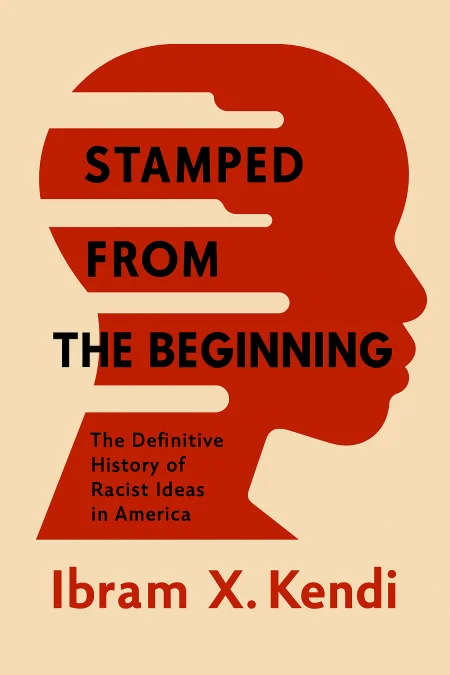
Stamped from the Beginning
The Definitive History of Racist Ideas in America
Book Edition Details
Summary
In the tapestry of American history, where ideals clash and ideologies collide, Ibram X. Kendi threads a narrative that unravels the sinister evolution of anti-Black racism. "Stamped from the Beginning" unfolds the intricate lives of five pivotal thinkers, from Cotton Mather to Angela Davis, spotlighting their roles in the perpetual tug-of-war between assimilation and segregation, racism and resistance. Kendi's exploration is not a mere recounting but a revelation: racism's roots are not nurtured in ignorance but cultivated to justify systemic inequities. As he deftly exposes how these prejudiced notions are woven into the nation's fabric, Kendi empowers readers with the insight to dismantle them. This book not only chronicles a haunting past but also arms us with the knowledge to forge a hopeful future, making it an essential read for anyone eager to understand—and change—the narrative.
Introduction
In 1761, a seven-year-old African girl stood naked on a Boston auction block, her small body barely covered by a dirty carpet. Within a few short years, this same child would become Phillis Wheatley, America's first published Black poet, celebrated in London's finest literary salons yet still legally enslaved in the very city that proclaimed itself the cradle of liberty. This striking paradox captures the central mystery that has haunted America for over four centuries: how did a nation founded on the revolutionary principle that "all men are created equal" simultaneously create and sustain one of history's most sophisticated systems of racial oppression? This sweeping historical journey traces the deliberate construction and constant evolution of racist ideas from their European origins through their American transformation. Rather than emerging from ignorance or natural prejudice, these ideas were systematically crafted by some of the brightest minds of each era—theologians, scientists, philosophers, and politicians—who needed intellectual justification for profitable but morally questionable policies. The story reveals how each generation of Americans convinced themselves they had transcended the racism of their predecessors, even as they invented new forms of discrimination perfectly suited to their contemporary needs. This exploration offers essential insights for anyone seeking to understand how ideas shape society, how power structures perpetuate themselves across centuries, and why genuine progress requires more than good intentions. It provides both a sobering reckoning with our past and a clear-eyed analysis of the patterns that continue to influence our present struggles for justice and equality.
Colonial Origins and Enlightenment Contradictions (1400s-1776)
The story begins not in America but in fifteenth-century Portugal, where Prince Henry the Navigator faced a moral dilemma that would echo across centuries. How could a Christian nation justify enslaving fellow human beings? The solution came in 1453 when chronicler Gomes Eanes de Zurara penned the first recorded defense of African enslavement, arguing that Portuguese slavers were actually performing acts of Christian mercy by rescuing Africans from their barbarous condition. This wasn't ignorant prejudice but calculated propaganda designed to legitimize a highly profitable enterprise. When these ideas crossed the Atlantic with European colonists, they found fertile ground in the theological and intellectual frameworks of the New World. Cotton Mather, the towering Puritan intellectual, became America's first great producer of racist ideas, weaving together biblical interpretation with emerging scientific thought. Mather preached that while African souls could become "white" through Christian conversion, their bodies remained naturally suited for bondage—a theological solution that allowed colonists to maintain both their Christian consciences and their economic interests. The transformation from these early justifications into systematic racial oppression occurred gradually through colonial legislation that created legal distinctions between White and Black laborers. The 1705 Virginia slave code became a model for racial control, legally defining enslaved people as property while paradoxically acknowledging their humanity through elaborate rules governing their behavior. These laws didn't simply reflect existing prejudices but actively created new categories of human difference that served specific economic and political purposes. By 1776, when Thomas Jefferson penned the Declaration of Independence, racist ideas had become so embedded in American thought that even the author of "all men are created equal" could simultaneously own hundreds of human beings without recognizing the contradiction. The colonial period established the foundational logic that would plague America for centuries: that racial oppression was not a betrayal of American ideals but their natural expression, requiring constant intellectual innovation to maintain this fundamental deception.
Revolutionary Ideals and Scientific Racism (1776-1865)
The American Revolution created an unprecedented intellectual crisis that demanded entirely new forms of racist justification. How could a nation proclaiming universal human equality continue to enslave one-sixth of its population? Thomas Jefferson, the revolution's most eloquent spokesman for freedom, became its most influential theorist of Black inferiority. His "Notes on the State of Virginia" provided what appeared to be scientific evidence for African intellectual limitations, arguing that while enslaved people possessed equal souls, nature had made them unequal in reason, beauty, and capacity for civilization. The period witnessed the emergence of scientific racism as a powerful new form of racial justification. Dr. Samuel Morton's skull measurements claimed to provide mathematical proof of white intellectual superiority, while scholars like Louis Agassiz developed elaborate theories about separate racial origins. These weren't fringe ideas but mainstream science, taught at prestigious universities and cited by leading intellectuals. The fraudulent 1840 census data appeared to show that freedom drove Black people insane, providing statistical evidence for the supposed benefits of slavery. Meanwhile, the cotton gin's invention in 1793 transformed the economics of slavery, making it more profitable than ever before. As cotton production exploded from 3,000 bales in 1790 to over 4 million by 1860, the demand for enslaved labor intensified dramatically. The American Colonization Society, founded in 1816, offered a racist solution that appealed to both slaveholders and many abolitionists: remove free Black people to Africa, eliminating the "problem" of racial equality while preserving the profits of slavery. Even the abolitionist movement remained deeply infected with racist thinking. William Lloyd Garrison demanded immediate emancipation but embraced "gradual equality," arguing that centuries of bondage had degraded African Americans who would need extensive uplift before achieving true equality. This period established the enduring American pattern of using increasingly sophisticated racist ideas to resolve the fundamental contradiction between democratic ideals and racial oppression, setting the stage for the ultimate confrontation that would tear the nation apart.
Reconstruction Failures and Jim Crow Institutionalization (1865-1950s)
The Civil War's end created a moment of unprecedented possibility that briefly glimpsed what genuine racial equality might look like in America. During Reconstruction, Black men voted, held office, and participated fully in democratic governance while Black communities built schools, churches, and businesses that demonstrated their capacity for self-determination. Yet this progress triggered a fierce intellectual and political backlash that would reshape racist ideas for generations to come, proving that the end of slavery was merely the beginning of a new phase in the evolution of racial oppression. As Black people proved their capabilities in freedom, defenders of white supremacy couldn't rely on old arguments about natural servility and needed more sophisticated theories rooted in emerging scientific disciplines. Social Darwinism provided a framework for arguing that racial competition was natural and inevitable, while new fields like criminology and psychology offered seemingly objective measures of racial difference. The rise of eugenics gave scientific credibility to arguments about racial hierarchy, with scholars measuring everything from skull capacity to crime statistics to document supposed racial traits with mathematical precision. The establishment of Jim Crow segregation required its own elaborate intellectual justification through the "separate but equal" doctrine that promised to maintain racial hierarchy while appearing to respect Black humanity. This legal fiction demanded extensive theoretical frameworks about racial differences that made separation seem natural and beneficial rather than oppressive. Popular culture reinforced these messages through minstrel shows, plantation novels, and early films that romanticized slavery while depicting Black people as either childlike dependents or dangerous threats requiring constant supervision and control. Perhaps most tragically, many Black intellectuals internalized these ideas even as they fought against discrimination. The strategy of "uplift suasion"—attempting to prove Black worthiness through exceptional achievement—inadvertently reinforced the notion that most Black people were indeed inferior and needed to be elevated through proper behavior and moral improvement. This period established patterns of thought that would persist well into the twentieth century, showing how racist ideas could survive even the most dramatic social transformations by adapting to new circumstances and cloaking themselves in new forms of scientific and cultural authority.
Civil Rights Progress and Contemporary Transformations (1950s-Present)
The mid-twentieth century civil rights movement achieved remarkable legal victories that dismantled formal segregation and secured voting rights, yet these triumphs often came with intellectual compromises that preserved underlying racist assumptions in new forms. Integration was frequently justified not as recognition of Black equality but as a means of improving Black people through contact with superior white institutions. This "assimilationist" approach accepted basic premises of white superiority while arguing that Black people could eventually achieve similar status through proper development, behavior modification, and cultural adaptation to mainstream American values. As legal barriers fell, entirely new forms of racist justification emerged that seemed more humane than crude biological racism but still located the source of racial disparities within Black communities rather than in ongoing discrimination. Cultural explanations replaced biological ones, with scholars arguing that historical oppression had created dysfunctional behaviors, family structures, and attitudes that perpetuated inequality across generations. The focus shifted from changing racist policies to changing Black behavior, a transformation that actually made racist ideas more palatable to liberal audiences who could support equality in principle while avoiding uncomfortable questions about systemic barriers. The persistence of racial inequality despite legal progress created intellectual space for "colorblind" ideologies that acknowledged past discrimination while insisting that contemporary disparities resulted from individual choices rather than structural barriers. Politicians perfected the art of racial appeals without racial language, using coded terms like "law and order," "welfare reform," and "personal responsibility" to mobilize racial resentment while claiming to be race-neutral. The War on Drugs exemplified this approach, creating policies that disproportionately targeted Black communities while being justified in completely race-neutral terms that focused on crime control and public safety. The election of Barack Obama in 2008 prompted declarations of a "post-racial" America but actually triggered new forms of racist backlash that revealed the persistence of these ideas in American political culture. The Tea Party movement, birtherism, and resurgent white nationalism demonstrated that racist ideas remained powerful forces capable of adapting to new circumstances. Meanwhile, movements like Black Lives Matter represented the latest chapter in the long struggle against racist ideas, challenging both overt white supremacy and more subtle forms of racial thinking while developing new frameworks for understanding how racism operates at unconscious and institutional levels in contemporary society.
Summary
The central revelation of this sweeping historical analysis is that racist ideas have never been static beliefs rooted in ignorance or natural prejudice, but rather represent a constantly evolving intellectual system designed to justify and maintain racial inequality in whatever form serves the interests of those in power. From colonial justifications for slavery through modern explanations for persistent inequality, racist ideas have shown remarkable adaptability, transforming themselves to meet new challenges while preserving their essential function of rationalizing racial hierarchy and protecting existing power structures from fundamental change. This understanding fundamentally transforms how we should approach the ongoing fight against racism in contemporary America. Rather than focusing primarily on changing hearts and minds through education and moral persuasion, we must recognize that racist ideas will persist as long as they serve powerful economic and political interests. True progress requires identifying and dismantling the policies and systems that create racial inequality, understanding that ideas typically follow material changes rather than leading them. The most well-intentioned efforts to combat racist thinking will ultimately fail if they don't address the underlying structures that make such thinking useful and profitable to those who benefit from racial hierarchy. The historical record offers both sobering lessons and genuine reasons for hope about the possibility of creating a more equitable future. It demonstrates that racist ideas are far more resilient and adaptable than many reformers have assumed, capable of surviving even dramatic social transformations by reinventing themselves in new forms that appear more enlightened while serving the same essential functions. Yet it also proves that these ideas are human constructions rather than natural truths, created by specific people for specific purposes and therefore capable of being systematically dismantled through sustained effort. The key lies in understanding that the battle against racist ideas is ultimately a battle against the interests they serve, requiring not just moral clarity but strategic thinking about how to build a society where genuine equality serves everyone's interests rather than threatening the privileges that have been protected by centuries of intellectual justification for racial oppression.
Related Books
Download PDF & EPUB
To save this Black List summary for later, download the free PDF and EPUB. You can print it out, or read offline at your convenience.
By Ibram X. Kendi
