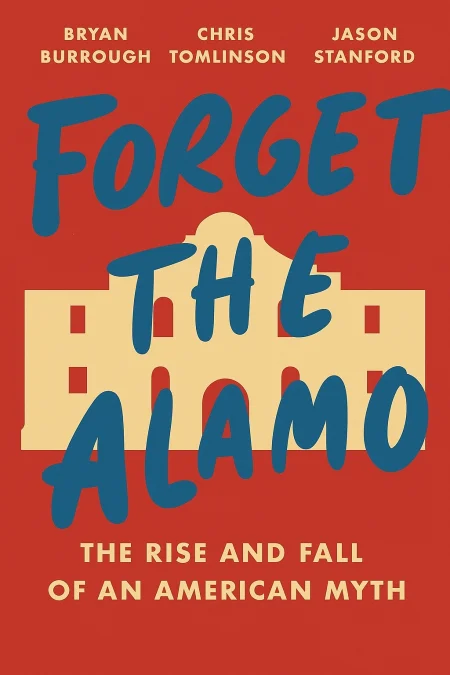
Forget the Alamo
The Rise and Fall of an American Myth
byBryan Burrough, Chris Tomlinson, Jason Stanford
Book Edition Details
Summary
In the heart of Texas lore lies a tale as towering as the Lone Star State itself: the Battle of the Alamo. Yet, beneath its legendary veneer of heroism and sacrifice, a more intricate truth awaits discovery. "Forget the Alamo" dismantles the mythos that has long cloaked this pivotal event, unraveling the narratives spun by the victors and exposing the oft-ignored threads of Tejano bravery and the complex motives behind the clash. As Texas grapples with its identity in an ever-evolving landscape, this book emerges as a beacon, challenging readers to confront the echoes of history that still reverberate today. A must-read for those seeking to understand the Alamo's true legacy and its enduring influence on American culture, this narrative invites you to reconsider what you thought you knew about Texas's most storied battle.
Introduction
On a cold March morning in 1836, the sound of cannon fire echoed across San Antonio as Mexican forces stormed a crumbling Spanish mission called the Alamo. What happened in those final moments would spark nearly two centuries of myth-making, political manipulation, and cultural warfare that continues to this day. The story most Americans know about brave defenders making their last stand against overwhelming odds has become one of our most powerful national legends, yet it obscures a far more complex and uncomfortable truth about slavery, land speculation, and the systematic erasure of Mexican voices from American history. This exploration reveals how a single military defeat was transformed into a symbol of heroic sacrifice, serving the needs of politicians, educators, and storytellers who required their history to justify everything from westward expansion to Cold War ideology. The book uncovers the economic forces that actually drove the Texas Revolution, particularly the central role of cotton cultivation and enslaved labor that has been carefully hidden beneath layers of patriotic mythology. For readers interested in understanding how historical narratives are constructed and weaponized, how economic interests drive political conflicts, and how myths serve present-day purposes rather than preserving historical truth, this investigation offers both revelation and warning about the stories we tell ourselves about our origins.
Cotton, Slavery, and the Texas Revolution (1820s-1836)
The American colonization of Texas began with dreams of cotton profits, not liberty. When Stephen Austin inherited his father's colonization plans in 1821, he understood that success depended entirely on one crop and the enslaved labor required to harvest it profitably. The fertile plains of Texas offered virgin territory perfect for cotton cultivation, but Mexico had abolished slavery, viewing it as incompatible with their new republic's liberal ideals. This fundamental contradiction would define the next fifteen years of escalating conflict. Austin and his colonists developed elaborate legal schemes to circumvent Mexican antislavery laws, transforming enslaved people into "indentured servants" bound by lifetime contracts. As Austin himself wrote, "Nothing is wanted but money, and negros are necessary to make it." The economic stakes were enormous, as cotton cultivation without enslaved labor would have made the American colonial project economically unviable. Mexican officials, desperate to populate their vulnerable northern frontier, repeatedly backed down when colonists threatened to leave rather than comply with abolition laws. This pattern of crisis and compromise created a dangerous precedent where American settlers learned they could ignore Mexican law with impunity. Each time Mexico attempted to enforce antislavery legislation, colonists successfully resisted through threats and political pressure. The underlying tension exploded when Santa Anna consolidated power and moved toward centralized control, threatening the federalist system that had allowed slavery to flourish under legal technicalities. For Texan colonists, federalism had become code for the right to maintain slavery, and when that protection disappeared, the economic foundation of their society faced extinction. The revolt that followed was not primarily about political oppression or cultural differences, but about preserving a way of life built on enslaved labor. This economic reality, carefully obscured in later mythmaking, shaped every aspect of the coming conflict and would influence how the story was told for generations to come.
From Military Defeat to Heroic Legend (1836-1960)
The thirteen-day siege that ended on March 6, 1836, represented both a catastrophic failure of military judgment and the raw material for one of America's most enduring myths. William Travis and Jim Bowie, commanding fewer than 200 men in an indefensible position, ignored warnings of Santa Anna's approach and found themselves trapped when 1,800 Mexican troops arrived. The compound they defended was never designed as a fortress, its walls too long and too low for effective defense by such a small garrison. The battle itself lasted barely an hour once Mexican forces breached the walls. Contrary to later legends, many defenders didn't die heroically at their posts but attempted desperate breakouts, only to be cut down by cavalry waiting outside. Santa Anna's order to execute all defenders, including those who surrendered, provided the emotional fuel needed to transform military disaster into propaganda victory. Within weeks, "Remember the Alamo" became the battle cry that helped Sam Houston's army achieve decisive victory at San Jacinto. The transformation from history to legend began immediately, driven by the practical needs of war propaganda. Early accounts emphasized heroism over tactical failure, sacrifice over poor judgment, and noble death over the uncomfortable reality that many defenders had tried to flee. The famous "line in the sand" story, Travis's dramatic letter, and Crockett's heroic last stand were largely invented by propagandists seeking to create inspiring mythology rather than preserve historical accuracy. By the twentieth century, popular culture had elevated the Alamo story to national prominence. Disney's 1954 Davy Crockett television series sparked a nationwide craze that sold millions of coonskin caps and embedded the legend deep in American consciousness. John Wayne's 1960 epic film completed this transformation, turning the story into explicit Cold War propaganda that portrayed the battle as democracy versus authoritarianism. The myth had evolved from regional folklore into a tool of American foreign policy, proving more powerful than any military victory in shaping how Americans understood their national character and global mission.
Academic Challenges and Cultural Wars (1960-2020)
The social upheavals of the 1960s finally cracked the consensus around the heroic Anglo narrative that had dominated Alamo historiography for over a century. The civil rights movement and rising Chicano activism challenged the traditional story for the first time, pointing out that the heroic version had been built on systematic erasure of Mexican contributions and the demonization of Latino culture. Mexican American scholars argued that the Alamo myth had been used to justify decades of discrimination and violence against their communities. Academic historians began applying rigorous standards to Alamo research, uncovering evidence that contradicted cherished legends. The 1975 revelation that Davy Crockett may have surrendered and been executed rather than dying heroically sparked fierce controversy, forcing Americans to confront the possibility that their most sacred historical narratives were based on fabrications. Scholars like Paul Andrew Hutton and James Crisp demonstrated that many dramatic elements of the traditional story were either heavily embellished or completely invented by later writers. These challenges met fierce resistance from defenders of the mythic version, creating cultural battles that played out in academic journals, popular media, and public forums. The conflict reflected broader tensions about race, identity, and the role of historical truth in shaping national narratives. Texas politicians discovered that taking strong positions on Alamo-related issues could mobilize conservative voters, leading to heated battles over textbook content and museum exhibits. The twenty-first century intensified these conflicts as debates over immigration and multiculturalism gave new urgency to questions about historical memory. Plans to renovate the Alamo site became flashpoints for cultural warfare, with traditionalists fearing that acknowledging uncomfortable truths about slavery would diminish the site's inspirational power. The 2020 protests following George Floyd's death brought these tensions to a head when demonstrators targeted the Alamo as a symbol of white supremacy, leading to armed confrontations that demonstrated how the battle had become a proxy for contemporary political divisions over race, memory, and American identity.
Summary
The rise and fall of the Alamo myth reveals the fundamental tension between comfortable legends and uncomfortable truths in American historical memory. For nearly two centuries, this story has served as a powerful tool for nation-building, justifying everything from westward expansion to foreign wars, but at the cost of erasing the central role of slavery in the Texas Revolution and systematically marginalizing Mexican and Native American voices. The transformation of a military defeat into a sacred narrative of heroic sacrifice demonstrates how myths become immune to factual correction once they serve essential cultural and political functions. The ongoing battles over the Alamo's meaning offer crucial insights for navigating historical memory in our diverse democracy. The core conflict reflects broader questions about who gets to tell America's story and whose experiences matter in shaping collective understanding of the past. Traditional narratives served the needs of Anglo-American expansion and identity formation but came at enormous cost to marginalized communities who found themselves permanently cast as enemies or erased entirely from the historical record. The Alamo's journey from historical event to cultural battleground provides three essential lessons for confronting our complex past. First, we must recognize that all historical narratives serve present-day purposes and ask whose interests they advance. Second, inclusive storytelling requires genuine dialogue between communities rather than top-down mandates from political or academic authorities. Finally, the goal should not be creating a single authoritative narrative but fostering understanding of how different groups experienced and remember the same events. Only by embracing this complexity can we move beyond the culture wars that have made the Alamo a symbol of division rather than shared heritage, building a more honest and inclusive understanding of who we are and who we aspire to become.
Related Books
Download PDF & EPUB
To save this Black List summary for later, download the free PDF and EPUB. You can print it out, or read offline at your convenience.
By Bryan Burrough
