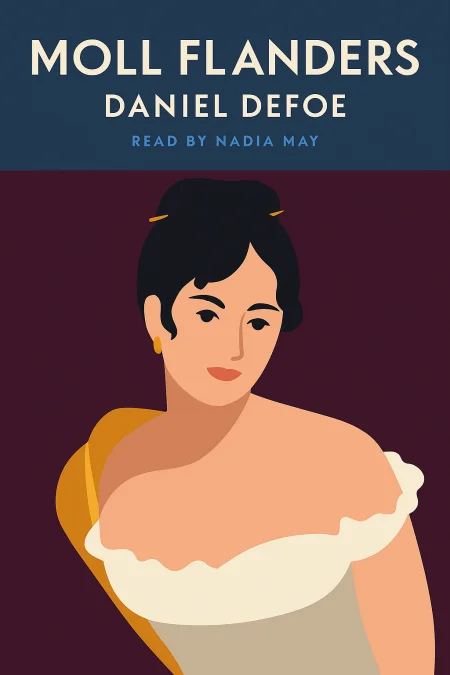
Moll Flanders
The Pursuit of Fortune by Any Means
Book Edition Details
Summary
Beneath the shadowed alleys of 17th-century England, a tale of audacious survival unfolds. Meet Moll Flanders, a woman whose life oscillates between peril and prosperity, embracing both scandalous infamy and penitent reflection. Daniel Defoe crafts a vivid chronicle of a fierce spirit navigating a society rife with rigid expectations and moral complexities. From the dank confines of Newgate to the sunlit streets of Virginia, Moll’s relentless pursuit of fortune and identity unfolds across a tapestry of marriages, larcenies, and unexpected alliances. Through wit and resilience, she defies the odds, crafting a narrative that challenges the societal confines of her time. This is not just a story; it's an unapologetic dance with destiny, where every twist of fate is a testament to Moll’s unyielding will to live and thrive.
Introduction
In the bustling coffeehouses of early 18th-century London, few could have predicted that a bankrupt merchant turned political pamphleteer would revolutionize the art of storytelling forever. Daniel Defoe, a man who lived through plague, fire, political upheaval, and personal ruin, possessed an extraordinary ability to transform life's harsh realities into compelling narratives that spoke directly to the human condition. Born into an age of religious dissent and commercial expansion, Defoe embodied the restless spirit of his era—a time when traditional hierarchies crumbled and new opportunities emerged for those bold enough to seize them. What made Defoe truly remarkable was not merely his prolific output of over 400 published works, but his revolutionary approach to fiction. He understood that readers craved authenticity, and he delivered it through characters who felt startlingly real, speaking in voices that resonated with genuine human experience. His protagonists weren't noble heroes from distant realms, but ordinary people facing extraordinary circumstances—shipwrecked sailors, reformed criminals, and ambitious women navigating a world that offered them few legitimate paths to prosperity. Through Defoe's remarkable journey, we discover how a man's personal struggles with debt, imprisonment, and social ostracism became the foundation for literary innovations that would influence storytelling for centuries to come. His transformation from failed businessman to master storyteller reveals the power of resilience and reinvention, while his creation of psychologically complex characters demonstrates how great literature emerges from deep understanding of human nature in all its contradictory glory.
From Bankruptcy to Literary Reinvention: Defoe's Transformative Journey
Daniel Defoe's path to literary greatness began not with quill and parchment, but with ledgers and trade goods. Born around 1660 as plain Daniel Foe, he entered the world of commerce with the ambitious spirit characteristic of England's emerging middle class. His early ventures in hosiery, wine, and tobacco reflected the expanding opportunities of a nation increasingly connected to global markets. Yet these same ventures would teach him harsh lessons about the precarious nature of fortune and the thin line between respectability and ruin. The collapse of Defoe's business empire in 1692, leaving him with debts of £17,000, marked a crucial turning point. Rather than retreat into obscurity, he demonstrated the resourcefulness that would later animate his fictional heroes. His transformation from Daniel Foe to Daniel Defoe—adding the aristocratic prefix "De"—symbolized his refusal to be defined by failure. This reinvention was more than cosmetic; it represented a fundamental shift from viewing himself as merely a merchant to embracing the role of public intellectual and social commentator. Defoe's entry into journalism and political writing emerged from necessity but flourished through genuine talent. His pamphlets and essays revealed a mind capable of penetrating social analysis, whether defending religious dissenters or proposing reforms for women's education. The very experiences that had humiliated him as a businessman—bankruptcy, imprisonment, and social disgrace—became invaluable assets as a writer. He understood intimately the struggles of ordinary people because he had lived them. This transformation from merchant to writer was not merely a career change but a profound evolution of identity. Defoe learned to see his personal disasters not as shameful secrets but as raw material for understanding the human condition. His years navigating the treacherous waters of commerce, politics, and social climbing gave him insights into character and motivation that would prove invaluable when creating the complex protagonists who would make his fiction immortal.
Crafting Moll Flanders: Revolutionary Realism and Moral Complexity
When Defoe sat down to write the story of Moll Flanders in 1722, he drew upon decades of observing human nature at its most desperate and resourceful. Moll emerged not as a conventional heroine but as something far more compelling—a woman whose moral compromises reflected the limited choices available to those born without privilege or protection. Defoe's genius lay in presenting her story without the heavy-handed moralizing typical of his era, instead allowing readers to understand her decisions through the logic of survival. The character of Moll Flanders represented a revolutionary approach to fiction. Rather than creating an idealized protagonist, Defoe crafted a woman whose life encompassed theft, prostitution, and multiple marriages—yet who remained fundamentally sympathetic. This moral complexity reflected Defoe's understanding that virtue and vice were often matters of circumstance rather than inherent character. Moll's criminal activities emerged from economic necessity, not innate wickedness, challenging readers to consider how they might behave under similar pressures. Defoe's technique of presenting Moll's story as authentic memoir rather than fiction served multiple purposes. It satisfied contemporary readers' hunger for true-life accounts while allowing him to explore controversial subjects under the guise of moral instruction. The detailed, matter-of-fact narrative style—describing criminal techniques alongside domestic arrangements with equal precision—created an unprecedented sense of realism that made readers feel they were encountering a real person rather than a literary construction. The psychological depth Defoe achieved with Moll Flanders established new possibilities for character development in fiction. Her internal contradictions—simultaneously calculating and naive, hardened by experience yet capable of genuine affection—reflected the complexity of real human psychology. Through Moll, Defoe demonstrated that compelling characters emerged not from moral perfection but from the tension between competing desires, needs, and circumstances that define actual human experience.
Pioneer of Modern Fiction: Defoe's Enduring Literary Legacy
Daniel Defoe's contributions to literature extended far beyond individual works to encompass fundamental innovations in storytelling technique and narrative perspective. His development of the first-person confessional narrative, combined with meticulous attention to realistic detail, established conventions that would dominate fiction for centuries. The psychological interiority he brought to characters like Robinson Crusoe and Moll Flanders created a template for the modern novel that writers from Samuel Richardson to James Joyce would build upon. The democratic spirit of Defoe's prose—clear, direct, and accessible to readers across social classes—reflected broader changes in English society while simultaneously helping to shape them. His characters spoke in the language of ordinary people rather than the elevated diction of classical literature, making fiction relevant to the expanding middle-class readership. This stylistic choice was both artistic and political, asserting that the experiences of common people deserved serious literary treatment. Defoe's influence on subsequent generations of writers cannot be overstated. His techniques for creating psychological realism through accumulation of concrete details inspired novelists throughout the 18th and 19th centuries. The moral ambiguity he introduced into fiction—allowing readers to sympathize with flawed protagonists—challenged traditional literary conventions and opened new possibilities for exploring human nature. Writers as diverse as Henry Fielding, Charles Dickens, and George Eliot drew upon innovations Defoe pioneered. Perhaps most significantly, Defoe established fiction as a vehicle for social commentary and psychological exploration rather than mere entertainment. His novels examined questions of class, gender, economics, and morality with a sophistication that elevated the novel from popular diversion to serious art form. The enduring appeal of his characters demonstrates that great literature emerges not from perfect heroes but from recognizably human figures struggling with universal challenges of survival, identity, and moral choice.
Summary
Daniel Defoe's remarkable journey from failed merchant to literary pioneer demonstrates that our greatest contributions often emerge from our deepest struggles, transforming personal adversity into universal insight that speaks across centuries. His revolutionary approach to fiction—creating psychologically complex characters who navigate moral ambiguity with recognizable human frailty—established the foundation upon which the modern novel was built. Through protagonists like Moll Flanders, Defoe proved that compelling literature could emerge from the experiences of ordinary people facing extraordinary circumstances, democratizing both the subjects and audience for serious fiction. The lessons embedded in Defoe's life and work remain strikingly relevant for contemporary readers. His example suggests that reinvention is always possible, that failure can become the foundation for unexpected success, and that authentic storytelling requires the courage to examine human nature without flinching from its contradictions. For aspiring writers, Defoe's career illustrates how personal experience—even painful experience—can be transformed into artistic material that resonates with universal themes. His legacy reminds us that great literature emerges not from moral perfection but from honest exploration of the complex choices that define human existence, making his work essential reading for anyone seeking to understand both the origins of modern fiction and the enduring power of storytelling to illuminate the human condition.
Related Books
Download PDF & EPUB
To save this Black List summary for later, download the free PDF and EPUB. You can print it out, or read offline at your convenience.

By Daniel Defoe
