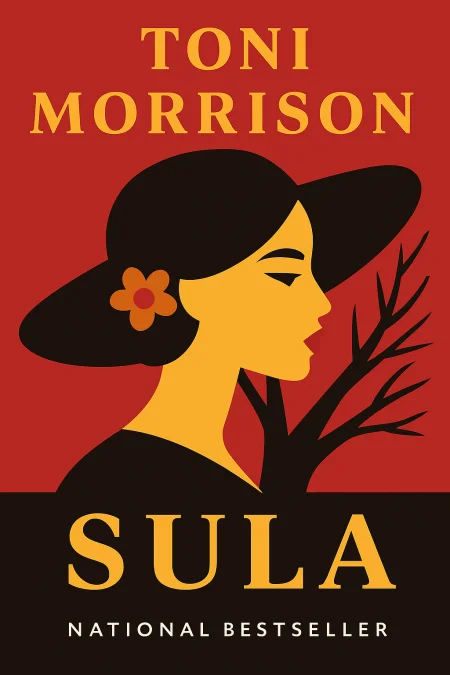
Sula
A Novel
Book Edition Details
Summary
Two girls—Sula Peace and Nel Wright—find their childhood intertwined by secrets and laughter in a modest Ohio town. Yet, life scatters their paths like leaves on the wind. Sula, the daring spirit, breaks free to wander the bustling cities, while Nel finds her anchor in family and domesticity. A decade later, Sula’s return stirs the waters of their friendship, now tested by time and choices. As Nel faces the realities of marriage and motherhood, Sula's unapologetic ways challenge the town's norms, casting ripples that question loyalty, identity, and the essence of belonging. Toni Morrison’s "Sula" is a poignant exploration of friendship’s fragility amid societal expectations in a 1920s African American community.
Introduction
In the hills above an Ohio river town, where the seasons carved their stories into human lives and community bonds stretched between love and betrayal, a remarkable chronicle unfolds across five decades of American transformation. This narrative illuminates how individual choices ripple through collective memory, how war reshapes not just nations but the intimate spaces where neighbors become family or enemies. Through the lens of one small community called the Bottom, we witness the collision between personal freedom and social expectation, the weight of history on ordinary lives, and the complex dance between belonging and independence that defines the human experience. The story captures three pivotal questions that echo through generations: How do communities forge identity in the face of external forces beyond their control? What happens when individual desires clash with collective survival? And perhaps most provocatively, how do we distinguish between love and possession, between nurturing and control? These themes speak to anyone seeking to understand how history lives not in textbooks but in the choices people make when faced with impossible circumstances, making this chronicle essential reading for those who recognize that the most profound historical forces often play out in the most intimate human relationships.
Formation and Bonds: Community Identity in the 1920s Bottom
The Bottom emerged from a bitter joke about geography and power, where black families claimed the hilltops above Medallion through a white farmer's deception about divine perspective. By the 1920s, this community had transformed betrayal into belonging, creating a world where children like Nel Wright and Sula Peace could discover friendship that transcended individual identity. The decade pulsed with the energy of people building something entirely their own, where Eva Peace commanded her three-story house like a ship captain and Hannah Peace moved through her days with an easy sensuality that both scandalized and comforted her neighbors. Community identity crystallized through shared rituals of survival and celebration. Shadrack's National Suicide Day, born from his war trauma, became woven into the fabric of local life as naturally as seasonal changes. Residents organized their calendar around this eccentric proclamation, demonstrating how communities absorb even the most disturbing individual experiences and transform them into collective meaning. The Bottom thrived on this alchemy of acceptance, where difference was not eliminated but integrated into a larger pattern of belonging. The bonds forged during this period carried a particular intensity born of necessity and choice. Nel and Sula's friendship represented the possibilities that emerged when young people could imagine futures unconstrained by others' limitations. Their connection transcended typical childhood friendship, becoming a merger of consciousness that allowed each to exist more fully. "They were solitary little girls whose loneliness was so profound it intoxicated them and sent them stumbling into Technicolored visions that always included a presence, a someone, who, quite like the dreamer, shared the delight of the dream." This decade established the fundamental tension between individual expression and community cohesion that would define the Bottom's evolution. The community's strength lay in its ability to accommodate various forms of difference while maintaining collective identity, yet this same flexibility would later be tested when individual choices began to challenge the community's capacity for acceptance and forgiveness.
War's Impact: Trauma, Loss, and Social Transformation (1940s)
The Second World War arrived in the Bottom not as distant headlines but as lived disruption that reshattered lives already marked by earlier conflicts. Young men who had found identity in community suddenly faced the machinery of global violence, returning changed in ways that defied easy recognition or healing. The war's impact extended far beyond those who served, creating ripple effects that transformed family structures, economic opportunities, and the very foundations of social trust that had sustained the community through previous decades. Personal trauma intersected with collective upheaval in devastating ways. Eva Peace's burning of her son Plum revealed how the war's psychological wounds could render traditional forms of love impossible to express or receive. Her act, motivated by a mother's desperate recognition that her son was trying to crawl back into the safety of her womb, demonstrated how violence creates cycles that extend far beyond battlefields. "I had room enough in my heart, but not in my womb, not no more," Eva explained, capturing the impossible position of those who must choose between different forms of destruction. The promise of wartime employment opportunities, particularly the tunnel project, represented both hope and betrayal. When the community finally gained access to work that might provide economic security, the opportunity became a death trap that claimed many of the Bottom's residents. This pattern reflected a broader historical truth about how marginalized communities often found their hopes transformed into new forms of devastation, even when external circumstances appeared to offer genuine progress. The war years revealed how external forces could penetrate even the most tightly knit communities, altering relationships that had seemed permanent. Traditional family structures bent under pressures that earlier generations had never faced, while economic disruptions forced difficult choices about loyalty, survival, and the price of integration into larger American society. These transformations set the stage for the more dramatic ruptures that would follow in subsequent decades.
Individual versus Community: Sula's Return and Social Disruption
Sula Peace's return to the Bottom in 1937, accompanied by a plague of robins, marked the beginning of a sustained examination of how communities respond to individuals who refuse conventional limitations. Her decade-long absence had transformed her into something her neighbors could not easily categorize or control, and her presence forced the community to confront its own boundaries between acceptance and rejection. Sula represented the logical extension of the Bottom's historical tolerance for difference, yet her particular form of independence challenged assumptions about gender, loyalty, and the social contracts that held communities together. The community's response to Sula revealed both its strengths and limitations. Residents began organizing their lives in opposition to her presence, using her as a focal point for defining their own virtue and coherence. This dynamic initially strengthened family bonds and community solidarity, as people cherished their relationships more consciously when faced with Sula's apparent indifference to such connections. However, this defensive unity came at the cost of the very openness and complexity that had previously characterized the Bottom's approach to human difference. Sula's friendship with Nel Wright, renewed after years of separation, became a testing ground for the possibility of maintaining intimate connection across the divide between individual freedom and community belonging. Their relationship embodied the tension between personal loyalty and social expectation, ultimately fracturing when Sula's involvement with Nel's husband Jude revealed the limits of even the deepest friendship. "We was girls together," Nel would later cry, recognizing too late the irreplaceable nature of their bond. The controversy surrounding Sula's choices forced the entire community to grapple with fundamental questions about the relationship between individual fulfillment and collective welfare. Her refusal to conform to expected patterns of behavior exposed the degree to which community identity depended on shared limitations rather than shared possibilities. This period demonstrated how societies often define themselves through exclusion, using certain individuals as examples of what cannot be tolerated rather than expanding their conception of what human community might encompass.
Legacy and Dissolution: Community's End and Historical Memory (1960s)
By 1965, the Bottom as a distinct community had largely disappeared, transformed by economic changes and demographic shifts that scattered its residents across the broader landscape of American integration. The hilltops where generations had built their lives became valuable real estate for white families seeking scenic views, while the original inhabitants found themselves displaced to valley locations that lacked the geographical and symbolic significance of their former home. This transformation reflected broader patterns of urban development that consistently disrupted established black communities in the name of progress. The community's dissolution revealed how historical memory functions when the physical spaces that sustained collective identity vanish. Nel Wright, now middle-aged and working in the same hotel where her former husband had once been employed, found herself one of the few remaining links to the Bottom's earlier incarnation. Her visits to Eva Peace in the nursing home became encounters with a past that seemed increasingly difficult to verify or understand, as Eva's accusations about Chicken Little's death forced Nel to confront her own role in events she had spent decades avoiding. The final recognition of loss came not through dramatic confrontation but through quiet acknowledgment of what had been irretrievably lost. Nel's moment of clarity at Sula's graveside, when she realized that her decades of mourning for her departed husband had actually been grief for her lost friendship, captured the way historical change often disguises the true nature of what disappears. "All that time, all that time, I thought I was missing Jude," she cried, finally understanding the deeper pattern of her own experience. The Bottom's end demonstrated how communities survive not through physical continuity but through the lasting impact of the relationships and stories they generate. Even as the geographical location transformed beyond recognition, the experiences of connection, conflict, and loss that had defined life there continued to shape the understanding of those who had lived through its dissolution. This pattern suggested that historical significance lies not in permanence but in the intensity and complexity of human relationships that flourish within specific times and places.
Summary
This chronicle reveals how historical forces manifest most powerfully through the intimate dynamics of human relationship and community formation. The central tension between individual freedom and collective belonging that defined the Bottom's evolution reflects a fundamental American contradiction between the promise of personal liberation and the necessity of social connection. The community's ultimate dissolution resulted not from external destruction but from the inability to maintain the delicate balance between accepting human complexity and preserving social coherence. The historical trajectory from the 1920s through the 1960s demonstrates how communities that begin with radical inclusiveness can gradually narrow their boundaries when faced with challenges to their fundamental assumptions. The Bottom's transformation from a place where difference was integrated into collective identity to one where difference became grounds for exclusion illustrates how fear can corrupt the very values that initially give communities their strength and meaning. For contemporary readers, this historical pattern offers crucial insights about nurturing inclusive communities while maintaining meaningful bonds. First, genuine community requires the courage to embrace complexity rather than seeking simple unity through shared limitations. Second, the health of any collective depends on its ability to support individual growth rather than demanding conformity as the price of belonging. Finally, lasting communities must find ways to honor both personal freedom and mutual responsibility, recognizing that these apparently opposing forces actually strengthen each other when held in creative tension rather than false opposition.
Related Books
Download PDF & EPUB
To save this Black List summary for later, download the free PDF and EPUB. You can print it out, or read offline at your convenience.

By Toni Morrison
