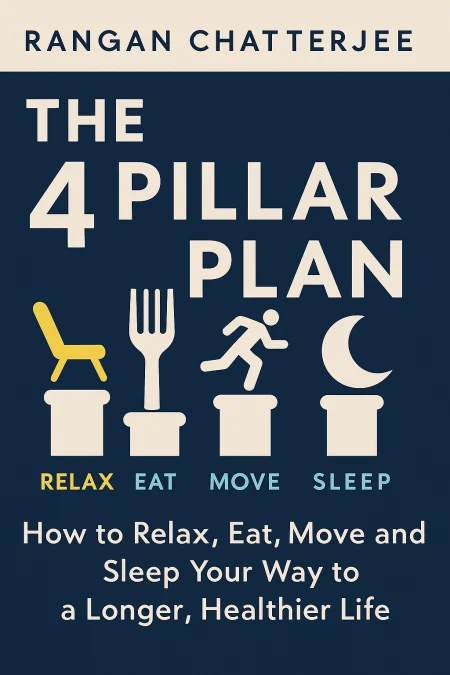
The 4 Pillar Plan
How to Relax, Eat, Move and Sleep Your Way to a Longer, Healthier Life
Book Edition Details
Summary
In the hustle and bustle of modern life, Dr. Rangan Chatterjee, renowned for his expertise in holistic health, offers a beacon of simplicity with "The 4 Pillar Plan." This transformative guide doesn't preach a radical overhaul but instead champions the power of subtle shifts across four foundational areas: relaxation, nutrition, movement, and rest. Imagine the profound impact of a weekly digital detox or the healing touch of morning sunlight. With insights born from cutting-edge research and two decades of medical practice, Chatterjee enriches his advice with compelling stories of real-life transformations. This isn't just another wellness book; it's a roadmap to reclaiming vitality and joy, one small change at a time. Prepare to be inspired, equipped, and empowered to craft a healthier, happier life.
Introduction
In our relentless pursuit of productivity and success, we've forgotten something fundamental: our bodies are not machines that can run indefinitely without maintenance. The epidemic of chronic fatigue, stress-related illnesses, and lifestyle diseases we're witnessing isn't just coincidence—it's the inevitable result of treating symptoms while ignoring root causes. Traditional medicine often focuses on what's wrong rather than asking why it went wrong in the first place. But what if the most powerful medicine isn't found in a prescription bottle, but in the simple, daily choices we make? What if transforming your health doesn't require expensive treatments or radical overhauls, but rather understanding how four fundamental pillars—relaxation, nutrition, movement, and sleep—work together to create lasting wellness? The human body is an interconnected system where every part affects every other part, and when we address health holistically, we unlock our natural capacity to heal, thrive, and flourish.
Relax: Master the Art of Stress Management
Stress management isn't about eliminating challenges from your life—it's about changing how your body responds to them. When we're constantly in fight-or-flight mode, our bodies produce excessive cortisol, the stress hormone that was designed for short-term emergencies but has become a chronic companion for many of us. This persistent state doesn't just make us feel overwhelmed; it fundamentally alters our biology, affecting everything from digestion to immune function. Consider Devon, a sixteen-year-old who arrived at the clinic with his mother after attempting self-harm. Rather than immediately prescribing antidepressants, deeper conversation revealed he was spending hours each night scrolling social media, exposing himself to constant stimulation and comparison. His brain never had a chance to rest or process emotions naturally. The intervention wasn't pharmaceutical—it was behavioral. Devon agreed to implement a simple digital sunset, turning off his phone one hour before bed. Within a week, he reported feeling different. After six weeks of gradually extending his device-free time and making dietary changes, his mother wrote to say he was like a different boy, making friends and no longer struggling with self-harm. No prescription was ever written. The path to nervous system regulation begins with creating sacred boundaries around your time and attention. Start by scheduling fifteen minutes of daily "me-time" as rigorously as you would any important appointment. This isn't selfish—it's essential maintenance for your mental and physical health. Practice the simple 3-4-5 breathing technique: inhale for three seconds, hold for four, exhale for five. This immediately activates your parasympathetic nervous system, shifting you from stress mode to restoration mode. Remember that saying no to others often means saying yes to your wellbeing. Your nervous system needs predictable periods of calm to function optimally, and creating these pockets of peace throughout your day will ripple into every other aspect of your health.
Eat: Fuel Your Body with Real Food
Real food isn't about following the latest dietary trend—it's about returning to the fundamental principle that food should nourish rather than merely fill us. The modern food environment has been engineered to override our natural satiety signals, leaving us simultaneously overfed and undernourished. When we eat processed foods high in sugar and refined carbohydrates, we create inflammation in our bodies and disrupt the delicate ecosystem of beneficial bacteria in our gut. Semera had tried every diet imaginable, struggling with her weight for years while experiencing mood swings, fatigue, and depression. Instead of another restrictive eating plan, she was given a simple rule: eat only foods that aren't highly processed. No calorie counting, no portion restrictions, just real food that didn't come with a long list of unpronounceable ingredients. Within days, Semera felt more energetic. Within a week, her mood stabilized and her cravings diminished. After one month, she had lost over a stone without feeling deprived or restricted. Two years later, she maintains her health effortlessly because she learned to work with her body's natural wisdom rather than against it. The transformation begins with purging your environment of processed foods and replacing them with ingredients that look like they came from nature. Focus on eating five different colored vegetables daily to feed your gut microbiome, the trillions of beneficial bacteria that influence everything from mood to immune function. Implement a twelve-hour eating window, allowing your body's natural repair processes to activate during the fasting period. Start reading ingredient labels and avoid products with more than five ingredients. This single rule automatically eliminates most processed foods while keeping your choices simple and sustainable. Your taste buds will adapt within weeks, and foods that once seemed bland will become satisfyingly flavorful.
Move: Design Your Life Around Movement
Movement isn't about punishing your body in a gym—it's about designing a life that naturally incorporates the physical activity your body craves. We've been conditioned to think of exercise as a separate activity we do at specific times, but our ancestors moved throughout their days as a natural part of living. The key is shifting from scheduled exercise sessions to integrated movement patterns that become seamless parts of your routine. Carina, a single mother working two jobs, was exhausted despite hiring a personal trainer for intense three-times-weekly sessions. These brutal workouts were actually adding stress to an already overtaxed system. When she replaced high-intensity training with restorative yoga sessions, something remarkable happened—she finally started losing weight. Her body needed recovery, not more punishment. Her story illustrates that more isn't always better when it comes to movement. Sometimes the most effective approach is the gentlest one, especially when life is already demanding. The goal is finding movement that energizes rather than depletes you. Begin with walking 10,000 steps daily, using the entire world as your gym. Take stairs instead of elevators, park farther from destinations, and walk to nearby errands instead of driving. Incorporate strength training twice weekly using your own bodyweight—squats while waiting for coffee to brew, push-ups against kitchen counters, or lunges while watching television. Add brief movement snacks throughout your day: two-minute dance sessions with your children, desk push-ups during work breaks, or stretching while watching television. These micro-movements accumulate into significant health benefits while keeping physical activity joyful rather than burdensome.
Sleep: Optimize Your Recovery and Energy
Quality sleep isn't a luxury—it's the foundation upon which all other health interventions depend. During sleep, your body performs cellular cleanup, consolidates memories, and regulates the hormones that control hunger, stress, and mood. Yet we live in a culture that treats sleep as optional, something to sacrifice when life gets busy. This backwards thinking undermines every other health effort we make. Barry, a retired bus driver, had been struggling with deteriorating sleep quality since leaving work. Despite good evening habits like turning off television early and reading before bed, he spent most days indoors tinkering with his train set in the garage. His former job had exposed him to abundant natural light through the bus windows, but retirement had inadvertently isolated him from this crucial circadian rhythm cue. A simple intervention transformed Barry's sleep: a daily morning walk to collect his newspaper from a shop fifteen minutes away. Within two weeks, he was falling asleep faster and waking more refreshed. The morning light exposure had reset his internal clock, demonstrating how environmental factors profoundly influence our biology. Your bedroom should be a sanctuary of absolute darkness—install blackout curtains, remove all electronic devices, and use red nightlights if needed. Create a consistent bedtime routine with a "No-Tech 90" period where all screens turn off ninety minutes before sleep. This allows your natural melatonin production to begin unimpeded. Expose yourself to bright morning light for at least twenty minutes daily, preferably outdoors without sunglasses. This simple practice helps maintain healthy circadian rhythms while providing the added benefits of fresh air and natural movement. Consistency matters more than perfection—maintain the same wake time even on weekends to keep your internal clock synchronized.
Summary
True health transformation doesn't require perfection across all areas simultaneously—it emerges from consistent small changes that compound over time. As this approach demonstrates, "the body doesn't work as the simplistic and reductionist textbook expects it to. It's a highly evolved biological mechanism that is completely interconnected." When we address root causes rather than symptoms, when we work with our biology rather than against it, remarkable healing becomes possible. The most powerful insight is that lifestyle itself is medicine, capable of reversing conditions that were once thought permanent. Start today by choosing one intervention from each pillar: schedule fifteen minutes of daily solitude, eliminate one processed food from your routine, take a twenty-minute walk, and establish a consistent bedtime. These seemingly simple changes will create cascading improvements that transform not just how you feel, but how you experience life itself.
Related Books
Download PDF & EPUB
To save this Black List summary for later, download the free PDF and EPUB. You can print it out, or read offline at your convenience.
By Rangan Chatterjee
