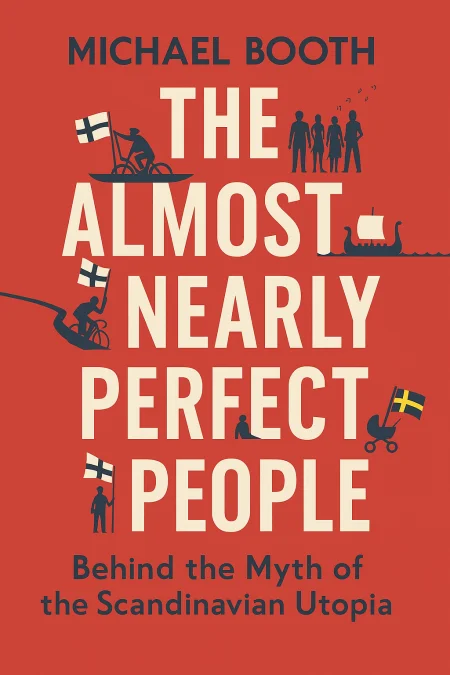
The Almost Nearly Perfect People
Behind the Myth of the Scandinavian Utopia
Book Edition Details
Summary
Curiosity and skepticism propel journalist Michael Booth as he ventures beyond the clichés of Nordic bliss in "The Almost Nearly Perfect People." Having called Denmark home for over a decade, Booth trades rose-colored glasses for a magnifying lens, unraveling the complex tapestry of Scandinavia. Are Denmark’s high taxes truly the secret to happiness? Does Finland's education system hold the key to global excellence? And what lies beneath Iceland’s wild exterior? Booth’s journey through these icy lands seeks to decode the enigma of their societal triumphs, only to reveal a landscape rife with contradictions—where hidden tensions simmer beneath the surface of serene, minimalist design. This incisive exploration offers readers a fresh perspective on a region often mythologized, yet rarely understood in its multifaceted reality.
Introduction
On a bitter February morning in 1864, Danish soldiers retreated across the frozen fields of Schleswig-Holstein, marking the end of Denmark's last territorial ambitions and the beginning of an extraordinary transformation. What appeared to be a humiliating defeat would ultimately become the foundation for one of history's most successful social experiments. Across Scandinavia, similar moments of crisis and introspection were reshaping entire nations, forcing them to abandon dreams of empire and embrace something far more revolutionary: the systematic pursuit of collective happiness and prosperity. The Nordic story challenges our most fundamental assumptions about power, success, and human nature. How did societies once dominated by Viking raids and imperial ambitions evolve into global exemplars of trust, equality, and social cooperation? What hidden costs accompanied their remarkable achievements, and how did they navigate the treacherous waters between individual freedom and collective responsibility? Most intriguingly, can their model survive the pressures of globalization, immigration, and technological change that challenge every developed nation today? For anyone seeking to understand how societies can build genuine prosperity while maintaining their humanity, the Nordic experience offers both inspiration and hard-won wisdom. These nations didn't stumble upon their success by accident—they forged it through centuries of pragmatic experimentation, painful compromises, and an almost obsessive commitment to social cohesion that both enabled their triumphs and created new dilemmas for the modern world.
From Imperial Loss to Cooperative Foundation (1658-1900)
The foundations of Nordic exceptionalism were laid not in triumph but in devastating defeat. Denmark's catastrophic losses began with the Treaty of Roskilde in 1658, which stripped away vast territories to Sweden, followed by the British bombardment of Copenhagen in 1807 and the final humiliation of surrendering Schleswig-Holstein to Prussia in 1864. Each defeat forced a painful reckoning with reality and a gradual abandonment of imperial dreams in favor of something more sustainable. From these ashes emerged a revolutionary philosophy captured in H.P. Holst's famous words: "What was lost without will be found within." This wasn't mere consolation but a fundamental reimagining of national purpose. Rather than seeking to reclaim lost territories through military might, Denmark embarked on what might be called positive parochialism, focusing intensively on developing what remained within its much-reduced borders. The agricultural cooperatives that transformed Danish farming from grain to dairy production virtually overnight exemplified this new approach, demonstrating that collective action could achieve what individual effort could not. Sweden faced its own moment of truth as its empire crumbled and industrial unrest threatened social stability. The response was characteristically pragmatic: rather than suppressing labor movements, Swedish leaders pioneered collective bargaining and social dialogue. The Ghent Agreement of 1899 in Denmark and Sweden's later Saltsjöbaden Agreement established frameworks for cooperation between workers, employers, and the state that would become templates for Nordic consensus politics. These early experiments in cooperation created the cultural foundation for everything that followed. The harsh northern climate had always demanded collective survival strategies, but the nineteenth century's political and economic crises transformed this necessity into a sophisticated philosophy of mutual dependence. By 1900, the Nordic countries had developed something unprecedented: societies where individual success was inseparable from collective welfare, where trust was not just a personal virtue but a national resource, and where the state was seen not as an oppressor but as the embodiment of shared values and aspirations.
Building the Welfare State Model (1900-1970)
The early twentieth century witnessed the Nordic countries' most remarkable transformation as they constructed comprehensive welfare states built on unprecedented levels of social trust and cooperation. World War II served as the crucible that forged modern Nordic identity, with Denmark and Norway's occupation by Nazi Germany, Sweden's precarious neutrality, and Finland's desperate winter war against the Soviet Union all reinforcing the vital importance of social solidarity and collective resilience in the face of existential threats. The post-war period saw an explosion of institution-building that would define Nordic societies for generations. Sweden's "People's Home" concept envisioned society as a large family where everyone contributed according to their ability and received according to their need. Universal healthcare, free education, generous unemployment benefits, and active labor market policies weren't just policy choices but expressions of a fundamental belief that prosperity should be shared and that the state had both the right and responsibility to ensure social cohesion. The genius of Nordic social democracy lay in recognizing that economic equality and social trust were mutually reinforcing. High taxes weren't seen as confiscation but as collective investment in shared prosperity. Denmark pioneered "flexicurity," allowing employers to hire and fire easily while providing generous unemployment benefits, creating labor market flexibility without individual insecurity. Citizens trusted their governments to spend tax money wisely because they trusted their fellow citizens not to abuse the system, creating a virtuous cycle that enabled ever more ambitious collective projects. Perhaps most remarkably, these policies enjoyed broad popular support precisely because they emerged from already cohesive societies. The social trust developed through centuries of cooperation in harsh climates made ambitious collective projects possible. By 1970, the Nordic countries had created something unprecedented in human history: prosperous, egalitarian societies where individual freedom and collective responsibility reinforced rather than contradicted each other, setting the stage for even greater challenges ahead.
Oil Wealth and Integration Challenges (1970-2015)
The discovery of North Sea oil in 1969 transformed Norway from Scandinavia's poor cousin into its wealthiest member, but the real story of this period lies in how all Nordic countries navigated the tensions between growing prosperity and maintaining social equality. Norway's decision to treat oil wealth as a collective inheritance rather than immediate consumption demonstrated unprecedented long-term thinking, creating the world's largest sovereign wealth fund while avoiding the resource curse that plagued other oil-rich nations. Sweden's industrial giants conquered global markets while maintaining generous worker benefits and high taxes, proving that extensive welfare states could coexist with economic dynamism. Yet prosperity brought new challenges that tested Nordic commitment to equality. The 1970s and 1980s saw growing debates about whether generous welfare systems were creating dependency and stifling entrepreneurship, while Sweden's experiment with wage-earner funds sparked fierce political battles that revealed deep tensions within the social democratic consensus. The period also witnessed the emergence of what critics called Nordic exceptionalism, a sometimes smug belief that these small nations had solved the fundamental problems of modern capitalism. International observers flocked to study Nordic models, often overlooking the specific historical and cultural conditions that made these systems possible. The Nordics themselves began to see their societies as laboratories for progressive politics, a self-image that would prove both empowering and constraining. By the 1990s, cracks were appearing in the Nordic facade. Sweden's banking crisis and Finland's economic collapse following the Soviet Union's demise revealed vulnerabilities inherent in small, open economies. More troubling were signs of social strain: rising crime rates, growing inequality, and the emergence of populist parties challenging the consensus politics that had dominated for decades. The golden age of Nordic social democracy was ending, but the foundations remained strong enough to support the adaptations that would be necessary for survival in an increasingly complex world.
Immigration Crisis and Model Adaptation (2015-Present)
The 2015 refugee crisis confronted the Nordic countries with their greatest test yet, forcing them to confront whether their model of social solidarity could extend beyond ethnically homogeneous populations. Sweden's open-door policy, once a source of international praise, came under severe strain as the country struggled to integrate hundreds of thousands of newcomers, leading to the emergence of parallel societies, rising crime rates in certain areas, and the political ascendance of the far-right Sweden Democrats. Denmark responded with some of Europe's strictest immigration policies, while Norway used its oil wealth to maintain more generous integration programs. These different approaches produced dramatically different outcomes and revealed the limits of Nordic solidarity, as the high-trust societies that enabled generous welfare states struggled to maintain cohesion in the face of rapid demographic change and cultural diversity that challenged long-held assumptions about social cooperation. The challenges coincided with broader pressures on Nordic welfare states from aging populations, global tax competition, and the rise of the gig economy. The COVID-19 pandemic temporarily reinforced faith in strong public institutions but also accelerated trends toward digitalization and remote work that could undermine the social solidarity on which Nordic systems depend. Climate change and the green transition created both opportunities and challenges for countries heavily dependent on fossil fuel exports or energy-intensive industries. Most significantly, the rise of populist parties across the region signaled a breakdown in the consensus politics that had characterized Nordic democracy for decades. While these parties remained largely excluded from power, their success forced mainstream parties to adopt tougher stances on immigration and national sovereignty, fundamentally altering the political landscape and raising profound questions about whether the Nordic model could adapt to diversity and complexity while maintaining the social solidarity that made their original success possible.
Summary
The Nordic journey from peripheral European kingdoms to global exemplars of progressive governance reveals a central paradox: the very success of these societies may have sown the seeds of their current challenges. The homogeneous, high-trust societies that enabled generous welfare states and consensus politics are being transformed by immigration, globalization, and generational change, forcing a fundamental reckoning with whether their model can adapt while maintaining the social solidarity that made their success possible. Three crucial lessons emerge from this historical trajectory that resonate far beyond Scandinavia's borders. First, sustainable prosperity requires balancing individual freedom with collective responsibility, a balance that must be constantly recalibrated as societies evolve and face new challenges. Second, successful institutions depend on cultural foundations that cannot be quickly built or easily transplanted, suggesting that each society must find its own path to equity and prosperity rather than simply copying Nordic policies. Finally, even the most successful models require continuous renewal and adaptation, as yesterday's solutions may become tomorrow's problems if applied rigidly to new circumstances. For contemporary policymakers and citizens grappling with rising inequality, climate change, and social fragmentation, the Nordic experience offers both hope and humility. It demonstrates that alternative forms of capitalism are possible and that small nations can achieve remarkable success through smart institutions and social cooperation, while also revealing the fragility of these achievements and the constant vigilance required to maintain them. The future of the Nordic model depends on whether these societies can reinvent themselves once again while preserving the values that made them beacons of hope for the world.
Related Books
Download PDF & EPUB
To save this Black List summary for later, download the free PDF and EPUB. You can print it out, or read offline at your convenience.
By Michael Booth
