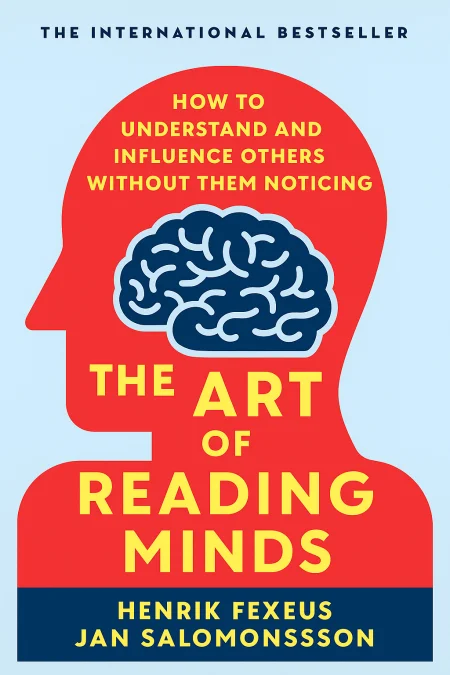
The Art of Reading Minds
Understand Others to Get What You Want
byHenrik Fexeus, Jan Salomonsson
Book Edition Details
Summary
What if you could peer into the minds of those around you without them even knowing? Enter the intriguing world of Henrik Fexeus's "The Art of Reading Minds," where the secrets of non-verbal communication unfold with captivating clarity. This international bestseller is your gateway to mastering the unspoken language that influences thoughts and emotions. With Fexeus's expert guidance, you'll uncover the art of persuasion, from becoming the charismatic life of the party to securing that elusive promotion at work. Through a series of lively, insightful chapters, you'll learn how to decode body language, employ subtle psychological influence, and even perform dazzling mind-reading feats. This isn't just a manual; it's your ticket to transforming everyday interactions into opportunities for deeper connection and influence, all while staying delightfully under the radar. Prepare to see the world—and its people—in a whole new light.
Introduction
Have you ever had the uncanny feeling that someone didn't like you, despite their polite words and friendly smile? Or perhaps you've walked into a room and immediately sensed tension, even though everyone appeared calm on the surface? These moments reveal a profound truth about human communication: we're constantly broadcasting our thoughts and feelings through channels we rarely acknowledge or understand. While we focus intently on spoken words, our bodies are having an entirely different conversation through subtle gestures, facial expressions, breathing patterns, and posture shifts that occur below the threshold of conscious awareness. The ability to decode these silent signals isn't mystical or supernatural—it's a learnable skill rooted in well-established psychological and physiological principles. Every emotion we experience creates measurable changes in our bodies, from the dilation of our pupils when we're interested to the barely perceptible muscle contractions that reveal our true feelings about what someone is saying. By understanding how our minds and bodies are inextricably connected, we can develop the remarkable ability to perceive what others are actually thinking and feeling, often before they're fully aware of it themselves. This knowledge opens doors to more authentic relationships, more effective communication, and a deeper understanding of the complex social world we navigate every day. You'll discover how to establish genuine rapport with anyone, recognize when someone is being deceptive, and even influence others' emotional states in positive ways. Most surprisingly, you'll learn that you already possess many of these abilities—you simply need to bring them into conscious awareness and refine them through practice.
The Science Behind Mind Reading and Rapport Building
The foundation of genuine mind reading lies in understanding that our thoughts and bodies are not separate entities, as the philosopher René Descartes mistakenly proposed centuries ago. Modern neuroscience has definitively proven that every mental process creates corresponding physical changes throughout our entire being. When you think of something frightening, your heart rate increases and blood flows to your leg muscles in preparation for escape. When you imagine biting into a sour lemon, your mouth actually contracts and produces saliva. These aren't coincidences—they're evidence of the fundamental unity between mind and body. This connection works in both directions. Just as thoughts influence our physical state, our posture and muscle tensions directly affect our mental and emotional experiences. By deliberately adopting the physical posture associated with confidence—straightening your spine, opening your chest, and raising your chin—you can actually trigger the neurochemical processes that create genuine feelings of self-assurance. This isn't positive thinking or mere visualization; it's a biological reality that we can harness to transform both our inner experience and how others perceive us. Rapport, that magical quality that makes some conversations flow effortlessly while others feel stilted and uncomfortable, emerges naturally when two people unconsciously mirror each other's body language, speech patterns, and energy levels. We instinctively like people who remind us of ourselves because they feel familiar and safe. By consciously adapting your communication style to match another person's preferred tempo, gesture patterns, and even breathing rhythm, you can create this sense of familiarity and trust within minutes of meeting someone. The key insight is that effective rapport isn't about manipulation or deception—it's about temporarily speaking someone else's nonverbal language to create optimal conditions for genuine understanding. When two people are in true rapport, they naturally take turns leading and following each other's movements and energy, creating a dance of mutual influence that enhances both participants' ability to communicate clearly and feel heard.
Decoding Emotions, Body Language, and Hidden Thoughts
Human faces contain over forty muscles, many of which operate entirely outside our conscious control, creating a remarkably detailed display of our internal emotional states. While we can easily fake a smile with our mouth, our eyes, eyebrows, and forehead continue broadcasting authentic information about what we're actually feeling. The difference between genuine and artificial emotional expressions lies in these subtle details—a real smile engages muscles around the eyes that most people cannot consciously activate, while a fake one leaves the upper face unchanged and emotionless. The seven universal emotions—surprise, sadness, anger, fear, disgust, contempt, and joy—each create distinct patterns of muscle activation that appear identically across all human cultures. However, we often display these emotions in abbreviated forms: slight expressions that use the complete pattern but with low intensity, partial expressions that activate only some of the relevant muscles, or microexpressions that flash across our faces for as little as one-twenty-fifth of a second before being suppressed. These fleeting signals often reveal what someone is truly feeling even when they're desperately trying to hide it. Perhaps most remarkably, you can often detect which emotion someone is about to experience before they become consciously aware of it themselves. Since muscular reactions occur faster than conscious thought processes, the physical signs of anger, fear, or disgust appear in the face moments before the person actually "feels" the emotion. This provides a crucial window of opportunity to address problematic emotional states before they fully develop and color someone's perception of your entire interaction. Understanding someone's preferred sensory system—whether they primarily process information through visual images, auditory patterns, or kinesthetic sensations—provides another layer of insight into their thought processes. People who think visually tend to speak quickly and breathe high in their chest, while those who process information kinesthetically move and speak more slowly, taking time to "feel" their way through decisions. By recognizing these patterns and adapting your communication style accordingly, you can ensure your message reaches others in the format their minds most readily understand and accept.
Detecting Deception and Understanding Attraction Signals
When people attempt to deceive us, they face the challenging task of controlling multiple communication channels simultaneously—their words, facial expressions, vocal tone, and body language must all convey the same false message. Since we're most skilled at controlling our speech and least aware of what our bodies are doing, deception often creates detectable contradictions between these different channels of communication. The hands might unconsciously cover the mouth as if to prevent lies from escaping, or gestural slips might appear as repetitive, meaningless actions that release the nervous tension created by maintaining a false facade. Voice patterns also shift dramatically under the stress of deception. People tend to speak faster, higher, and louder when feeling guilty about lying, or slower, deeper, and quieter when experiencing shame. Pauses appear in unusual places, speech becomes fragmented or overly repetitive, and linguistic patterns change in telltale ways. Liars often create distance from their deception by avoiding personal pronouns, speaking in negatives rather than positives, and using unnecessarily formal or abstract language that obscures rather than clarifies their meaning. However, these same stress indicators can appear for many reasons besides deception—nervousness, excitement, fatigue, or simply thinking about something unrelated to your conversation. The key is recognizing patterns of contradictory signals and understanding their context rather than jumping to conclusions based on isolated behaviors. Attraction creates its own fascinating array of unconscious signals that most people remain completely unaware they're displaying. The mating dance begins with establishing rapport across a room through synchronized body language and meaningful eye contact. It progresses through primordial displays of submission and challenge—women often look down briefly after making eye contact, signaling harmlessness, while both sexes unconsciously begin grooming themselves and improving their posture to appear more attractive. As comfort increases, people remove barriers between them, face each other directly, and even begin subtle forms of undressing like loosening ties or removing shoes. These signals operate so far below conscious awareness that participants often remain convinced they were merely having a pleasant business conversation even while engaging in elaborate courtship rituals.
Practical Influence Techniques and Psychological Anchoring
The power to influence others' thoughts and emotions carries profound responsibility and should only be used to help people achieve positive states that serve their best interests. Through carefully crafted language patterns, you can plant suggestions directly into someone's unconscious mind, bypassing their critical analytical filters. Negations prove particularly powerful because our minds must first understand what we're being told not to think about before applying the abstract concept of "not"—meaning the phrase "don't think of a blue elephant" inevitably creates exactly the mental image it claims to prohibit. Embedded commands work by speaking on multiple levels simultaneously. While your conscious message might be casual conversation, specific words or phrases can be subtly emphasized through voice tone or timing to convey secondary meanings that the listener's unconscious mind readily absorbs. Politicians and advertisers have mastered these techniques, using them to create emotional associations with their products or causes without their audience realizing they're being influenced. Anchoring represents perhaps the most direct method of emotional influence, creating conditioned responses that can instantly trigger specific feelings in yourself or others. By associating a particular touch, gesture, or word with moments of peak positive emotion, you create a psychological switch that can later reproduce those feelings on command. This technique works because our nervous systems naturally form connections between simultaneous experiences, just as Pavlov's dogs learned to associate bells with food. The most ethical and effective anchors emerge from genuine positive experiences rather than artificially manufactured ones. When you notice someone experiencing authentic joy, enthusiasm, or confidence, a simple touch on their shoulder combined with a specific word or phrase can create a lasting anchor. Later, reproducing that same stimulus can help them access those resourceful emotional states when facing challenges or making important decisions. Used responsibly, anchoring becomes a powerful tool for helping others overcome limiting emotional patterns and access their full potential in crucial moments.
Summary
The most profound realization from understanding nonverbal communication is that authentic human connection happens primarily through channels we rarely acknowledge consciously, yet our unconscious minds process this information constantly and use it to form deep impressions about trustworthiness, compatibility, and emotional states. By bringing these automatic processes into conscious awareness, we gain the remarkable ability to communicate more effectively, build stronger relationships, and help others access their best emotional states while protecting ourselves from manipulation and deception. This knowledge fundamentally changes how we navigate social interactions, replacing guesswork and misunderstanding with precise awareness of what's actually happening beneath the surface of our conversations. Rather than diminishing the mystery of human connection, understanding these principles enhances our appreciation for the sophisticated biological and psychological systems that enable us to form meaningful bonds with others. The real magic lies not in supernatural powers, but in the elegant way our minds and bodies have evolved to share information and create understanding across the apparent barriers between individual consciousness. How might your relationships transform if you became consistently aware of the emotional states and genuine reactions of those around you? What positive changes could you create in your personal and professional life by helping others feel truly understood and emotionally supported through your enhanced awareness of their unspoken communication?
Related Books
Download PDF & EPUB
To save this Black List summary for later, download the free PDF and EPUB. You can print it out, or read offline at your convenience.
By Henrik Fexeus
