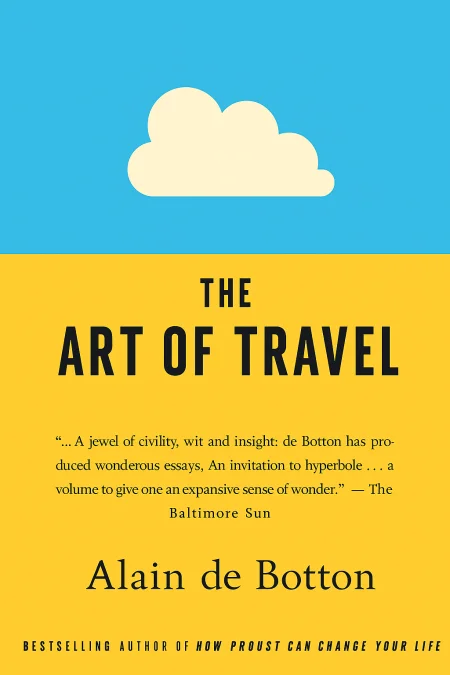
The Art of Travel
Learn how to get the most out of your next travel adventure
Book Edition Details
Summary
Wanderlust takes a reflective turn in Alain de Botton's "The Art of Travel," a captivating blend of philosophical musing and travelogue. Here, journeys unfold as more than mere movement—they become explorations of the soul. De Botton, with his signature wit and thoughtful insight, invites readers to ponder the nuances of travel: the thrill of the unknown, the magic of anticipation, and the art of observation. From the vibrant shores of Barbados to the bustling terminals of Heathrow, every scene is a canvas, painted with the perspectives of literary giants like Baudelaire and Wordsworth. This book isn't a checklist of destinations but a guide to seeing the world through fresh eyes. In its pages, the ordinary transforms into the extraordinary, making it an essential companion for those who seek meaning beyond the map.
Introduction
There's something magical about standing in an airport departure lounge at dawn, watching planes taxi toward distant runways while clutching a boarding pass to somewhere you've never been. The anticipation tingles through your body like electricity—this journey will be different, transformative, life-changing. Yet how often do we return home from our adventures feeling somehow unchanged, carrying little more than photographs and souvenirs? The gap between our travel dreams and reality reveals a profound truth: the art of meaningful travel isn't about the destinations we choose, but how we choose to see them. This exploration delves into the psychology of wanderlust and the complex relationship between expectation and experience. Through intimate observations and philosophical insights, we discover that travel's greatest gift isn't escape from our ordinary lives, but a deeper appreciation of the extraordinary hiding in plain sight. Whether we're crossing continents or simply walking down a familiar street, the capacity for wonder, growth, and genuine discovery lies not in our circumstances, but in our willingness to engage with the world around us with fresh eyes and an open heart.
The Paradox of Anticipation and Reality
Picture yourself months before a long-awaited vacation, poring over guidebooks and dreaming of azure seas or snow-capped peaks. Your imagination crafts perfect scenes—a sunset dinner overlooking the Mediterranean, morning coffee in a charming Parisian café, or that Instagram-worthy moment at Machu Picchu. The anticipation becomes intoxicating, filling mundane Tuesday afternoons with possibilities. You research restaurants, plan itineraries, and count down the days with mounting excitement. Then reality arrives. The Mediterranean restaurant has terrible service and crying children at the next table. The Parisian café smells of stale cigarettes and serves lukewarm coffee. Machu Picchu is shrouded in fog, and you're surrounded by dozens of other tourists taking the same photograph. The gap between your mental images and lived experience feels like a betrayal, leaving you wondering if something is wrong with you for not feeling the magic you expected. This disconnect between anticipation and reality isn't a flaw in travel—it's an inevitable feature of human psychology. Our imaginations work like skilled editors, creating highlight reels while omitting the mundane details that comprise most experiences. We envision walking along a beach at sunset but forget about the hot sand burning our feet, the aggressive vendors, or our own fatigue. The beauty exists, but it's woven into a tapestry of ordinary moments that our fantasies conveniently overlooked. Understanding this paradox liberates us from the pressure of perfect experiences and opens us to unexpected discoveries. When we release our grip on predetermined outcomes, we create space for genuine surprise and wonder. The most memorable travel moments often arrive unplanned—a spontaneous conversation with a stranger, an unscheduled detour that reveals hidden beauty, or finding profound peace in a moment we never thought to anticipate.
Finding Beauty in Unexpected Places
Late one evening, a traveler found herself stranded at a roadside service station between London and Manchester. Fluorescent lights hummed overhead, casting harsh shadows on plastic tables dotted with dried ketchup. A few weary travelers nursed cups of tea while trucks thundered past on the motorway outside. Everything about the place seemed designed to epitomize modern ugliness—the industrial architecture, the processed food, the impersonal atmosphere of transit and anonymity. Yet as she sat by the floor-to-ceiling windows, something shifted. The very isolation of the place began to feel poetic, like a lighthouse standing sentinel against the darkness. The harsh lighting that initially repelled her now seemed to create an honest space where pretense fell away. Here, among the vending machines and vinyl seating, was a democracy of tiredness and solitude. Everyone was equal under these unforgiving lights—business executives and lorry drivers, teenagers and pensioners, all temporarily residents of this liminal world between destinations. She began to notice details that day's rushed commuters miss: the careful way someone stirred sugar into coffee, the kindness in a server's tired eyes, the dignity of fellow travelers making the best of uncomfortable circumstances. The service station became a stage for quiet human dramas, a place where people's essential humanity emerged stripped of the usual social masks. The beauty wasn't in the architecture or amenities, but in the authentic moments of connection and reflection that the space somehow made possible. This revelation challenges our conventional understanding of where beauty resides. We often search for it in designated beautiful places—museums, scenic overlooks, historic landmarks—while remaining blind to the profound moments available in overlooked spaces. Beauty isn't a fixed property of certain locations, but a quality of attention we can bring to any environment. The motorway service station, in its honest functionality and democratic anonymity, offers something precious: a reminder that wonder and meaning can emerge anywhere, if only we approach the world with curious, compassionate eyes.
Art as a Guide to Seeing
Vincent van Gogh arrived in the South of France carrying little more than an easel and an unshakeable belief that he could teach people to see. The landscape of Provence had been painted countless times before—rolling fields, ancient olive groves, cypress trees swaying in the mistral winds. Previous artists had rendered these subjects with technical skill and classical training, creating competent but forgettable works that failed to capture what van Gogh sensed was the true spirit of the place. Working with fevered intensity under the blazing sun, van Gogh painted cypresses not as mere trees but as living flames reaching toward heaven, their forms twisted by an inner fire that mirrored his own passionate engagement with the world. His olive groves pulsed with silver and green energy, their gnarled trunks telling stories of endurance and renewal. The night sky over the Rhône exploded with swirling stars and cosmic winds invisible to casual observers but blazingly apparent to his artist's eye. When van Gogh's paintings first appeared, critics dismissed them as crude exaggerations. The colors were too vivid, the brushstrokes too visible, the emotional content too raw. Surely art should aim for photographic accuracy, they argued, not this wild distortion of reality. But van Gogh understood something profound: literal reproduction isn't the same as truth. His "distortions" revealed deeper realities about the Provençal landscape—its fierce vitality, its ancient rhythms, its capacity to inspire awe and transformation in those willing to look beyond surface appearances. Today, countless travelers visit Provence carrying van Gogh's vision in their minds. They see cypresses and immediately think of flames, notice the silver shimmer of olive leaves that previous generations overlooked, and find themselves moved by night skies that once seemed merely dark. Art hasn't changed the landscape—it has changed how we see, teaching us to notice beauty that was always there waiting for recognition. Great artists don't create beauty; they reveal it, training our eyes to perceive the extraordinary dimensions of ordinary experience and forever enriching our capacity for wonder.
Summary
The journey toward meaningful travel begins with a simple recognition: the most transformative adventures happen not in exotic locations, but in the subtle shift of consciousness that allows us to see familiar things with fresh eyes. Through examining the gap between anticipation and reality, discovering beauty in unlikely places, and learning how art reshapes perception, we uncover travel's deepest secret—it's not about covering distance but about cultivating attention, curiosity, and openness to surprise. Every departure holds the promise of return with expanded awareness, whether we've crossed oceans or simply walked through our own neighborhood with the eyes of an explorer. The greatest souvenirs aren't objects but moments of genuine seeing—those instances when the world suddenly reveals its hidden layers of meaning and beauty. True travelers understand that the capacity for wonder isn't a privilege reserved for exotic destinations but a skill that can transform any Tuesday afternoon into an adventure. When we approach the world with this traveling mind-set, every experience becomes an opportunity for discovery, every place becomes capable of teaching us something new about beauty, connection, and the inexhaustible richness of simply being awake to life as it unfolds around us.
Related Books
Download PDF & EPUB
To save this Black List summary for later, download the free PDF and EPUB. You can print it out, or read offline at your convenience.
By Alain de Botton
