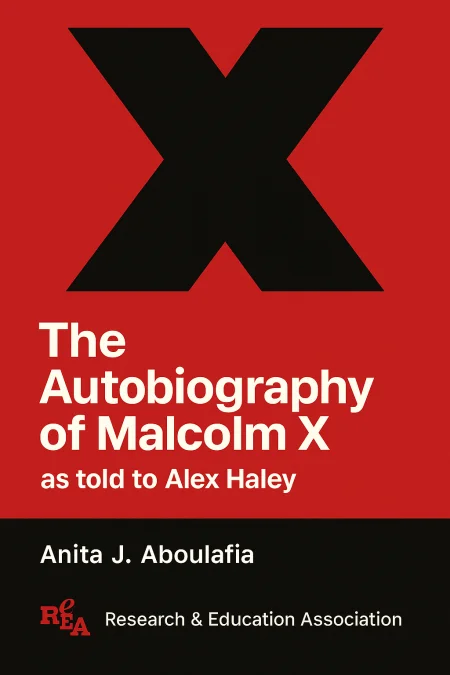
The Autobiography of Malcolm X
As told to Alex Haley
byAnita J. Aboulafia, Alex Haley, Research & Education Association
Book Edition Details
Summary
In the transformative pages of The Autobiography of Malcolm X, the reader is immersed in the raw, unflinching evolution of Malcolm Little into Malcolm X—a voice that roared against the chains of oppression. This MAXnotes edition unravels the compelling saga of a man who walked the shadowy corridors of crime before igniting a fervent quest for justice and identity. Through expert insights, vibrant illustrations, and thought-provoking discussions, this guide illuminates the tumultuous journey of a figure who redefined resilience and rebellion. Witness the indomitable spirit of a leader who galvanized a movement, challenging the status quo with unwavering conviction and unparalleled courage.
Introduction
In the turbulent landscape of 1960s America, few figures commanded attention quite like Malcolm X. Born Malcolm Little in 1925, he emerged from the depths of urban despair to become one of the most compelling and controversial voices of his generation. His journey from street hustler to revolutionary thinker represents one of the most dramatic personal transformations in American history. Through his unflinching honesty about his past and his evolving understanding of race, identity, and human dignity, Malcolm X challenged both Black and white Americans to confront uncomfortable truths about society and themselves. His story illuminates the complex realities of growing up Black in America during the Jim Crow era, while his intellectual evolution demonstrates the power of education and self-reflection to fundamentally reshape one's worldview. Readers will discover how personal tragedy and systemic racism shaped his early years, witness his remarkable transformation through education and spiritual awakening, and understand how his revolutionary ideas about Black pride and human rights continue to resonate today.
From Darkness to Crime: Early Life and Street Years
Malcolm's childhood was marked by violence and loss that would haunt him for years to come. Born in Omaha, Nebraska, his family faced constant threats from white supremacist groups who targeted his father, Earl Little, for his involvement with Marcus Garvey's Black nationalist movement. The family's house was burned down by racists, and Earl Little's mysterious death when Malcolm was six left the family devastated. His mother, Louise Little, struggled to hold the family together under the crushing weight of poverty and grief, eventually suffering a mental breakdown that led to her institutionalization. The destruction of his family unit thrust young Malcolm into the harsh realities of the foster care system. Despite showing academic promise and even being elected class president, his dreams were crushed when a white teacher told him that becoming a lawyer was "no realistic goal for a nigger." This moment of casual racism shattered his faith in the American dream and marked the beginning of his drift toward the streets. He dropped out of school and moved to Boston, where he was dazzled by the urban Black culture of Roxbury and the sophisticated nightlife that seemed to offer escape from his painful past. In Boston and later New York, Malcolm transformed himself into "Detroit Red," a street-smart hustler who dealt drugs, ran numbers, and eventually organized burglary rings. His criminal activities escalated as he became addicted to cocaine and embraced a lifestyle of violence and exploitation. The young man who had once dreamed of becoming a lawyer now carried guns and lived by the brutal code of the streets. His relationship with a white woman named Sophia further complicated his life, reflecting the complex racial dynamics and self-hatred that plagued many Black Americans of his generation. This descent into criminality was not merely personal failure but a predictable outcome of systemic racism and social neglect. Malcolm's early experiences revealed how American society failed its most vulnerable citizens, particularly Black children who faced both overt discrimination and the destruction of their family structures. His criminal years, while destructive, also demonstrated his intelligence, leadership abilities, and charisma—qualities that would later serve him in very different ways.
Prison Awakening: Islamic Faith and Self-Education
Malcolm's arrest and imprisonment in 1946 initially seemed like the inevitable end to his criminal career, but it became the catalyst for the most profound transformation of his life. Sentenced to ten years for burglary, he entered Charlestown State Prison as an angry, barely literate young man consumed by hatred and self-destructive impulses. His fellow inmates nicknamed him "Satan" for his fierce rejection of religion and his violent temperament. However, this period of forced reflection would become the foundation for his intellectual and spiritual rebirth. The transformation began with his family's conversion to the Nation of Islam and their persistent efforts to reach him through letters and visits. His brother Reginald's simple instruction to stop eating pork and smoking cigarettes puzzled Malcolm initially, but it represented his first step toward a new understanding of himself and his place in the world. When Reginald explained that "the white man is the devil" and introduced him to the teachings of Elijah Muhammad, Malcolm experienced what he later described as a blinding revelation that recontextualized his entire life experience. Prison became Malcolm's university, where he embarked on an extraordinary program of self-education that would continue for the rest of his life. He copied the entire dictionary by hand to improve his vocabulary, devoured books on history, philosophy, and religion, and engaged in debates with fellow inmates and visitors. His reading revealed to him the hidden history of Africa and the systematic oppression of Black people throughout the world. This knowledge filled him with both rage at the injustices he discovered and pride in the achievements of Black civilizations that had been erased from mainstream historical narratives. The Nation of Islam's teachings provided Malcolm with a framework for understanding his experiences and those of Black Americans generally. The organization's emphasis on Black pride, self-reliance, and separation from white society resonated deeply with someone who had experienced firsthand the failures of integration and the persistence of white supremacy. His conversion was complete and total, transforming not just his beliefs but his entire identity. When he was released from prison in 1952, Malcolm Little was gone forever, replaced by Malcolm X, a disciplined, articulate minister ready to spread Elijah Muhammad's message to the world.
Minister and Revolutionary: Nation of Islam Leadership
Upon his release from prison, Malcolm X threw himself into building the Nation of Islam with the fervor of a true believer. His natural charisma, combined with his street credibility and newfound intellectual sophistication, made him an extraordinarily effective recruiter and spokesperson. He established mosques in Detroit, Boston, and New York, transforming the Nation from a small, obscure sect into a significant force in Black America. His fiery speeches and television appearances brought national attention to the organization's message of Black nationalism and separation from white society. Malcolm's approach differed markedly from the mainstream civil rights movement led by figures like Martin Luther King Jr. While King preached nonviolence and integration, Malcolm advocated for Black pride, self-defense, and the creation of separate Black institutions. His famous declaration that Black Americans should achieve equality "by any means necessary" challenged the passive resistance strategies that dominated civil rights activism. He argued that Black people had the right to defend themselves against white violence and should not rely on the goodwill of their oppressors for liberation. His intellectual evolution accelerated during his years as a minister, as he continued his voracious reading and began to develop his own interpretations of the Nation's teachings. He became increasingly sophisticated in his understanding of international affairs, connecting the struggle of Black Americans to liberation movements in Africa and Asia. His speeches began to incorporate broader themes of human rights and self-determination, moving beyond the narrow racial focus that had initially defined his message. The media attention that Malcolm attracted was both a blessing and a burden for the Nation of Islam. His articulate presentations of Black nationalist ideology brought unprecedented visibility to the organization, but also created tensions within the leadership. Malcolm's growing prominence sometimes overshadowed Elijah Muhammad himself, breeding resentment among other officials who viewed his media success with suspicion. These internal conflicts, combined with Malcolm's evolving understanding of Islam and his growing doubts about some of the Nation's teachings, would eventually lead to a dramatic break that would define the final phase of his life.
Final Evolution: Mecca Pilgrimage and Human Rights Vision
The pilgrimage to Mecca in 1964 marked the beginning of Malcolm's final and most profound transformation. Having grown increasingly disillusioned with Elijah Muhammad's personal conduct and the Nation of Islam's rigid doctrines, Malcolm embarked on the hajj seeking authentic Islamic teachings and spiritual renewal. What he discovered in the holy city fundamentally challenged his beliefs about race and religion. In Mecca, he encountered Muslims of every race and nationality worshipping together as equals, sharing meals and treating each other with genuine brotherhood regardless of skin color. This experience shattered Malcolm's belief in the inherent evil of white people and opened his mind to the possibility of genuine racial harmony based on shared spiritual values. He began writing letters home describing his new understanding, explaining that he could no longer subscribe to blanket condemnations of any race. The problem, he realized, was not white people per se, but rather the racist system and attitudes that pervaded American society. This distinction allowed him to maintain his criticism of racism while opening the door to potential alliances with sincere white allies. Upon returning from Mecca, Malcolm founded the Organization of Afro-American Unity and began articulating a new vision of Black liberation that emphasized human rights over civil rights and international solidarity over domestic isolation. He sought to connect the African American freedom struggle with liberation movements in Africa and Asia, attempting to bring America's racial problems before the United Nations as violations of human rights. His speeches during this period reflected a more nuanced understanding of both the problems facing African Americans and potential solutions. However, Malcolm's evolution also made him increasingly dangerous to his former associates in the Nation of Islam. His intimate knowledge of the organization's inner workings and his growing influence as an independent leader posed a significant threat to Elijah Muhammad's authority. Death threats became commonplace, and Malcolm lived his final months under constant threat of assassination. The assassination on February 21, 1965, at the Audubon Ballroom in Harlem cut short a life that was still evolving and growing, robbing America of one of its most dynamic voices on race and human rights.
Summary
Malcolm X's life stands as a testament to the transformative power of education, self-reflection, and moral courage in the face of systemic oppression and personal adversity. His journey from the traumatized child of Malcolm Little to the revolutionary voice of Malcolm X demonstrates that no one is beyond redemption and that the most profound changes often come from the most unexpected places. His unflinching honesty about his own mistakes and evolution challenges us to examine our own assumptions and prejudices, while his intellectual courage in questioning even his most deeply held beliefs shows the importance of remaining open to growth and change throughout our lives. Malcolm X's legacy reminds us that true leadership requires not just the ability to inspire others but the willingness to confront uncomfortable truths about ourselves and our society, making his story essential reading for anyone seeking to understand the ongoing struggle for justice and human dignity in America and beyond.
Related Books
Download PDF & EPUB
To save this Black List summary for later, download the free PDF and EPUB. You can print it out, or read offline at your convenience.
By Anita J. Aboulafia
