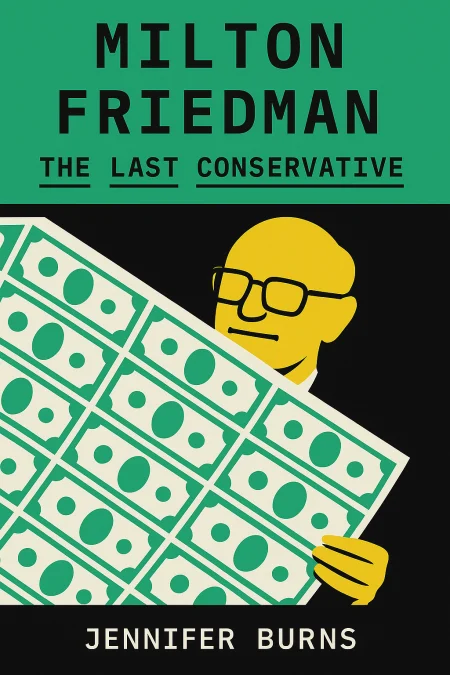
Milton Friedman
The Last Conservative
Book Edition Details
Summary
Milton Friedman, a towering figure in economics, reshaped the financial world with his bold ideas and unwavering faith in the power of free markets. In a riveting biography by historian Jennifer Burns, readers are invited to delve into the life and legacy of this intellectual giant. With unprecedented access to archival materials, Burns uncovers Friedman's transformative theories—from the intricacies of monetary policy to the controversial socio-economic debates that defined an era. Beyond his celebrated collaborations with Anna Schwartz and other luminaries, Friedman's influence extended into the corridors of power, challenging and shaping the doctrines of modern conservatism. This captivating narrative not only chronicles a life dedicated to economic thought but also offers a profound exploration of the man whose vision crafted the foundation of contemporary neoliberalism, leaving a complex and indelible mark on society.
Introduction
In the autumn of 1971, as President Nixon announced wage and price controls to combat inflation, a small group of economists watched in dismay from the University of Chicago. Among them sat Milton Friedman, whose decades of research had demonstrated why such policies would fail spectacularly. Yet within a few years, this same man's ideas would transform how governments worldwide approached monetary policy, market regulation, and the fundamental relationship between state and economy. His intellectual journey from academic outsider to global policy architect reveals one of the most remarkable transformations in modern economic thought. This story illuminates three pivotal questions that continue to shape our world: How do abstract economic theories become concrete government policies? What happens when free-market principles collide with political realities? And can economic freedom truly exist alongside authoritarian governance? Through Friedman's experiences, we witness the collapse of Keynesian consensus, the birth of modern central banking, and the global spread of market-oriented reforms that redefined capitalism itself. Anyone seeking to understand how ideas shape political power, how academic debates influence real-world outcomes, or why contemporary economic policies evolved as they did will find in this narrative essential insights into the forces that govern modern financial systems and the ongoing tension between market freedom and government control.
From Depression to Chicago School: Early Formation (1912-1946)
Milton Friedman's intellectual awakening occurred against the backdrop of capitalism's greatest crisis, when traditional economic wisdom lay shattered and new ideas competed for dominance. Born in 1912 to immigrant parents in New Jersey, he arrived at the University of Chicago in 1932 as banks collapsed and unemployment soared past twenty percent. This timing proved formative, exposing him to both the human costs of economic failure and the intellectual ferment that such crises generate. At Chicago, Friedman encountered professors like Frank Knight and Henry Simons who were developing a distinctive approach to economic analysis. Unlike their contemporaries at Harvard or Columbia who increasingly embraced government intervention, the Chicago faculty maintained deep skepticism toward centralized planning while recognizing that pure laissez-faire had failed. This tension produced innovative thinking about how markets could be preserved through carefully designed institutions rather than discretionary government management. Knight's emphasis on uncertainty and competition, combined with Simons' "positive program for laissez-faire," planted intellectual seeds that would later bloom into comprehensive free-market philosophy. The Great Depression forced young economists to grapple with fundamental questions about market stability and government's proper role. While many contemporaries concluded that capitalism required permanent oversight, Friedman began developing alternative explanations that emphasized monetary factors over market failures. His early exposure to the Federal Reserve's policy mistakes during the 1930s convinced him that government intervention often worsened the problems it sought to solve, a insight that would become central to his mature thinking. During World War II, Friedman's government service at the Treasury Department provided crucial practical experience that tempered his theoretical inclinations. Working on tax policy and statistical analysis, he learned how economic theories translated into real-world policies affecting millions of lives. This period established a pattern that would define his career: combining rigorous academic research with active engagement in policy debates, always seeking to bridge the gap between abstract principles and concrete solutions.
Building the Monetarist Challenge: Theory and Opposition (1946-1970)
Returning to Chicago after the war, Friedman entered an academic world dominated by Keynesian economics, which promised that government could fine-tune economic performance through fiscal policy and demand management. The prevailing wisdom held that markets were inherently unstable and required constant intervention to maintain full employment. Against this backdrop, Friedman began constructing what would become known as monetarism, a comprehensive alternative that placed money and monetary policy at the center of economic analysis. The foundation of Friedman's challenge emerged through his collaboration with Anna Schwartz on "A Monetary History of the United States." Their meticulous research revealed that the Federal Reserve's mismanagement of money supply, rather than inherent market failures, had caused the Great Depression. This finding directly contradicted the Keynesian narrative and suggested that monetary policy was far more powerful than previously recognized. Friedman's famous conclusion that "inflation is always and everywhere a monetary phenomenon" provided a simple yet revolutionary alternative to complex Keynesian models of aggregate demand. Friedman's 1967 presidential address to the American Economic Association delivered a devastating critique of the Phillips curve, the theoretical foundation of Keynesian policy-making. While conventional wisdom suggested a stable trade-off between unemployment and inflation, Friedman argued this relationship was illusory in the long run. His concept of the "natural rate of unemployment" predicted that attempts to maintain artificially low joblessness through inflation would ultimately produce stagflation, a phenomenon that Keynesian theory could not explain but which would soon plague Western economies. Beyond technical economics, Friedman was developing a broader philosophical framework that connected free markets to individual liberty. His book "Capitalism and Freedom" proposed radical alternatives to government programs, from school vouchers to negative income taxes, all designed to harness market mechanisms while preserving personal choice. By 1970, as inflation began accelerating and Keynesian remedies proved inadequate, Friedman's monetarist alternative gained credibility among both academics and policymakers seeking new approaches to economic management.
Stagflation Crisis and Policy Triumph: Global Influence (1970-1990)
The 1970s vindicated Friedman's predictions in the most dramatic fashion possible, as Western economies experienced the unprecedented combination of high inflation and high unemployment that economists called stagflation. The collapse of the Phillips curve relationship left Keynesian policymakers without effective tools, creating an intellectual vacuum that monetarist ideas rushed to fill. Friedman's framework suddenly seemed not radical but prescient, offering both explanation for the crisis and potential solutions. Paul Volcker's appointment as Federal Reserve Chairman in 1979 marked the practical triumph of monetarist principles in American policy-making. Volcker's dramatic shift toward controlling money supply growth, rather than interest rates, represented a fundamental change in central banking philosophy directly inspired by Friedman's research. The resulting recession was severe but brief, and inflation fell dramatically from double-digit levels. As Friedman had long argued, there was no painless way to restore price stability, but the long-term benefits justified short-term costs. Friedman's influence extended far beyond American borders during this transformative period. His controversial advisory role in Chile sparked global debates about the relationship between free markets and political freedom, while his ideas gained traction among conservative leaders like Margaret Thatcher in Britain. The "Washington Consensus" that emerged in the 1980s bore a distinctly Friedmanesque stamp, emphasizing privatization, deregulation, and sound money as keys to economic development. His television series "Free to Choose" brought these concepts to millions of viewers worldwide, creating popular support for market-oriented reforms. The fall of the Berlin Wall and collapse of socialist economies seemed to vindicate Friedman's long-standing argument that economic and political freedom were inextricably linked. Central banks around the world adopted inflation targeting and greater independence, while governments embraced privatization and deregulation on an unprecedented scale. By 1990, the intellectual revolution that began in Chicago's economics department had conquered much of the developed world, fundamentally altering the relationship between markets and government that had defined the post-war era.
Legacy and Modern Impact: Markets, Freedom, and Consequences (1990-2006)
Friedman's final decades were marked by both the global triumph of his ideas and growing recognition of their limitations and unintended consequences. The neoliberal revolution of the 1990s implemented market-oriented policies across both developed and developing nations, yet the practical results often diverged from his theoretical expectations. Financial deregulation proceeded faster and further than Friedman had anticipated, sometimes producing instability rather than efficiency, while the relationship between economic and political freedom proved more complex than his optimistic predictions suggested. The rise of behavioral economics during this period challenged key assumptions underlying Friedman's framework, particularly the notion that individuals consistently make rational economic decisions. Meanwhile, the increasing sophistication of macroeconomic models moved beyond his relatively simple monetarist prescriptions, as central banks adopted more flexible approaches to inflation control. Yet his core insights about the importance of rules over discretion, the power of market incentives, and the dangers of government overreach remained influential even as specific policy prescriptions evolved. Friedman's Nobel Prize in 1976 had already established his academic legacy, but the global spread of market capitalism raised new questions about inequality, environmental degradation, and social cohesion that his framework struggled to address. Countries like China demonstrated that market reforms could coexist with authoritarian governance, challenging his fundamental belief that economic freedom necessarily led to political liberty. These developments forced reconsideration of whether market solutions could address all economic and social problems without complementary institutions and policies. As Friedman aged, he watched his ideas evolve in ways he had not fully anticipated, sometimes serving interests and purposes far removed from his original intentions. The financialization of the global economy, the growing power of multinational corporations, and increasing inequality all bore some relationship to policies inspired by his work, yet represented outcomes he had not foreseen. His death in 2006 marked the end of an era, but the debates he initiated about markets, government, and human freedom continued to shape economic and political discourse worldwide.
Summary
The Friedman revolution reveals the extraordinary power of economic ideas to reshape political reality, demonstrating how rigorous intellectual work can ultimately transform both academic disciplines and practical policy-making across the globe. At its core, this transformation illuminated the eternal tension between market mechanisms and government control, showing how the pendulum of economic thought swings between faith in spontaneous order and belief in planned coordination. Friedman's triumph represented not merely a victory for free-market economics, but a fundamental shift in how societies balance individual freedom against collective security and social welfare. The historical trajectory from Keynesian dominance through monetarist influence to contemporary economic policy offers crucial lessons for ongoing debates about capitalism, democracy, and social organization. First, it demonstrates that intellectual persistence combined with empirical rigor can eventually overcome entrenched orthodoxies, suggesting that today's conventional wisdom should remain subject to continuous scrutiny and challenge. Second, it reveals how economic crises create opportunities for new ideas to gain political traction, reminding us that periods of disruption often herald fundamental changes in policy direction and institutional arrangements. Most importantly, Friedman's legacy illustrates both the promise and perils of translating abstract economic theories into concrete political programs. While his insights about monetary policy and market mechanisms proved remarkably prescient, the broader implementation of free-market ideology produced consequences he had not fully anticipated, from financial instability to rising inequality. This mixed record suggests that effective economic policy requires not choosing between markets and government, but designing institutions that harness the strengths of both while minimizing their respective weaknesses and unintended effects.
Related Books
Download PDF & EPUB
To save this Black List summary for later, download the free PDF and EPUB. You can print it out, or read offline at your convenience.
By Jennifer Burns
