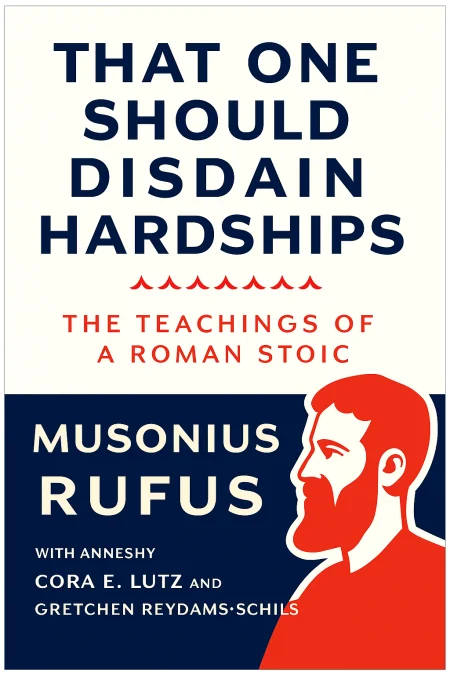
That One Should Disdain Hardships
The Teachings of a Roman Stoic
byMusonius Rufus, Cora E. Lutz, Gretchen Reydams-Schils
Book Edition Details
Summary
In the vibrant heart of ancient Rome, where power and philosophy entwined, one Stoic voice dared to resonate above the clamor of imperial ambition. Musonius Rufus, a beacon of practical wisdom, urged that true philosophy lives in our deeds, not in dusty tomes or lofty lectures. This collection, brought to life by Cora E. Lutz’s elegant translation and Gretchen Reydams-Schils's insightful introduction, distills his teachings into a timeless guide for living courageously and ethically. Musonius, often hailed as the "Roman Socrates," tackled life's challenges head-on, offering a doctrine steeped in reality, where resilience and reason forge the path to a virtuous life. For those drawn to the profound simplicity of Stoic thought, this treasure trove of Musonius's lectures offers more than insight; it promises transformation.
Introduction
Ancient philosophy often appears as abstract theorizing disconnected from daily concerns, yet one Roman Stoic teacher challenged this perception by insisting that philosophical wisdom must translate into concrete action. Musonius Rufus argued that virtue cannot exist merely as intellectual understanding but must manifest through lived practice, hardship endurance, and ethical relationships. His teachings present philosophy not as academic exercise but as training for human excellence through deliberate cultivation of character. This approach fundamentally reframes how we understand the relationship between knowledge and virtue. Rather than viewing ethical theory as preparation for virtuous action, Musonius positioned practice itself as the primary means of acquiring wisdom. His methodology involved rigorous training exercises, social engagement, and direct confrontation with conventional values. Modern readers wrestling with the gap between knowing what is right and actually doing it will find his integration of theory and practice particularly relevant. The following analysis examines how Musonius constructed his case for philosophy as embodied wisdom, the evidence he marshaled to support this vision, his reconceptualization of fundamental concepts like virtue and human nature, and the broader implications of his practical approach for understanding ethical development.
Core Argument: Philosophy as Lived Practice Over Theory
Philosophy achieves its proper function only when translated into action rather than remaining confined to intellectual discourse. Musonius established this central thesis by arguing that virtue represents a practical skill comparable to medicine or music, where theoretical knowledge proves worthless without corresponding ability to perform. Just as physicians must successfully treat patients and musicians must actually play instruments, philosophers must demonstrate their understanding through ethical conduct. This position directly challenged the prevailing academic approach to philosophy in imperial Rome. While contemporary teachers emphasized logical sophistication and rhetorical skill, Musonius insisted that philosophical education should focus on character development through sustained practice. He compared students who accumulated theoretical knowledge without practical application to invalids who study medicine but never recover their health. The argument extends beyond individual development to encompass social responsibility. Musonius maintained that philosophers must engage with practical concerns like marriage, child-rearing, and civic duties rather than withdrawing into contemplative isolation. This engagement serves both as training ground for virtue and as contribution to communal welfare. The practical orientation transforms the very definition of philosophical success. Rather than measuring achievement through argumentative prowess or scholarly recognition, Musonius evaluated progress through observable improvements in character, relationships, and social contribution. This framework positions philosophy as fundamentally concerned with human flourishing rather than abstract truth-seeking.
Supporting Evidence: Training, Hardship, and Social Relationships
Musonius supported his practical philosophy through systematic analysis of training methods that develop virtue through direct experience rather than theoretical instruction. He prescribed two complementary forms of exercise: individual soul training through logical analysis of genuine versus apparent goods, and combined soul-body conditioning through deliberate exposure to hardship. These practices mirror athletic training where repeated physical exertion builds strength and endurance. The hardship component receives particular emphasis through compelling analogies and examples. Musonius pointed to acrobats risking their lives for minimal payment, fighting cocks enduring injury rather than surrender, and Spartan youth embracing physical trials as preparation for virtue. These examples demonstrate that humans naturally accept suffering when pursuing valued goals, making philosophical hardship reasonable by comparison. Marriage and family relationships provide crucial evidence for philosophy's social dimension. Musonius argued that intimate partnerships offer the highest form of virtue practice because they demand sustained patience, justice, courage, and self-control under the most challenging conditions. He challenged conventional assumptions about gender roles by maintaining that both men and women require identical virtues, though their applications may differ based on physical capabilities rather than moral capacity. Professional and economic activities further substantiate the practical approach. Musonius recommended farming and manual labor as ideal occupations for philosophers because they provide opportunities to demonstrate self-sufficiency, endurance, and productive contribution while maintaining close contact with nature. This integration of intellectual and physical work embodies the unity of soul and body that characterizes human excellence.
Conceptual Analysis: Virtue, Nature, and Human Excellence
Virtue represents the perfection of human rational capacity rather than mere compliance with external rules or social conventions. Musonius redefined virtue as the harmonious development of practical wisdom, justice, courage, and self-control through deliberate training that aligns human behavior with natural purposes. This conception emphasizes function over form, measuring virtue through its effects on character and relationships rather than through adherence to prescribed behaviors. Human nature receives careful analysis that distinguishes between authentic natural tendencies and socially conditioned desires. Musonius argued that humans possess innate inclinations toward virtue, evidenced by universal claims to goodness and widespread recognition of moral standards. However, corrupted social environments distort these natural tendencies, requiring philosophical training to restore proper development. The concept of living according to nature emerges as the fundamental principle governing human excellence. Musonius interpreted natural living as fulfilling distinctively human capacities rather than indulging animal appetites. Since reason represents humanity's highest faculty, natural living requires developing rational judgment and using it to guide all activities from eating and clothing to marriage and civic participation. Excellence manifests through integrated development of all human capacities in service of rational goals. Musonius rejected artificial separations between intellectual, physical, and social aspects of human development, arguing instead for comprehensive training that strengthens body, sharpens mind, and deepens relationships simultaneously. This holistic approach produces individuals capable of meeting any challenge while contributing to communal welfare.
Critical Assessment: Practical Wisdom Versus Conventional Values
The practical approach to philosophy demonstrates both remarkable strengths and significant limitations when evaluated against conventional educational and social expectations. Musonius succeeded in developing a coherent framework that integrates intellectual rigor with moral development, providing clear guidance for ethical living while avoiding abstract theorizing disconnected from human concerns. His emphasis on training through hardship and social engagement offers concrete methods for character development that remain relevant across cultural contexts. The social implications of Musonius's teaching prove particularly innovative, especially regarding gender equality and economic justice. His arguments for women's philosophical education and equal moral capacity anticipated modern discussions of human rights by nearly two millennia. Similarly, his critique of luxury and emphasis on manual labor challenged prevailing aristocratic values while promoting economic self-sufficiency and social contribution. However, the practical approach faces serious challenges when confronting complex moral dilemmas that require sophisticated theoretical analysis. Musonius's confidence in natural moral intuitions may prove insufficient for addressing systematic injustices or unprecedented ethical problems. Additionally, his emphasis on individual character development, while valuable, may underestimate the importance of institutional reforms and collective action in promoting social welfare. The integration of philosophical practice with conventional social roles creates potential tensions between intellectual independence and social conformity. While Musonius advocated challenging conventional values through virtuous example, his acceptance of existing social structures may limit the transformative potential of philosophical education. Contemporary readers must consider whether practical philosophy requires more radical social criticism than Musonius provided.
Summary
Musonius Rufus demonstrated that authentic philosophical wisdom emerges through sustained practice rather than theoretical speculation, establishing virtue as a practical skill requiring deliberate cultivation through hardship, relationships, and social engagement. His framework successfully bridges the gap between moral knowledge and ethical action by treating philosophy as comprehensive training for human excellence rather than academic exercise. Modern readers seeking to translate ethical understanding into meaningful change will find his emphasis on embodied wisdom both challenging and profoundly relevant to contemporary struggles with moral development and social responsibility.
Related Books
Download PDF & EPUB
To save this Black List summary for later, download the free PDF and EPUB. You can print it out, or read offline at your convenience.
By Musonius Rufus
