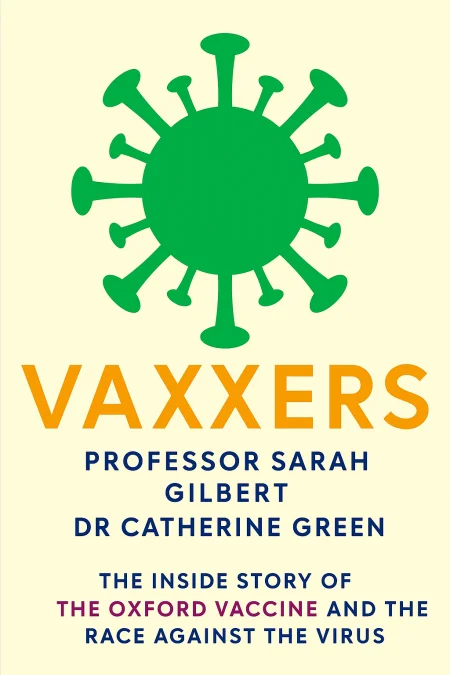
Vaxxers
The Inside Story of the Oxford AstraZeneca Vaccine and the Race Against the Virus
bySarah Gilbert, Catherine Green
Book Edition Details
Summary
Behind the sterile walls of a bustling lab, two intrepid scientists, Professor Sarah Gilbert and Dr. Catherine Green, embark on a high-stakes mission that reads like a thriller. When whispers of a mysterious pneumonia in China reach their ears in early 2020, these brilliant minds race against an invisible enemy—the COVID-19 virus—to forge a life-saving solution. "Vaxxers" chronicles their journey from that initial spark of urgency to the historic development of the Oxford-AstraZeneca vaccine. As the world teetered on the brink, Gilbert and Green harnessed cutting-edge science and raw determination, delivering hope when it was needed most. This is their exhilarating inside story—a testament to human ingenuity and the relentless pursuit of a brighter future in the face of a global pandemic.
Introduction
On a Welsh campsite in August 2020, Dr. Catherine Green found herself in an unexpected conversation by a pizza van. A fellow camper expressed fears about vaccines, claiming "we don't know what's in them." In that moment, Green realized she had to speak up. She introduced herself as someone who had literally made the Oxford COVID-19 vaccine, ordering every ingredient, supervising each batch, and putting the precious substance into vials. This encounter crystallized something profound: the disconnect between the careful, dedicated work of scientists and public understanding of their efforts. This extraordinary story takes us behind the scenes of one of humanity's greatest scientific achievements. Two brilliant women scientists, Sarah Gilbert and Catherine Green, working alongside hundreds of dedicated colleagues, raced against time to develop a vaccine that would save millions of lives. Their journey reveals the human side of scientific breakthrough: the sleepless nights, the calculated risks, the moments of doubt, and the unwavering commitment to serving humanity. Through their eyes, we witness how ordinary people can accomplish extraordinary things when faced with a global crisis. Their story offers hope, illuminates the beauty of scientific collaboration, and demonstrates that even in our darkest moments, human ingenuity and compassion can light the way forward.
From Disease X to Global Pandemic
On New Year's Day 2020, Sarah Gilbert was browsing science websites when reports from Wuhan caught her attention. Four cases of unusual pneumonia, possibly SARS-like, had appeared in China. The patients weren't responding to antibiotics, and most had connections to a seafood market. Gilbert, a professor of vaccinology at Oxford, made mental notes and continued with her holiday. By January 3rd, the cases had grown to forty-four, with eleven critically ill. Something was stirring, but no one yet understood its magnitude. Gilbert's expertise in emerging pathogens meant she had been preparing for this moment for years. The concept of "Disease X" had haunted the scientific community since 2018, representing the inevitable unknown pathogen that would cause the next pandemic. Her work on MERS, another coronavirus, had given her team the tools they would desperately need. When Chinese scientists released the genetic sequence of the novel coronavirus on January 10th, Gilbert and her colleague Tess Lambe were ready to act within forty-eight hours. The transition from mysterious pneumonia to global pandemic happened with breathtaking speed. Within weeks, the virus had spread across continents, and by March, entire nations were locking down. What began as a handful of cases in a distant market became humanity's greatest challenge in generations. This transformation revealed both our interconnected vulnerability and our capacity for rapid scientific response. The groundwork laid for Disease X became the foundation for one of the fastest vaccine developments in history, proving that preparation, even for the unknown, can save the world.
Racing Against Time: Design to Clinical Trials
By late January 2020, Catherine Green faced a crucial decision at Oxford's Clinical Biomanufacturing Facility. Sarah Gilbert needed her to drop everything and begin making starting materials for a potential COVID-19 vaccine using an untested "rapid method." There was no confirmed funding, and it meant abandoning other critical projects. Green looked at the escalating situation globally and made a leap of faith: "Let's go for it." Within days, her small team was working around the clock, knowing that every hour could mean thousands of lives saved or lost. The pressure was immense. Green's team was attempting to compress what normally took years into mere weeks. The rapid method had never been used successfully, and failure would set them back months. Working in protective equipment, handling precious materials worth more than gold, they persevered through early setbacks. When the rapid method failed in mid-February, they pivoted to a modified classic approach, working with the precision of Swiss watchmakers while racing against an exponential curve of global infection. On April 23rd, the first volunteer received the vaccine at Oxford's clinical center. From the moment Chinese scientists shared the genetic sequence to the first injection took just sixty-five days, a feat previously thought impossible. The achievement required not just scientific brilliance, but extraordinary human dedication. Teams worked eighteen-hour days, sacrificed weekends, and pushed through exhaustion because they understood the stakes. Their story demonstrates that when humanity faces its greatest challenges, ordinary people can transcend their limitations through purpose, collaboration, and an unwavering commitment to serving something greater than themselves.
Manufacturing Billions: Scale-Up to Global Distribution
The transition from laboratory success to global solution presented challenges that dwarfed even the initial breakthrough. When AstraZeneca joined as a commercial partner in April 2020, Catherine Green's team suddenly found themselves working with a pharmaceutical giant that thought in terms of billions of doses rather than hundreds. The learning curve was steep for both sides: Oxford's team operated like a family pizzeria, handling every detail personally, while AstraZeneca functioned like a global franchise with complex systems and specialized teams speaking in abbreviations Oxford didn't understand. The scale-up required not just technical innovation but a complete reimagining of manufacturing processes. Sandy Douglas led efforts to prove that production could work at industrial scale, moving from ten-liter cultures producing hundreds of doses to thousand-liter bioreactors capable of producing millions. Each step demanded perfect execution, as any contamination or error would destroy months of work and delay global vaccination by precious weeks. The team worked with manufacturers across continents, building a network capable of producing three billion doses while maintaining Oxford's commitment to provide the vaccine at cost to developing nations. By autumn 2020, a web of production facilities spanned the globe, from Oxford BioMedica around the corner from the original laboratory to the Serum Institute of India, the world's largest vaccine manufacturer. This network faced constant challenges: supply chain disruptions, political tensions, and the pressure of producing a product that billions of people desperately needed. The successful scale-up proved that with sufficient urgency and cooperation, humanity can mobilize industrial capacity on an unprecedented scale, transforming a university laboratory's breakthrough into a tool of global salvation.
Beyond COVID-19: Lessons for Future Pandemics
As 2021 dawned with vaccine rollouts beginning worldwide, the Oxford team found themselves confronting a new reality: their work was far from over. Variants of the virus were emerging, requiring new versions of the vaccine to stay ahead of an evolving pathogen. On February 18th, exactly one year after beginning work on the original vaccine, Catherine Green once again received synthetic DNA for a variant vaccine, this time targeting the South African strain. The cycle was beginning anew, but now with hard-won wisdom and battle-tested systems. The pandemic revealed both humanity's vulnerability and its remarkable capacity for innovation under pressure. The traditional timeline for vaccine development, stretching over decades, was compressed into months not by cutting corners, but by removing unnecessary delays, working in parallel rather than sequence, and maintaining unprecedented focus and funding. The success demonstrated that the scientific infrastructure existed to respond rapidly to future pandemics, but only if lessons learned were institutionalized and resources maintained during peaceful times. Looking toward the inevitable "Disease Y," the team recognized that preparation must begin now, not after the next crisis emerges. The platforms developed for COVID-19 could be rapidly adapted for new pathogens, but this required sustained investment in research infrastructure, global surveillance systems, and international cooperation. The Oxford team's experience proved that while we cannot predict the next pandemic's specific characteristics, we can build the tools and systems to respond with unprecedented speed and effectiveness.
Summary
The creation of the Oxford AstraZeneca vaccine stands as a testament to what humanity can achieve when urgency meets preparation, when scientific rigor combines with human compassion, and when ordinary people rise to meet extraordinary challenges. Sarah Gilbert and Catherine Green, along with their dedicated teams, didn't just develop a vaccine; they demonstrated that the marriage of careful preparation with bold action can literally save the world. Their story reveals that behind every scientific breakthrough lies not just brilliance, but countless acts of daily heroism: working through exhaustion, making difficult decisions with incomplete information, and maintaining faith in the face of uncertainty. The lessons extend far beyond virology or manufacturing. In our personal lives, we can embrace the Oxford team's approach: preparing for uncertainty by developing robust skills and systems, responding to crises with both urgency and careful attention to detail, and never losing sight of our responsibility to serve something greater than ourselves. Their experience teaches us that collaboration across boundaries, whether scientific disciplines or national borders, multiplies our individual capabilities exponentially. Most importantly, their story reminds us that hope is not passive optimism, but active engagement with challenging problems, sustained by the knowledge that human ingenuity and compassion, properly directed, can overcome seemingly impossible obstacles and create a better future for all.
Related Books
Download PDF & EPUB
To save this Black List summary for later, download the free PDF and EPUB. You can print it out, or read offline at your convenience.
By Sarah Gilbert
