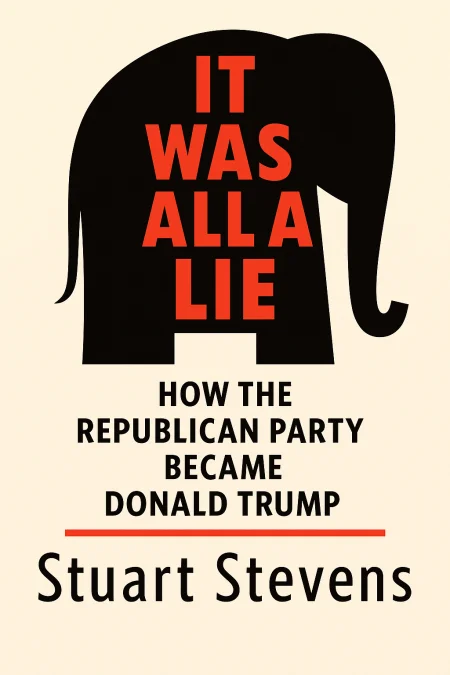
It Was All a Lie
How the Republican Party Became Donald Trump
Book Edition Details
Summary
In the shadowed corridors of power, one man stands to confess the unvarnished truth. Stuart Stevens, a maestro of Republican campaigns, unravels the chilling saga of a political party that has bartered its soul for victory. "It Was All a Lie" is more than a memoir; it is a raw, introspective journey through the heart of a party's moral decay. Stevens offers an insider's gaze at a half-century of hypocrisy, where ideals of family values and fiscal prudence were mere facades. This is not merely about the Trump era; it is a revelation that Trump's rise was an inevitability, the climax of a long-brewing storm of deceit and racial undertones. Brutally candid and deeply personal, Stevens pulls no punches in his lament for what the GOP has become—a desolate landscape where anger reigns supreme, and truth is a casualty.
Introduction
The transformation of America's conservative movement represents one of the most dramatic political realignments in modern democratic history. What emerges from this analysis is not merely a story of electoral strategy gone awry, but a fundamental examination of how institutional principles can be systematically abandoned when power becomes the ultimate objective. The central thesis challenges the common narrative that recent political upheavals represent an aberration—instead revealing them as the logical culmination of decades-long patterns of strategic choices that prioritized winning over governing philosophy. The examination unfolds through a methodical deconstruction of key conservative claims about fiscal responsibility, moral leadership, constitutional adherence, and democratic norms. Rather than accepting surface-level explanations for political behavior, this approach demands we trace the deeper structural forces that shaped party evolution over fifty years. By analyzing the gap between stated principles and actual governance outcomes, we can understand how a major political institution gradually hollowed out its own moral authority. The analytical framework employed here moves beyond typical partisan critique to examine the mechanics of institutional decay. Through careful examination of voting patterns, policy outcomes, and strategic communications, a pattern emerges that illuminates how democratic institutions can be systematically weakened from within while maintaining their outward forms.
The Systematic Erosion of Conservative Principles
The foundation of modern conservative politics rested on several supposedly immutable principles: fiscal discipline, strong national defense, constitutional originalism, and moral leadership. Yet examination of actual governance reveals these were largely rhetorical constructs designed for electoral advantage rather than governing philosophy. The pattern becomes clear when analyzing decades of budget data, voting records, and policy implementation. Consider the fundamental contradiction at the heart of conservative fiscal policy. While Republican platforms consistently promised reduced spending and balanced budgets, every Republican administration since Reagan has presided over massive deficit expansion. The Reagan years saw debt triple from $934 billion to $2.7 trillion. The pattern repeated under both Bush presidencies, with spending increases that dwarfed Democratic administrations. When Republicans finally achieved unified control under Trump, they immediately passed tax cuts that exploded deficits to record levels. This pattern reveals that fiscal conservatism served primarily as a weapon against Democratic spending priorities rather than a genuine commitment to fiscal discipline. Republicans discovered they could attack Democratic social programs as fiscally irresponsible while simultaneously supporting massive tax cuts for wealthy constituencies and increased military spending. The strategy worked politically but created an unsustainable governance model based on permanent contradiction. The moral dimension of this erosion proves equally significant. The party that built its identity around family values and personal character ultimately embraced a leader who embodied the antithesis of these principles. This transition was not sudden but represented the culmination of decades of weaponizing moral language for political advantage while tolerating moral compromise within party ranks. The infrastructure was already in place to rationalize any behavior that served political ends.
The Machinery of Deception and Self-Justification
The conservative media ecosystem that emerged over five decades created an alternative information environment that increasingly diverged from empirical reality. This system began with ideologically motivated publications in the 1940s and 1950s but evolved into a sophisticated apparatus designed to provide alternative explanations for inconvenient facts. The elimination of the Fairness Doctrine in 1987 accelerated this process, allowing partisan media to operate without obligation to present competing viewpoints. This media infrastructure served a crucial function in maintaining party unity despite obvious contradictions between stated principles and actual governance. When Republican policies failed to deliver promised results, conservative media provided alternative explanations that preserved the underlying ideological framework. Economic problems could be blamed on Democratic obstruction, policy failures attributed to deep state sabotage, and electoral losses explained through voter fraud conspiracy theories. The psychological appeal of this system cannot be understated. It offered conservatives a coherent worldview that explained away cognitive dissonance and provided emotional satisfaction through the confirmation of existing beliefs. Rather than confronting uncomfortable realities about policy outcomes or electoral trends, party members could retreat into an information bubble that validated their preconceptions and demonized critics. The sophistication of this deception machinery reached its apex with the integration of social media platforms and foreign interference in American elections. Russian intelligence services recognized and exploited existing vulnerabilities in the conservative information ecosystem, amplifying divisive content and conspiracy theories that furthered their strategic objectives. The Republican Party's embrace of these narratives, even after their foreign origins were exposed, demonstrates the complete subordination of truth to political utility.
The Choice Between Democracy and Authoritarianism
The stress test of democratic institutions reveals which political actors prioritize constitutional governance over partisan advantage. When faced with clear evidence of foreign interference in American elections, the party that once defined itself through opposition to Russian expansionism instead chose to minimize and deflect attention from these attacks. This response pattern illuminates the fundamental choice facing conservative leadership: defend democratic institutions or protect partisan interests. The systematic assault on voting rights represents another dimension of this authoritarian drift. Under the pretext of preventing voter fraud—a phenomenon that extensive investigation has shown to be virtually nonexistent—Republican-controlled states implemented numerous barriers to voting that disproportionately affected demographic groups unlikely to support Republican candidates. These measures follow historical patterns of voter suppression that characterized earlier periods of democratic backsliding. The embrace of conspiracy theories as governing philosophy marks perhaps the most dangerous development in this authoritarian evolution. When political leaders promote demonstrably false claims about election integrity, media credibility, and institutional competence, they undermine the shared factual foundation necessary for democratic governance. The promotion of alternative facts creates conditions where any policy outcome can be explained away and any electoral loss dismissed as illegitimate. The tolerance for political violence represents the final stage of this authoritarian trajectory. Leaders who encourage supporters to view political opponents as existential threats, who praise violence against journalists, and who refuse to condemn extremist groups create conditions where democratic norms become impossible to maintain. The January 6th assault on the Capitol represented not an aberration but the logical culmination of years of escalating rhetoric that legitimized political violence.
The Path Forward for American Conservatism
The future of conservative politics depends entirely on whether the movement can rediscover governing principles beyond mere opposition to liberal policies. The current trajectory leads inexorably toward irrelevance as demographic changes make the white grievance strategy increasingly untenable. States that have already undergone these demographic transitions provide clear evidence of how this story ends: Republican parties become regional minorities unable to compete in statewide elections. The alternative requires a fundamental reckoning with the contradictions and compromises that created this crisis. This means acknowledging that many supposedly conservative policies have failed to deliver promised results and that the party's messaging has often been fundamentally dishonest about both problems and solutions. Such acknowledgment would require a degree of institutional humility that seems impossible given current leadership structures. The international dimension of this challenge cannot be ignored. American conservatism once provided global leadership in promoting democratic values and human rights. The current alliance with authoritarian movements worldwide represents a complete abandonment of this legacy and eliminates any moral authority to critique democratic backsliding elsewhere. Restoring credibility would require years of consistent commitment to democratic principles regardless of short-term political costs. The ultimate question remains whether American conservatism can survive the complete subordination of principles to power that characterizes its current incarnation. Historical precedent suggests that political movements based primarily on grievance and opposition eventually collapse under the weight of their own contradictions. The only uncertainty is whether this collapse occurs gradually through electoral defeats or catastrophically through institutional breakdown.
Summary
The fundamental insight revealed through this systematic analysis is that political movements cannot long survive the complete abandonment of their foundational principles without losing both their moral authority and their practical effectiveness. The conservative movement's transformation from a philosophy of governance into a vehicle for maintaining power at any cost illustrates how democratic institutions can be hollowed out from within while maintaining their external forms. This process of institutional decay, once begun, proves extremely difficult to reverse because it creates incentive structures that reward further compromise and punish principled stands. Understanding these dynamics proves essential for anyone concerned with preserving democratic governance and constitutional principles in an era of increasing polarization and institutional stress.
Related Books
Download PDF & EPUB
To save this Black List summary for later, download the free PDF and EPUB. You can print it out, or read offline at your convenience.
By Stuart Stevens
