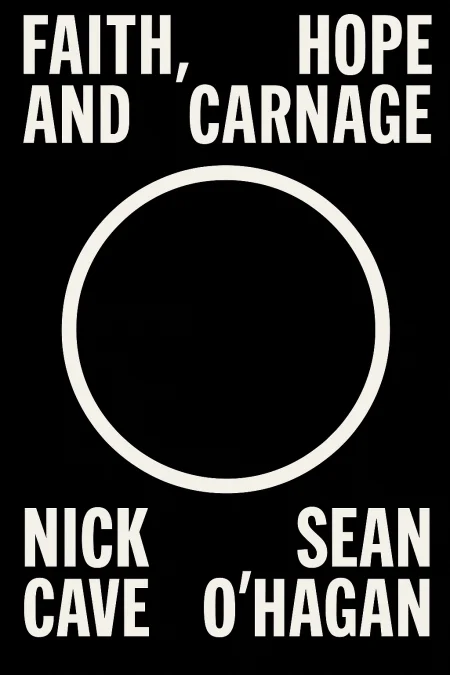
Faith, Hope and Carnage
A Meditation on Faith, Art, Music, Freedom, Grief, and Love
Book Edition Details
Summary
Within the pages of "Faith, Hope and Carnage," the enigmatic Nick Cave bares his soul in a candid dialogue with journalist Seán O’Hagan. This isn’t just a recounting of events; it's an unfiltered voyage into the mind of a musical icon whose work has both haunted and inspired. Through forty hours of raw, intimate conversation, Cave explores the intricate tapestry of his life, weaving through themes of faith, art, and love, and confronting the raw agony of grief after the tragic loss of his son. More than a memoir, this book is a testament to resilience and reinvention, offering readers profound reflections and a beacon of hope from a visionary artist grappling with life's deepest questions.
Introduction
In a small recording studio overlooking a quiet English cemetery, two musicians sat surrounded by synthesizers and silence. One was preparing to create what would become his most vulnerable and transcendent work, while just outside the window lay the grave of his fifteen-year-old son. This wasn't just another album session—it was an act of communion with grief, a desperate search for meaning in the aftermath of unimaginable loss. Nick Cave's journey through the darkest valleys of human experience reveals something profound about the relationship between suffering and creativity. When catastrophe strikes, we face a choice: we can either be destroyed by our pain or transformed by it. This exploration follows an artist's evolution from chaos to contemplation, from rage to reverence, as he discovers that our greatest wounds can become our most sacred doorways. Through intimate conversations spanning years, we witness how personal devastation can lead to spiritual awakening, how doubt can deepen faith, and how the act of creation itself becomes a form of prayer. This is not merely the story of one man's grief, but a meditation on how we all might find beauty and purpose in our darkest hours, turning our suffering into service for others.
The Beautiful Kind of Freedom: From Chaos to Contemplation
The pandemic arrived like an unwelcome guest, canceling tours and emptying concert halls worldwide. For most performers, this felt like catastrophe. But when Nick Cave heard his entire world tour was canceled, something unexpected happened. After an initial moment of horror, a wave of relief washed over him. For the first time in decades, he could simply be at home with his wife, read books on his balcony, and exist without the constant demands of performance and travel. This enforced stillness became a gift he hadn't known he needed. The phone stopped ringing constantly, and his days took on a beautiful repetition reminiscent of his former life as an addict—but this time the ritual was creative rather than destructive. He found himself writing prolifically, responding to fan letters through his Red Hand Files project, and most importantly, reflecting deeply on the journey that had brought him to this point. The chaos of his younger years had given way to something more profound: the discipline to sit with uncertainty, to embrace vulnerability as strength, and to recognize that true freedom often comes not from endless options but from conscious limitations. What emerged was an artist unencumbered by his past personas, ready to create from a place of radical authenticity rather than performance.
Sacred Songs and Spiritual Awakening in Dark Times
The recording sessions for Ghosteen unfolded like a sacred ritual in the Malibu studio where Cave and his collaborator Warren Ellis had secluded themselves. They barely slept, rarely left the grounds, and worked with an intensity that felt otherworldly. Cave described feeling as if he was trying to contact the dead, while Ellis sat in the yard at dawn in his underwear, headphones on, listening obsessively to their previous day's work. What emerged from these sessions defied conventional songwriting. Instead of linear narratives, Cave found himself channeling visions of wild animals racing across burning beaches, spirit children ascending toward the sun, and a recurring image of his wife sitting peacefully at their kitchen table—the last intact memory before their world shattered. These weren't songs in the traditional sense but prayers made manifest, attempts to create a sonic space where his lost son's spirit might find rest. The creative process became a form of meditation, a way of accessing what he calls the "impossible realm" where imagination meets spiritual possibility. Through improvisation and surrender, Cave discovered that some of his most profound artistic statements came not from careful composition but from allowing something greater than himself to flow through the work. The album became both a map of grief and a testament to the mysterious forces that guide us through our darkest passages.
Love, Loss and the Impossible Realm of Grief
The phone call came on an ordinary evening while Cave was watching television. A stranger had found his son Arthur's phone and belongings near the cliffs outside Brighton, and there was police activity at the scene. Within hours, the incomprehensible became real: their beautiful, mischievous fifteen-year-old boy had fallen from the cliff and died. The sound that followed was described as "the loudest noise in the world" roaring through Cave's head, while his other son's legs collapsed beneath him and his wife caught their falling child. What followed was not just personal devastation but a complete reconstruction of reality. Cave found himself carrying a physical torment that felt like his body might literally explode from despair. Yet within this annihilation, something unexpected began to emerge. He started receiving thousands of letters from people sharing their own experiences of loss, creating an unprecedented communion of grief that transcended the boundaries between artist and audience. Through this correspondence, Cave discovered that grief, while intensely personal, is also profoundly universal. Everyone who has truly loved will eventually face this particular darkness, and those who survive it often find themselves enlarged rather than diminished by the experience. The impossible realm of grief became not just a place of suffering but a threshold to deeper compassion, spiritual awakening, and ultimately, a more authentic way of being human.
Absolution Through Art: Finding Meaning in Suffering
In a ceramics studio in South London, Cave found himself working with clay for the first time since childhood, creating figurines that told the story of a devil's journey from birth to death to forgiveness. Each piece emerged from his hands with startling clarity of purpose, depicting scenes of violence, remorse, and ultimate redemption. The final sculpture showed the devil's lifeless body being forgiven by the outstretched hand of a spirit child—a vision that revealed itself as both personal confession and universal prayer. The ceramic series became part of a larger artistic project that included his music, his Red Hand Files correspondence, and even this very conversation. Everything he created seemed to be asking the same fundamental question: can we be forgiven? Not just by others or by God, but by those we've lost, and ultimately by ourselves. Cave realized that all his recent work was an extended plea for absolution, a way of making amends for the ordinary human failing of not being able to protect those we love most. This recognition transformed his understanding of art's purpose. No longer content to create solely for personal expression or commercial success, he began to see his work as a form of service—a way of putting beauty and meaning back into the world as recompense for its inevitable cruelties. Through this lens, every song, every response to a grieving fan, every moment of creative vulnerability became an act of repair, a small contribution to the cosmic balance between suffering and love.
Summary
The transformation chronicled here reveals a profound truth about the human experience: our greatest wounds often become our most powerful sources of healing, both for ourselves and others. Through the alchemy of art and authentic expression, personal catastrophe can be transmuted into universal wisdom, private pain into public service, and the silence of loss into the eloquent language of compassion. The journey from chaos to contemplation isn't about eliminating suffering but about learning to dance with it, to find within our darkest moments the seeds of our most luminous contributions. When we stop running from our pain and instead allow it to teach us, we discover that vulnerability is not weakness but the very foundation of genuine strength. The impossible realm where grief and grace intersect becomes not a place to escape but a sacred threshold to cross, again and again, as we learn to love more deeply precisely because we know how quickly everything we cherish can disappear.
Related Books
Download PDF & EPUB
To save this Black List summary for later, download the free PDF and EPUB. You can print it out, or read offline at your convenience.
By Nick Cave
