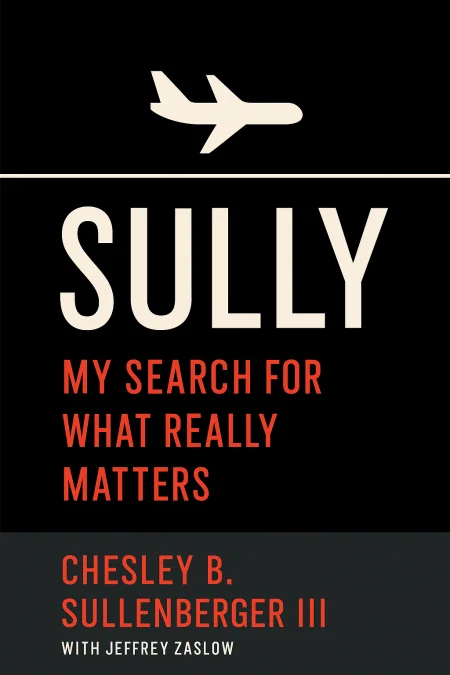
Sully
My Search for What Really Matters
byChesley B. Sullenberger III, Jeffrey Zaslow
Book Edition Details
Summary
In a world where quick thinking and unwavering resolve can spell the difference between life and catastrophe, "Sully" stands as a testament to human ingenuity and courage. On a frigid January day in 2009, Captain Chesley "Sully" Sullenberger etched his name into history by orchestrating a miraculous emergency landing on the icy waters of the Hudson River, safeguarding 155 souls. Beyond the headlines and Hollywood glitz, this memoir unfurls the tapestry of Sully's life—his devotion to preparedness, the crucible of military service, and the skies that tested him. It's a stirring chronicle of perseverance and moral fortitude, reminding us that in times of uncertainty, values endure, and heroes are forged not by chance, but by choice.
Introduction
On a cold January afternoon in 2009, Captain Chesley "Sully" Sullenberger found himself facing every pilot's worst nightmare: complete engine failure over one of the world's most densely populated cities. In just 208 seconds, he would transform from an anonymous airline captain into a symbol of grace under pressure, demonstrating that decades of preparation and unwavering dedication to duty can culminate in a single moment of extraordinary calm. Born in the flatlands of Texas with dreams of flight, Sullenberger represents the embodiment of the American ideal—that through discipline, continuous learning, and moral clarity, ordinary individuals can rise to meet extraordinary challenges. His story reveals the profound truth that heroism isn't born in moments of crisis but forged through years of quiet dedication to excellence. From his earliest days watching fighter jets streak across Texas skies to his methodical approach to mastering every aspect of aviation safety, Sullenberger's journey illuminates the power of preparation meeting opportunity. Through his experiences, readers will discover how a lifetime of small, deliberate choices in character-building can prepare us for our own defining moments, how true leadership emerges not from seeking glory but from serving others, and how the cultivation of expertise becomes a moral obligation when lives depend on our competence.
Early Foundations: From Texas Boy to Fighter Pilot
Growing up in rural Denison, Texas, young Sully Sullenberger lived in a world where the horizon stretched endlessly and military jets from nearby Perrin Air Force Base thundered overhead at three thousand feet. These daily aerial displays captivated a five-year-old boy who quickly abandoned childhood dreams of becoming a policeman or fireman in favor of something far more compelling. The sight of those powerful machines slicing through the wide Texas sky planted an unshakeable conviction that would guide every major decision of his life. His father, a Navy dentist during World War II, understood the profound responsibility that came with military service and encouraged his son's aviation ambitions. When sixteen-year-old Sully asked to take flying lessons, his father connected him with L.T. Cook Jr., a crop-dusting pilot who had trained civilian aviators for the war effort. Cook was a man of few words and exacting standards, charging six dollars per hour for the plane and three dollars for instruction. Under Cook's watchful eye, Sully learned that flying demanded absolute precision—there were no second chances at altitude. The discipline instilled during those early lessons on Cook's grass airstrip would prove invaluable when Sully entered the United States Air Force Academy in 1969. The academy's rigorous environment, with its emphasis on duty, honor, and service before self, shaped him into a leader who understood that true strength came from preparation and humility. The hazing and physical challenges that broke other cadets only reinforced his determination to excel in aviation. As a fighter pilot flying F-4 Phantoms, Sully operated in an environment where split-second decisions could mean the difference between life and death. He witnessed colleagues who didn't return from training missions, their aircraft wreckage serving as stark reminders that competence wasn't optional—it was survival. These experiences taught him that every flight was a test, every procedure sacred, and every moment of inattention potentially catastrophic.
Professional Journey: Mastering the Art of Aviation
Transitioning from military to commercial aviation in 1980, Sullenberger entered an industry in the midst of dramatic change. Airline deregulation had created new economic pressures, but it had also democratized air travel, making him part of a profession that would safely transport millions of ordinary people to their destinations. Starting as a flight engineer on Boeing 727s at Pacific Southwest Airlines, earning less than two hundred dollars a week, he approached this new chapter with the same methodical dedication that had characterized his military service. The airline cockpit demanded different skills than fighter aviation but required the same unwavering attention to detail. Sullenberger immersed himself in understanding every system, every procedure, and every potential failure mode of the aircraft he flew. He became known among colleagues as a "pilot's pilot"—someone who made the complex appear effortless through sheer preparation. When other pilots sought smooth air for their passengers or found innovative solutions to operational challenges, they looked to Sullenberger's example. His commitment to safety extended far beyond his individual flights. Sullenberger became deeply involved in developing crew resource management training programs, helping transform airline culture from one where captains ruled through intimidation to one emphasizing collaboration and open communication. He understood that the safest flights resulted from teams working together, where every crew member felt empowered to speak up when something didn't seem right. Throughout his career, Sullenberger maintained an intellectual curiosity about aviation that went far beyond basic competency. He studied accident reports, analyzed near-misses, and constantly asked himself how he might respond in similar circumstances. This wasn't morbid fascination but professional obligation—every lesson learned from others' experiences was a tool that might someday save lives. His consulting business, Safety Reliability Methods, reflected this broader mission to apply aviation's systematic approach to safety across other industries.
The Ultimate Test: Flight 1549 and the Hudson Landing
On January 15, 2009, just ninety-five seconds after departing LaGuardia Airport, Flight 1549 encountered a flock of Canada geese that destroyed both engines of the Airbus A320. In that instant, Sullenberger faced a situation for which no amount of simulator training could fully prepare him: flying a powerless airliner over the most densely populated area in North America with 155 lives depending entirely on his judgment and skill. The cockpit voice recorder would later reveal the remarkable calm with which Sullenberger and First Officer Jeff Skiles worked through their crisis. While automated warning systems filled the cabin with urgent alarms and air traffic controllers offered increasingly desperate alternatives, the two pilots methodically worked through emergency procedures, their voices betraying none of the terror their passengers were experiencing. Sullenberger's decision to attempt a water landing in the Hudson River rather than risk a failed return to LaGuardia demonstrated the kind of split-second risk assessment that separates competent pilots from exceptional ones. The successful ditching—executed with wings level and at precisely the right speed—was only half the victory. Sullenberger's insistence on personally walking the sinking cabin twice to ensure no passengers remained behind embodied the captain's ancient responsibility to be the last to leave his ship. His calm directive to flight attendants and passengers, his methodical distribution of life vests to those shivering on the aircraft wings, and his organization of the evacuation reflected a lifetime of preparation for a moment he hoped would never come. The rescue operation that followed showcased not just Sullenberger's leadership but the extraordinary response of ordinary New Yorkers who rushed to help. Ferry captains, police officers, divers, and countless volunteers demonstrated that heroism isn't the province of a single individual but the collective response of a community when crisis demands the best of human nature.
Legacy and Reflection: What Really Matters in Life
The aftermath of Flight 1549 thrust Sullenberger into a spotlight he neither sought nor particularly welcomed. Suddenly, the man who had spent decades in the anonymity of the airline cockpit found himself called a hero, invited to the White House, and asked to throw first pitches at major league baseball games. Yet through all the acclaim, he remained fundamentally unchanged—still the methodical, self-effacing professional who deflected praise toward his crew and the first responders who made the rescue possible. His reluctance to embrace the "hero" label reflected a deeper understanding of what January 15th truly represented. The successful outcome wasn't the result of supernatural courage or split-second inspiration but the culmination of thousands of hours of preparation, study, and commitment to excellence. Every lesson learned from his father's workshop in Texas, every procedure mastered at the Air Force Academy, every safety briefing attended during his airline career had prepared him for those 208 seconds over Manhattan. Sullenberger's story resonated so powerfully because it affirmed something many Americans feared they had lost: that competence, dedication, and moral clarity still mattered in an increasingly complex world. His example demonstrated that the most meaningful heroism often comes not from grand gestures but from the quiet accumulation of knowledge, the steady adherence to principle, and the willingness to accept responsibility when others depend on your judgment. The experience also deepened his appreciation for life's true priorities. The pilot who had spent much of his career away from home, missing dance recitals and family dinners in service of his profession, emerged from the Hudson with renewed commitment to the relationships that matter most. His marriage to Lorrie, his role as father to daughters Kate and Kelly, and his connections to the communities that shaped him became the foundation from which all other accomplishments derived their meaning.
Summary
Sullenberger's journey from a five-year-old boy watching jets overhead to the captain who safely guided 155 people to an improbable survival demonstrates that true heroism is not born in moments of crisis but forged through decades of preparation, continuous learning, and unwavering commitment to serving others. His story offers two profound lessons for anyone seeking to live a meaningful life: first, that expertise becomes a moral obligation when others depend on our competence, and second, that the most important test of character comes not in how we handle success but in how we respond when everything we've worked for hangs in the balance. For anyone interested in aviation, leadership, or simply understanding how ordinary individuals can rise to meet extraordinary challenges, Sullenberger's example provides both inspiration and practical wisdom about the power of preparation to transform crisis into triumph.
Related Books
Download PDF & EPUB
To save this Black List summary for later, download the free PDF and EPUB. You can print it out, or read offline at your convenience.
By Chesley B. Sullenberger III
