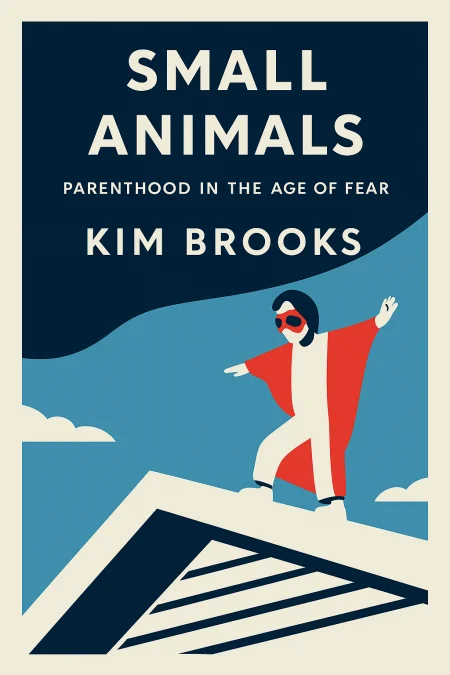
Small Animals
Parenthood in the Age of Fear
Book Edition Details
Summary
In a world brimming with parental anxiety, Kim Brooks stands at the crossroads of personal turmoil and cultural critique. One seemingly trivial decision—to leave her child briefly unattended—catapults her into a whirlwind of societal judgment and self-reflection. "Small Animals" dissects the pervasive climate of fear that haunts modern parenting, daring to question the relentless vigilance expected of today's mothers and fathers. Brooks's narrative, laced with humor and unflinching honesty, challenges the notion of 'good parenting' and exposes the cost of a generation's obsession with safety. This book is not just an exploration; it's a bold call to reclaim the joy and spontaneity of raising children, compelling us to reconsider what truly matters in nurturing the young minds of tomorrow.
Introduction
Modern American parenting has become a minefield of anxiety, surveillance, and criminalization that would be unrecognizable to previous generations. What was once considered normal childhood independence—playing alone at a park, waiting briefly in a car, walking to school—has been transformed into evidence of parental negligence worthy of criminal prosecution. This cultural shift represents more than mere overprotectiveness; it reveals a fundamental transformation in how society views children, parents, and risk itself. The emergence of intensive parenting culture has created a paradox where the safest generation of children in history is treated as the most endangered. Parents find themselves trapped between competing demands: providing children with independence necessary for healthy development while navigating a social environment that criminalizes unsupervised childhood. This tension has profound consequences not only for individual families but for the broader fabric of community life and democratic participation. Through examining the intersection of fear, judgment, and social control in contemporary parenting, we can understand how well-intentioned protective impulses have metastasized into a system of mutual surveillance and punishment. The analysis reveals how class, race, and gender shape the enforcement of these new norms, and how the cost of this cultural transformation extends far beyond any individual family's experience. The examination challenges readers to consider whether our current approach to childhood safety serves children's genuine wellbeing or merely satisfies adult anxieties about control and moral purity.
The Culture of Fearful Parenting and Criminalization
Contemporary American parenting operates under a regime of unprecedented fear that has fundamentally altered the parent-child relationship. Parents today invest extraordinary amounts of time, money, and emotional energy into managing risks that previous generations either accepted as inevitable or never considered at all. This shift represents more than heightened awareness—it constitutes a complete reimagining of what responsible parenting requires. The criminalization of everyday parenting decisions marks a dramatic expansion of state intervention into family life. Activities that were commonplace thirty years ago—allowing children to play unsupervised, walk to school alone, or wait briefly in cars—now trigger police investigations and child protective services involvement. This transformation has occurred without corresponding increases in actual danger to children, suggesting that the changes reflect cultural anxieties rather than genuine safety concerns. The enforcement of these new standards reveals stark inequalities in how parental judgment is evaluated. Middle-class parents may face harassment and legal consequences, but they often have resources to navigate the system. Working-class parents and parents of color, however, frequently encounter harsher treatment and fewer options for defending their choices. The system that claims to protect all children systematically punishes those whose parents lack economic and social capital. This cultural shift has created a feedback loop where fear breeds more fear, and judgment reinforces itself through social pressure and legal enforcement. Parents modify their behavior not only to protect their children from unlikely dangers but to protect themselves from the judgment of neighbors, authorities, and other parents who have internalized these new standards of constant supervision.
The Social Construction of Childhood Risk
Risk assessment in modern parenting has become fundamentally divorced from statistical reality, operating instead through emotional narratives and cultural anxieties. Parents routinely make decisions based on vivid but extremely rare scenarios—stranger abduction, playground injuries, car accidents during brief errands—while ignoring more probable dangers like childhood obesity, social isolation, and developmental delays caused by excessive supervision. The availability heuristic explains much of this distorted risk perception. Media coverage of tragic but exceptional events creates the illusion that these dangers are common and imminent. Parents can easily recall stories of abducted children or accidents involving unattended cars, making these scenarios feel more probable than statistics would support. Meanwhile, the gradual developmental costs of restricted independence remain invisible and unmemorable. Historical analysis reveals that moral panics about childhood safety typically emerge during periods of broader social anxiety and uncertainty. The stranger danger phenomenon of the 1980s coincided with economic recession, Cold War tensions, and rapid social change. Similarly, contemporary parenting fears reflect deeper anxieties about economic inequality, social fragmentation, and loss of community cohesion. Children become symbols onto which adults project their fears about their own lack of control. The social construction of risk also serves to reinforce class and cultural boundaries. Defining "good parenting" as constant supervision and endless enrichment activities creates standards that only privileged families can meet. Working parents, single parents, and families without extensive resources are automatically classified as inadequate, regardless of their children's actual wellbeing or their own love and commitment.
Class, Race, and Gender in Parental Surveillance
The enforcement of intensive parenting standards operates through mechanisms that systematically disadvantage marginalized communities while reinforcing existing hierarchies of social privilege. When concerned citizens report "neglectful" parents to authorities, they rarely target families who match their own demographic profile. Instead, these interventions disproportionately affect working-class families, single mothers, and parents of color whose circumstances force them to make different choices about supervision and independence. The criminal justice system's response to parenting cases reveals stark disparities based on social position. Affluent parents who leave children in cars or allow unsupervised play may face investigation, but they typically have access to legal representation, alternative explanations for their behavior, and social networks that provide character references. Poor parents and parents of color encounter more skeptical authorities, harsher consequences, and fewer resources for mounting effective defenses. Gender dynamics compound these inequalities, as mothers bear primary responsibility for children's safety and wellbeing in social expectations. Fathers who leave children unsupervised may be viewed as appropriately focused on work responsibilities, while mothers engaging in identical behavior face accusations of selfishness or neglect. This double standard reinforces traditional gender roles while punishing women who attempt to balance multiple responsibilities. The intersection of these factors creates particularly harsh consequences for mothers who deviate from middle-class, white, heterosexual norms of intensive mothering. Single mothers working multiple jobs, mothers of color parenting in communities with limited resources, and mothers who prioritize their own needs alongside their children's face the greatest risk of criminalization and family separation. The system that claims to protect children often destroys the families that need support most.
The Psychological Costs of Overprotective Parenting
Intensive parenting practices designed to maximize children's safety and success may actually undermine their psychological development and long-term wellbeing. Children who grow up under constant supervision lack opportunities to develop self-efficacy, resilience, and independent problem-solving skills. They enter adulthood having been protected from the very experiences that build confidence and competence. Research on college student mental health reveals alarming increases in anxiety, depression, and inability to cope with normal challenges among young adults raised in this protective environment. Students arrive at universities having achieved impressive academic credentials while lacking basic life skills and emotional regulation abilities. They struggle with decision-making, conflict resolution, and recovery from setbacks because their parents have managed these challenges for them throughout childhood. The epidemic of childhood anxiety disorders correlates with the rise of helicopter parenting and the elimination of unsupervised play. Children who never experience manageable risks or navigate social conflicts without adult intervention fail to develop internal resources for handling stress and uncertainty. Paradoxically, the effort to protect children from all possible harm leaves them more vulnerable to psychological distress and less capable of protecting themselves. The broader social costs include the loss of childhood as a distinct developmental phase characterized by exploration, play, and gradual independence. When children's time becomes as structured and supervised as adult work schedules, they lose opportunities for creativity, social learning, and the simple pleasure of unstructured experience. This represents not merely individual loss but the erosion of cultural values that recognize childhood as inherently valuable rather than merely preparatory for adult productivity.
Summary
The transformation of American parenting into a regime of intensive supervision and constant anxiety represents one of the most significant social changes of the past generation, with consequences extending far beyond individual families to the very nature of childhood, community, and democratic participation. The analysis reveals how fear-based parenting serves neither children's genuine wellbeing nor parents' authentic values, but instead functions as a mechanism of social control that reinforces existing inequalities while undermining the resilience and independence necessary for human flourishing. This work provides essential insight for readers seeking to understand how cultural anxiety manifests in family life and how individual choices about child-rearing connect to broader questions of freedom, community, and social justice in contemporary American society.
Related Books
Download PDF & EPUB
To save this Black List summary for later, download the free PDF and EPUB. You can print it out, or read offline at your convenience.
By Kim Brooks
