
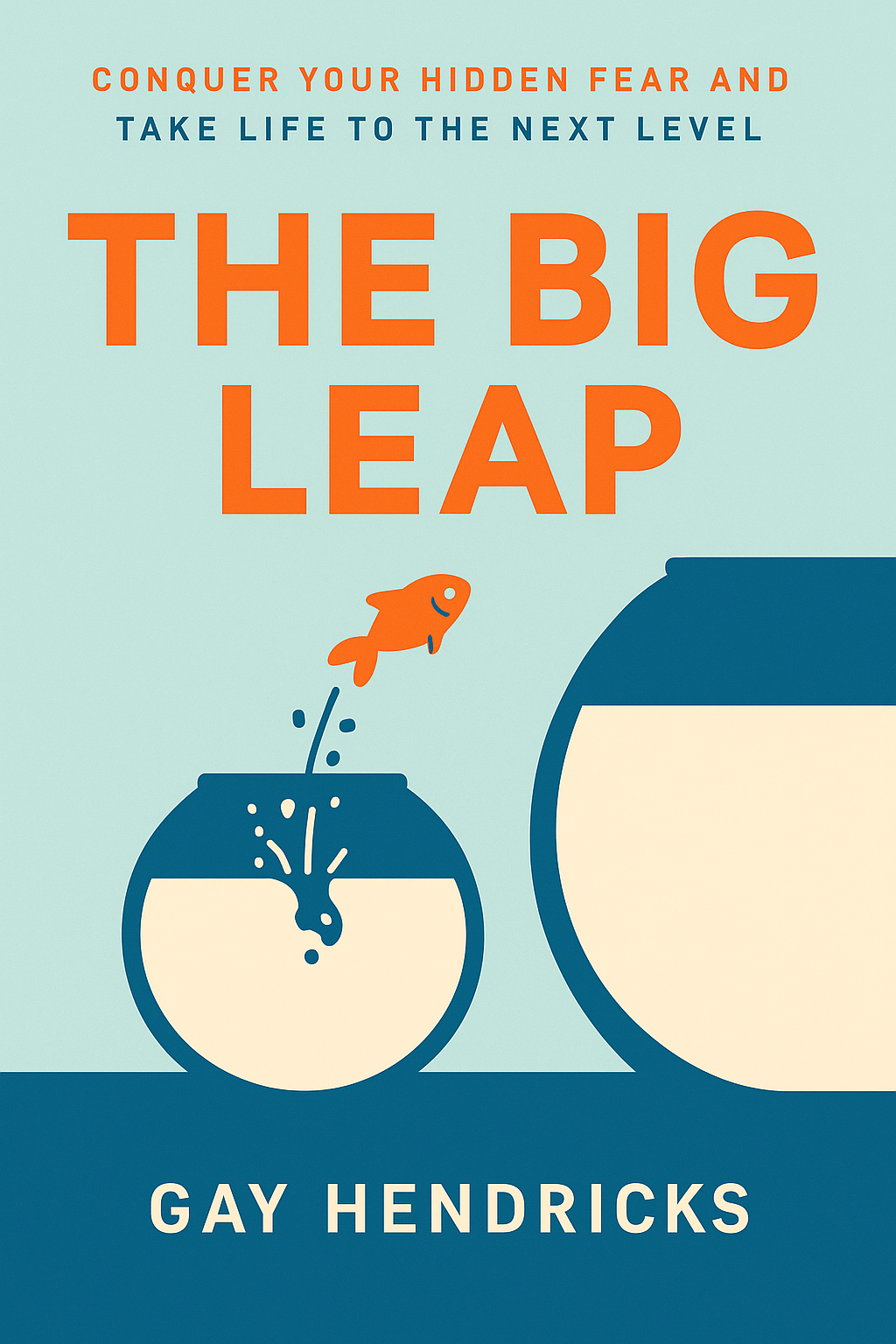
The Big Leap
Conquer Your Hidden Fear and Take Life to the Next Level
Book Edition Details
Summary
Walls of doubt and fear may loom large, but Gay Hendricks offers a daring escape plan in "The Big Leap." This transformative guide, nestled in the hearts of self-help enthusiasts who cherish the wisdom of Wayne Dyer and Eckhart Tolle, unveils the hidden saboteurs of our success. Hendricks expertly illuminates how our own minds betray our deepest desires, armed with practical strategies to dismantle these self-imposed barriers. With each page, readers are invited to step beyond their limits, face down their fictitious fears, and embrace a life of unbounded potential. "The Big Leap" isn't just a book; it's a catalyst for change, promising a breakthrough into a realm where true success awaits.
Introduction
Have you ever wondered why some of your greatest breakthroughs are quickly followed by setbacks? Why do we sometimes sabotage ourselves just when things are going exceptionally well? The truth is, most of us have an invisible thermostat that determines how much success, love, and abundance we allow ourselves to experience. When we exceed this internal setting, we unconsciously create problems to bring ourselves back down to familiar territory. This self-imposed limitation affects every area of our lives, from our relationships and finances to our creative expression and overall happiness. The good news is that once you understand how this mechanism works, you can learn to transcend these artificial boundaries and step into what represents your true potential - your Zone of Genius. This journey isn't just about achieving more success; it's about learning to sustain and enjoy the extraordinary life you're capable of creating, while inspiring others to do the same.
Identifying Your Upper Limit Problem Patterns
The Upper Limit Problem manifests in remarkably predictable ways once you know what to look for. At its core, it operates like an internal thermostat that keeps you within a familiar range of success and happiness. When you exceed this setting, your unconscious mind creates situations to bring you back down to more comfortable levels. Consider Michael Dell, the founder of Dell Computer, who worked with the author during his company's rapid growth phase. Despite his brilliant business acumen, Dell had to learn to recognize when his own internal barriers were holding him back from even greater success. The key was developing what the author calls "benign vigilance" - paying keen but relaxed attention to the patterns that emerge when things are going well. The most common Upper Limit behaviors include worry, criticism and blame, deflecting compliments, starting arguments, and even getting sick or injured at crucial moments. Take the example of a successful stockbroker who found himself creating elaborate worry scenarios about his family whenever he had a particularly profitable day. The worry wasn't about real dangers - it was his psyche's way of bringing him down from the high of financial success. To identify your patterns, start by examining what happens right after your victories. Do you find yourself manufacturing problems, getting into conflicts, or suddenly feeling guilty about your good fortune? Pay attention to the specific ways you deflect positive energy, whether through dismissing compliments or creating distractions when things are flowing smoothly. The first step is simply awareness. Notice these patterns without judgment, treating them as fascinating data about your internal operating system. Once you can spot them in real-time, you've taken the crucial first step toward transcending them and allowing yourself to sustain higher levels of success and fulfillment.
Discovering and Living in Your Zone of Genius
Your Zone of Genius represents the intersection of what you most love to do, what you're uniquely gifted at, and what creates the highest value for others and yourself. Unlike your Zone of Excellence, where you can achieve great results but may feel unfulfilled, your Zone of Genius is where work doesn't feel like work and time seems to expand to support your activities. Nancy, a mystery novelist and mother of three, provides a powerful example of someone breaking into her Zone of Genius. Despite having published a successful first novel, she had relegated her writing to whatever time remained after household chores and family responsibilities. She believed she couldn't sit down to write unless her house was perfectly clean and all tasks were completed first. This seemingly reasonable approach was actually a sophisticated form of self-sabotage. During coaching, Nancy realized her pattern reflected deeper fears about outshining her siblings, who had shown mixed reactions to her first book's success. Her unconscious mind had constructed a scenario where fully committing to her writing would somehow harm her family relationships. The breakthrough came when she courageously reversed her priorities, forcing herself to write first thing each morning before attending to domestic tasks. To discover your Zone of Genius, ask yourself four key questions. What do you most love to do that you can engage in for hours without fatigue? What work doesn't feel like work to you? What produces the highest ratio of satisfaction and results for the time invested? What is your unique ability that, when fully expressed, provides enormous benefits to yourself and others? The transition requires making what the author calls an "Enlightened No" to requests that don't serve your genius, even when they seem beneficial for other reasons. This isn't about being selfish; it's about focusing your energy where it creates the most value and fulfillment for everyone involved.
Creating Einstein Time for Maximum Success
Most people struggle with time because they operate from a Newtonian paradigm that treats time as a scarce resource "out there" that can pressure them "in here." This creates a perpetual sense of time urgency and the feeling that there's never enough time for what matters most. Einstein Time operates from a radically different premise: you are where time comes from. A Manhattan stockbroker discovered this principle during his daily subway commute when he was running late for an important meeting. Wedged between passengers and unable to check his watch, he felt panic rising. Then he remembered the Einstein Time concept and shifted his perspective, thinking "I am time, and I'll make enough of it so I won't be late." He relaxed into the present moment, and when he arrived at his destination, he was actually the first person to reach the meeting room. The key insight is that our experience of time changes based on how much space we're willing to occupy with our awareness. When you're contracting away from the present moment due to fear or resistance, time seems to congeal and move slowly. When you're fully present and engaged, time flows effortlessly and you accomplish more with less effort. To shift into Einstein Time, begin by taking complete ownership of your relationship with time. Stop complaining about time or treating it as something external that controls you. Eliminate phrases like "I don't have time for that" and replace them with honest statements about your priorities. When you feel time pressure, ask yourself "Where in my life am I not taking full ownership?" or "What am I trying to disown?" The practical result of this shift is remarkable: you get more done in less time while feeling less stressed and having abundant energy for creative activities. You discover that rushing and time pressure were actually symptoms of not being fully present and engaged with what you were doing.
Building Thriving Relationships Beyond Upper Limits
Success can actually make relationships more challenging because both partners must learn to handle increased levels of positive energy together. Research shows that 80 percent of highly successful people have unsatisfying relationships, falling into patterns of devitalized connection, passive congeniality, or constant conflict. However, understanding the Upper Limit Problem can transform these dynamics completely. Jim and Jane, a famous couple, illustrate this challenge perfectly. During their first five years together, their relationship thrived. But when sudden success brought magazine covers and public attention, they began experiencing their Upper Limit Problem as a couple. Without understanding what was happening, they fell into nearly two years of constant arguing and criticism. The success had exceeded their unconscious thermostat setting for how much happiness and recognition they could handle together. Their breakthrough came when they recognized that their conflicts weren't really about the surface issues they were fighting about. Instead, their arguments were Upper Limit symptoms - ways of bringing themselves back down when their combined success and happiness exceeded their comfort zone. Once they understood this dynamic, they could address the real issue: expanding their capacity to enjoy success and love simultaneously. The key to thriving relationships lies in both partners committing to transcending their Upper Limits together. This means learning to speak microscopic truths about feelings, eliminating the habit of projection where you attribute your internal experiences to your partner, and taking 100 percent responsibility for your experience rather than trying to make your partner the source of your happiness or problems. Practical strategies include taking regular time alone to recharge your individual battery, communicating about emotions without trying to fix or change them, and celebrating successes together rather than immediately finding something to worry about. Most importantly, approach your relationship as a spiritual path where every interaction offers an opportunity to choose love over fear, connection over separation. Remember that every power struggle is really two people competing for the victim position. When both partners claim 100 percent responsibility for creating their experience, genuine intimacy and creativity become possible. The relationship transforms from a source of limitation into a launching pad for both people to live more fully in their Zones of Genius.
Summary
The journey to your Zone of Genius is ultimately about learning to handle more positive energy, love, and success without unconsciously sabotaging yourself. As the author reveals, "I expand in abundance, success, and love every day, as I inspire those around me to do the same." This isn't just a goal to achieve but a way of being that transforms every aspect of your life. The Upper Limit Problem isn't a character flaw - it's simply old programming that can be updated once you recognize how it operates. Your commitment to living in your Zone of Genius creates a ripple effect, inspiring others to step into their own potential and creating a world where success and fulfillment aren't rare exceptions but natural expressions of human creativity. Start today by noticing one way you might be limiting yourself, breathe into that awareness with compassion, and take one small step toward expressing more of who you really are. Your Zone of Genius is waiting for you to claim it.
Related Books
Download PDF & EPUB
To save this Black List summary for later, download the free PDF and EPUB. You can print it out, or read offline at your convenience.
By Gay Hendricks
