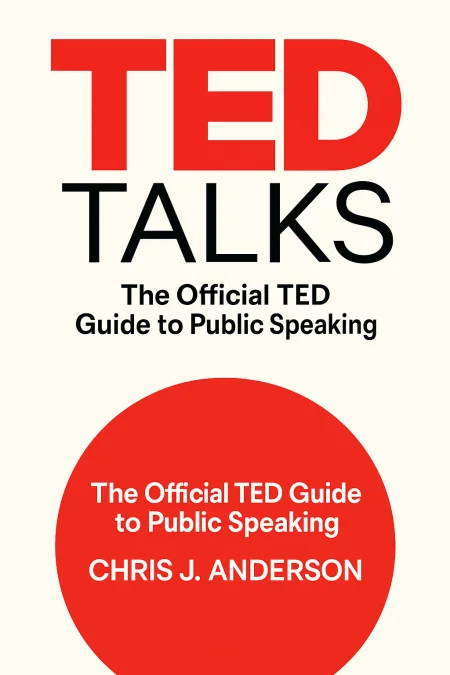
TED Talks
The Official TED Guide to Public Speaking
Book Edition Details
Summary
What if the key to a mesmerizing presentation lies not in the words, but in the way they're brought to life? In this essential guide, TED curator Chris Anderson pulls back the curtain on the art of powerful oration, revealing the secrets that make TED Talks a global phenomenon. Forget cookie-cutter speeches; Anderson champions the individuality of each speaker, teaching you how to harness your own voice to captivate and inspire. Drawing wisdom from iconic speakers like Sir Ken Robinson and Elizabeth Gilbert, this book is more than a manual—it's a roadmap to sparking change with your ideas. Whether you're a seasoned speaker or a novice, discover how to craft a talk that could electrify a room and reshape perspectives.
Introduction
Standing before an audience, your heart racing and palms sweating, you face one of humanity's most primal fears yet most powerful opportunities. Public speaking isn't just about overcoming nervousness or mastering techniques—it's about unlocking your ability to plant seeds of change in other minds. In our interconnected world, a single well-crafted talk can ripple across continents, inspiring millions and catalyzing movements that reshape society. The ancient art of human-to-human communication has been revolutionized by technology, transforming intimate conversations into global dialogues. Every idea you've ever cared deeply about, every insight you've gained through experience, every solution you've discovered to a pressing problem—all of these deserve to be shared. The question isn't whether you have something valuable to say, but whether you'll find the courage and skill to say it in a way that truly connects with others and compels them to act.
Build Your Foundation with Purpose
At the heart of every transformative presentation lies a deceptively simple yet profound principle: your talk isn't about you—it's about gifting an idea to your audience. This fundamental shift in perspective changes everything about how you approach public speaking, from preparation to delivery. Consider the journey of Richard Turere, a twelve-year-old Maasai boy from Kenya who seemed utterly unlikely to command a stage in California. When TED discovered Richard, he stood hunched in a corner, painfully shy, struggling to describe his invention in halting English. His family raised cattle, constantly losing livestock to lion attacks that threatened their survival. Most people would have focused on killing the predators, but Richard observed something different. While stationary campfires didn't deter lions, walking around with a torch did—the big cats feared moving lights. Teaching himself electronics by experimenting with old radio parts, Richard created a system of lights that turned on and off in sequence, mimicking human movement around the cattle pen. Built from solar panels, a car battery, and motorcycle parts, his "lion lights" completely stopped the attacks. Word spread, other villages adopted the technology, and suddenly both cattle and lions were safer. When Richard finally took the TED stage, his nervousness only made him more endearing. As he spoke about his invention with growing confidence, the audience was captivated not by polished delivery, but by the power of his idea and his authentic passion for solving a real problem. The transformation happened because Richard learned to focus outward rather than inward. Instead of worrying about his English or his stage presence, he concentrated on sharing something that mattered—a solution that could help communities across Africa coexist with wildlife. His talk succeeded because it carried genuine value for others. Your foundation must begin with identifying what you truly want to give your audience. Ask yourself what insight, solution, or perspective you possess that could genuinely improve their lives or expand their understanding. This isn't about impressive credentials or dramatic personal stories—it's about recognizing the unique value that your experience, knowledge, or viewpoint brings to others. Once you identify that core gift, everything else becomes a tool for delivering it effectively. The most powerful talks emerge when speakers realize they're not performing for applause or advancing their careers, but serving as conduits for ideas that need to spread. This service mindset transforms anxiety into purpose, self-consciousness into generosity, and presentations into genuine conversations that can change minds and inspire action.
Craft Your Message with Power
The difference between a forgettable presentation and one that transforms lives often comes down to a single element: the throughline. This connecting thread weaves together every story, example, and insight into a coherent journey that audiences can follow and internalize. Think of neuroscientist Jill Bolte Taylor, who experienced a massive stroke at thirty-seven and spent eight years recovering her ability to speak, read, and walk. When she finally took the TED stage, she didn't simply recount her medical ordeal. Instead, she structured her entire talk around a profound insight: the stroke had given her a unique window into how the human brain works, revealing the distinct functions of our left and right hemispheres in ways no textbook could capture. Her throughline was elegantly simple yet revolutionary: "This morning I woke up with a brain hemorrhage, and this is what I learned about consciousness." She brought an actual human brain onto the stage, holding it with reverence as she explained how this three-pound mass of tissue creates our entire reality. The audience watched, mesmerized, as she described the morning of her stroke—how she observed her own brain functions shutting down one by one, how she experienced the dissolution of her sense of self, and paradoxically, how this terrifying medical emergency opened her to a profound sense of peace and connection with the universe. What made her talk extraordinary wasn't just the dramatic story, but how every detail served her central message about the dual nature of human consciousness. She didn't waste time on medical jargon or lengthy recovery details. Instead, she crafted each moment to build understanding of how our brains create our experience of reality, and how we might consciously choose which aspects of that experience to cultivate. The key to crafting your message lies in ruthless editing and focus. You must resist the temptation to include everything you know about your topic. Instead, choose one powerful idea that can be properly unpacked in your available time. This means making difficult decisions about what to leave out, even if those excluded elements feel important to you. Start by completing this sentence in fifteen words or fewer: "The one thing I most want my audience to understand is..." If you can't do this concisely, your message isn't ready. Once you have your throughline, test every story, statistic, and example against it. If an element doesn't directly support your central message, cut it—no matter how interesting or impressive it might be. Remember that your goal isn't to download all your knowledge into the audience's minds, but to plant one powerful seed that can grow and flourish long after your talk ends. That single, well-developed idea will have far more impact than a dozen half-explained concepts.
Connect Through Authentic Delivery
The moment you step onto a stage, you face a fundamental challenge: an audience of strangers deciding whether to open their minds to you. This decision happens largely below the level of conscious thought, influenced by subtle cues about your authenticity, vulnerability, and genuine care for their wellbeing. Monica Lewinsky understood this challenge intimately when she returned to public speaking at TED after seventeen years of relative silence. Her very presence on stage carried enormous weight—she was the woman whose name had become synonymous with one of the biggest political scandals in American history. The stakes couldn't have been higher, and she knew that any hint of insincerity or calculation would be detected instantly. Her strategy was counterintuitive: instead of projecting invulnerable confidence, she embraced complete authenticity about her fear. "Nervous is too mild a word to describe how I felt," she later explained. "More like gutted with trepidation. Bolts of fear. Electric anxiety." But rather than hiding these feelings, she channeled them into preparation and purpose. She wrote "THIS MATTERS" across the top of her speech notes, reminding herself that her message about public shaming and cyberbullying was bigger than her personal comfort. When Monica finally walked onto the TED stage, something remarkable happened. Her obvious nervousness, combined with her willingness to be completely honest about her experience, created an instant connection with the audience. People weren't seeing a political figure or media personality—they were seeing a human being courageously sharing hard-won wisdom. She spoke with measured deliberation about the price of shame, the weaponization of humiliation, and the urgent need for compassion in our digital age. The talk succeeded not because Monica masked her vulnerability, but because she transformed it into a source of connection and credibility. The audience could sense that every word was earned through genuine suffering and reflection. Her nervousness became proof of her authenticity rather than evidence of incompetence. This principle extends far beyond managing stage fright. Authentic delivery means bringing your genuine personality to the stage, not trying to imitate someone else's speaking style. It means making eye contact with individual audience members, as if you're having a conversation with friends rather than performing for a crowd. It means allowing your natural passion for your topic to show through your voice and gestures, rather than maintaining artificial composure. Most importantly, authentic delivery requires you to stay connected to your purpose throughout your presentation. When you feel nervous or lose your way, return to the reason you're speaking: the gift you want to give your audience. This service mindset will ground you in something larger than your personal comfort and help you deliver your message with the sincerity it deserves.
Summary
The renaissance in public speaking we're witnessing today represents far more than a trend in communication—it reflects humanity's deepest need to share wisdom, connect across differences, and collectively solve the challenges we face. As neuroscientist Jill Bolte Taylor discovered during her stroke recovery, "We have the power to choose, moment by moment, who and how we want to be in the world." This choice extends to every presentation we give: we can choose to serve our egos or serve our ideas, to protect ourselves or give generously to others. The path forward is both simple and profound: identify an idea that matters more than your comfort, craft it into a coherent message that others can understand and use, and deliver it with the full authenticity of your humanity. Your unique perspective, born from your specific experiences and insights, represents something the world needs to hear. The tools and techniques of great speaking can be learned, but they must serve a purpose greater than personal advancement. In our interconnected age, your willingness to step forward and share what you've learned isn't just an opportunity—it's a responsibility to the human community that has shaped and supported your journey.
Related Books
Download PDF & EPUB
To save this Black List summary for later, download the free PDF and EPUB. You can print it out, or read offline at your convenience.
By Chris J. Anderson
