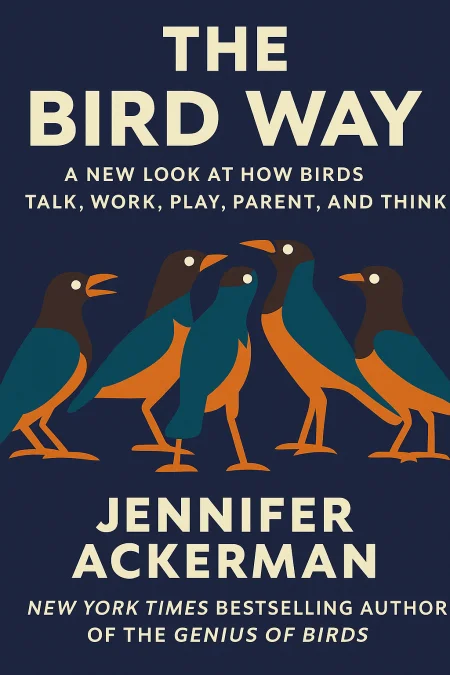
The Bird Way
A New Look at How Birds Talk, Work, Play, Parent, and Think
Book Edition Details
Summary
In a world where feathered creatures challenge the very essence of intelligence, Jennifer Ackerman takes us on an eye-opening odyssey into the complex psyche of birds. Forget everything you assumed about avian life—these aren't mere chirping beings but masterminds of deception, artistry, and altruism. From a magpie's cunning theft to a parrot's poetic dance, each page reveals astonishing revelations that shake the foundations of what it means to be "bird-brained." As Ackerman travels from lush rainforests to bustling urban jungles, she unearths the secrets behind their vibrant plumage and mysterious calls. This is not just a study of birds; it's a vivid celebration of their boundless diversity and a daring exploration into the uncharted territories of animal behavior. Prepare to have your understanding of intelligence redefined by creatures that soar beyond the skies and into the realms of genius.
Introduction
Picture this: you're walking through a park when you notice a crow methodically dropping nuts onto the road, waiting patiently for cars to crack them open, then swooping down to collect its perfectly prepared meal. Or perhaps you've watched a hummingbird visit your garden, somehow remembering exactly which flowers it visited yesterday and which ones should be ready for another sip of nectar today. These aren't just charming wildlife moments—they're glimpses into one of nature's most astonishing secrets: the extraordinary intelligence hidden within bird brains no larger than walnuts. For centuries, we've dismissed birds as creatures of pure instinct, coining the phrase "bird-brained" to describe someone lacking intelligence. But groundbreaking research is revealing that many bird species possess cognitive abilities that rival and sometimes exceed those of primates, including our closest relatives. From ravens that can plan for tomorrow's breakfast to parrots that understand abstract concepts like zero, birds are forcing scientists to completely reimagine what intelligence looks like in the natural world. They've evolved minds that pack incredible processing power into compact neural architectures, creating cognitive solutions that are both alien and remarkably sophisticated. This journey into avian intelligence will introduce you to birds that engage in complex conversations with grammar-like rules, craft tools with the precision of master engineers, and navigate social relationships so intricate they'd challenge a diplomat. You'll discover how these feathered creatures perceive colors we can't even imagine, solve problems through reasoning rather than trial and error, and demonstrate forms of creativity and cultural learning that challenge our most basic assumptions about consciousness and cognition. The story of bird intelligence isn't just about understanding our feathered neighbors—it's about recognizing that brilliant minds can evolve in forms we never expected.
Avian Communication: Language-Like Calls and Strategic Deception
When you hear birds singing outside your window, you might assume they're simply announcing their presence or attracting mates. But recent discoveries reveal that bird communication systems possess a complexity that rivals human language in surprising ways. Many species don't just make noise—they construct meaningful messages with grammar-like rules, cultural dialects, and even the ability to lie with sophisticated vocal deception. Consider the Japanese great tit, a small songbird that combines different calls to create compound messages, much like how we combine words to form sentences. When these birds spot a snake, they produce a specific "jar jar" call that means danger on the ground. When they see a hawk, they use a different "pi pi pi" call indicating aerial threat. But here's where it gets fascinating: they can combine these calls in specific sequences to create more complex meanings, and other birds understand these combinations differently than individual calls. If researchers play back these calls in the wrong order, the listening birds become confused and don't respond appropriately, suggesting they're processing something remarkably similar to syntax. Even more impressive is how birds learn and adapt their communication across different communities. Fairy-wrens living near noisy miners have learned to understand and respond to the miners' alarm calls, effectively becoming bilingual. But fairy-wrens in areas without miners show no recognition of these same calls, proving that birds actively learn the "languages" of their neighbors rather than being born with universal understanding. This cultural transmission of communication creates multilingual bird communities where different species share vital survival information through learned vocal traditions. Perhaps most startling is the discovery of deliberate vocal deception in species like the superb lyrebird. Males don't just mimic other birds' songs for show—they use these imitations strategically during mating. At the climax of copulation, males suddenly switch to perfectly mimicking the alarm calls of multiple species simultaneously, creating a false chorus of danger that frightens females into remaining motionless. This acoustic illusion increases the male's chances of successful fertilization, representing one of nature's most sophisticated examples of lying through vocal manipulation. These birds literally construct false realities through sound, demonstrating that the line between communication and deception can be remarkably thin in the avian world.
Tool Use and Problem-Solving: From Fire Hawks to Memory Masters
The image of humans as the only true tool users has been thoroughly shattered by discoveries of remarkable engineering abilities in birds. New Caledonian crows craft hooked tools from leaves and twigs with such precision that each population has developed its own distinct manufacturing traditions, passed down through generations like cultural knowledge. These birds don't just use found objects—they envision the finished tool before beginning construction, working through multiple deliberate steps to create implements perfectly suited for specific tasks. What makes avian tool use even more extraordinary is its diversity and innovation. Some Australian raptors—black kites, brown falcons, and whistling kites—have learned to use fire itself as a hunting tool, deliberately carrying burning sticks to spread wildfires that flush out prey from unburned areas. While this behavior remains scientifically controversial due to limited documentation, it's deeply embedded in Aboriginal knowledge systems spanning thousands of years. If confirmed, these "fire hawks" would represent the first known use of fire as a tool by any non-human animal, fundamentally challenging what we thought separated humans from other species. Beyond tool use lies an even more impressive cognitive feat: the memory capabilities that enable birds to navigate complex foraging strategies. Hummingbirds, despite having brains smaller than peas, maintain detailed mental maps of hundreds of flowers across vast territories. They remember not just where each flower is located, but when it was last visited, its nectar quality, and its refill rate. This information processing rivals sophisticated computer systems, allowing these tiny birds to optimize their energy expenditure with mathematical precision. Clark's nutcracker takes memory mastery to almost unbelievable extremes, caching up to 30,000 seeds across hundreds of locations each autumn, then relocating up to 80 percent of these hidden stores throughout the winter and following spring. These birds remember not just where they buried each cache, but what type of seeds are in each location and which ones should be retrieved first based on nutritional needs and spoilage rates. Their spatial memory capabilities exceed those of most mammals, suggesting that intelligence isn't about brain size but about how efficiently neural networks can process and store information. This remarkable cognitive ability allows a single bird to essentially plant and manage an entire forest, making nutcrackers one of the most important architects of mountain ecosystems.
Social Intelligence: Cooperation, Play and Complex Relationships
Bird societies reveal levels of social sophistication that rival the most complex human organizations, with individuals navigating intricate relationships, forming strategic alliances, and engaging in cooperative behaviors that require understanding others' minds and motivations. Ravens, despite their somber reputation, are among nature's most playful creatures, engaging in elaborate aerial games, sliding down snowy slopes for apparent fun, and playing catch with sticks and stones well into adulthood. This playfulness isn't mere frivolity—it appears crucial for developing the cognitive flexibility that makes ravens such exceptional problem-solvers and social strategists. The cooperative behaviors of birds often involve coordination so sophisticated it requires individuals to understand what others know and intend. Harris's hawks hunt in coordinated packs like aerial wolves, with different birds playing specific roles in capturing prey too large for any individual to handle alone. Some act as blockers, others as chasers, and still others as ambush predators, all timing their movements with precision that suggests they can predict and respond to their teammates' actions. Even more remarkable are the duetting behaviors of species like canebrake wrens, where mated pairs sing precisely timed call-and-response songs with coordination that exceeds human conversational timing. Perhaps most impressive is how birds share information and create cultural learning networks within their communities. Great tits demonstrate cultural transmission by passing novel foraging techniques through populations—the famous example being their discovery of how to open milk bottles in Britain, which spread across the country through social learning rather than genetic inheritance. Antbird communities function as living information networks, where specialist species that track army ant raids share location data with generalist followers, creating dynamic foraging cooperatives that benefit entire ecological communities. Some birds even engage in collaborative parenting arrangements where helper birds assist in raising young that aren't their own, creating extended family structures that maximize survival success through cooperative effort rather than individual competition. These behaviors suggest that birds possess theory of mind—the ability to understand that others have thoughts, knowledge, and intentions different from their own—a cognitive ability once thought to be uniquely human.
Summary
The hidden intelligence of birds reveals that brilliant minds can evolve along multiple pathways, challenging our human-centered view of consciousness and cognition while demonstrating that extraordinary intelligence can emerge in neural architectures dramatically different from our own. Birds have achieved remarkable cognitive abilities through brains that pack more processing power into smaller spaces than we ever thought possible, creating minds capable of language-like communication, sophisticated tool use, complex social reasoning, and memory feats that sometimes surpass human capabilities. Their communication systems demonstrate grammar-like properties and cultural learning, their problem-solving abilities challenge traditional boundaries between human and animal intelligence, and their social behaviors reveal understanding of others' minds and cooperative strategies that rival our most complex organizations. This new understanding forces us to reconsider fundamental questions about the nature of intelligence itself: if consciousness and complex reasoning can emerge in such dramatically different neural structures, what other forms of cognition might exist in the natural world that we have yet to recognize or appreciate? How might this knowledge change our approach to conservation, our relationship with other species, and our understanding of our own place in the web of intelligent life on Earth? The story of avian intelligence ultimately teaches us that the universe of possible minds is far vaster and more wonderful than we ever imagined, reminding us that intelligence, like life itself, finds ways to flourish in forms that continue to surprise and humble us with their unexpected brilliance and beauty.
Related Books
Download PDF & EPUB
To save this Black List summary for later, download the free PDF and EPUB. You can print it out, or read offline at your convenience.
By Jennifer Ackerman
